
Separate CNC Encoder Position Retention from the Controller Backup
A configuration copy and a battery invoice can leave different retained states unexplained. Ask which component, information and service history each record covers.
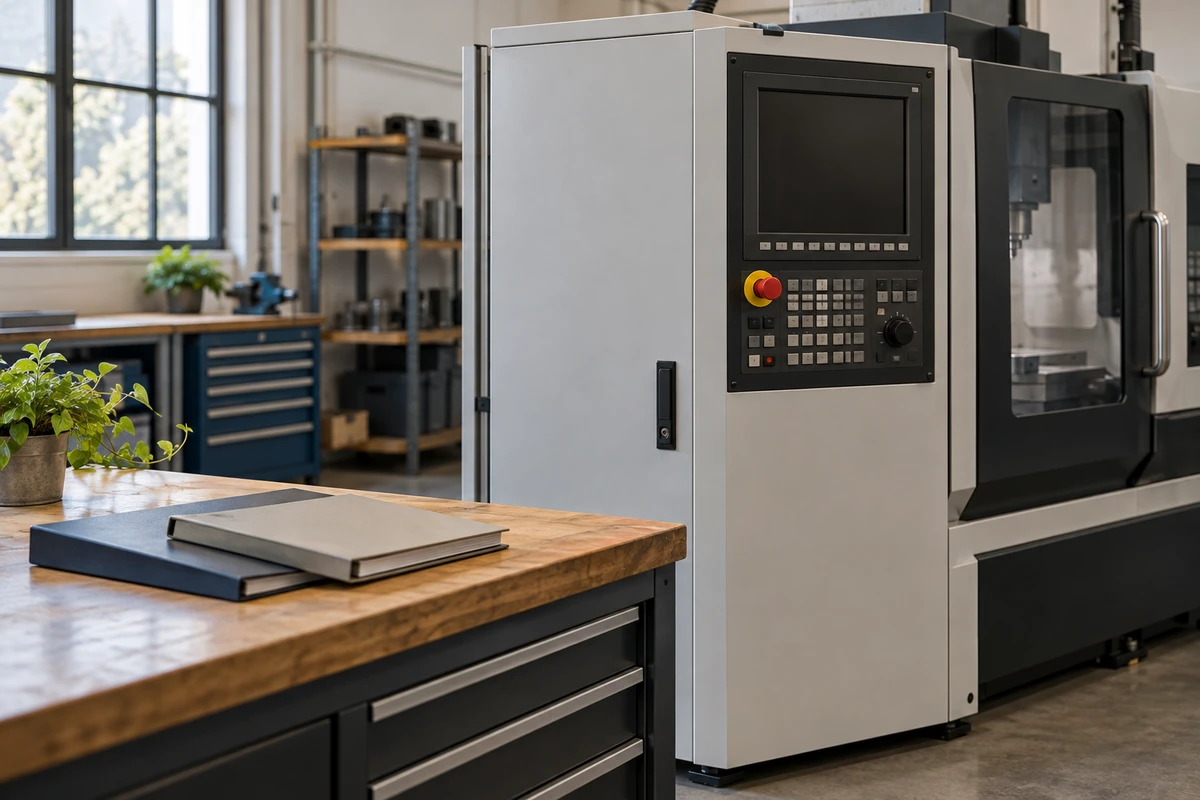
A seller’s “new battery and complete backup” statement can leave an important CNC handover question open: which retained information does each part of that statement cover? Before closing the records for a used or transferred machine, ask the responsible provider to distinguish encoder position retention from controller memory and from the supplied backup files.
The useful outcome is an attributable account of the retained-state history and any unresolved technical assessment. It is not a verdict that coordinates survived storage, a battery replacement instruction or permission to restart the machine. No actual machine or service record is assessed here.
Establish the feedback mode before requesting a battery history
Begin with the identified controller, drive and encoder, linked to the delivered machine. Ask the qualified provider which feedback mode applies. A sales description such as “absolute” or “closed loop” is not a complete statement about what this configuration retains during power-off.
A component list may identify a product capable of several modes while saying nothing about the mode used in this installation. Keep the provider’s configuration-specific answer beside the product identity. If the answer is pending, label applicability unconfirmed rather than demanding a battery record for a function that has not been established.
Do not ask purchasing staff to inspect internal electronics or change a mode to resolve the question. Existing manufacturer references, configuration documentation and attributable provider statements are the starting evidence.
Keep the retention domains distinct without separating their meaning
Yaskawa’s MP controller and SERVOPACK FAQ describes an encoder battery retaining multi-turn information when drive power is absent. It distinguishes that use from its incremental and single-turn examples. The same FAQ describes controller battery-backed SRAM containing retained variables, alarm history, an absolute-encoder offset and clock data. Position-related information therefore need not reside entirely in the encoder. These are bounded Yaskawa product and mode examples, not a battery inventory for every CNC control. Yaskawa FAQ CNT-SRV-05588T
For document review, give each provider-identified retention function its own entry. Record the component, the information the provider says it retains and the applicable reference. A shared battery part description would not make two service records interchangeable: the record must still identify which function was covered.
This distinction also prevents an overly neat but misleading handover split in which “controller” means only programs and “encoder” means everything related to position. Ask the technical owner to explain the relationship for the actual system, including any controller-held position-related information.
Read service history as a sequence of attributed events
Request the last attributable service record for each relevant retention function, with its actual scope. Preserve reported warnings and their dates or stated period, along with the provider’s recorded disposition. “Battery serviced” is incomplete when the paperwork names neither the component nor the function.
Carry known storage and power-off periods into the same review. Identify who supplied the history and which period they can account for. A seller who acquired the machine recently may have reliable knowledge of its own custody but no records for the preceding owner. Preserve that limit rather than merging the periods into one continuous assurance.
Keep an absent date unknown. Purchase, arrival and a new owner’s inventory entry are not evidence of a battery-service event. Conversely, missing documentation does not prove that service never occurred or that retained data were lost. The gap is a question for the responsible provider, with its possible consequences left for qualified assessment.
Ask what the supplied backup actually covers
Retain the existing backup manifest and the supplier’s description of its coverage. Then ask how that coverage relates to the identified retention functions and the state being handed over. A file-delivery receipt is evidence of the supplied package; it cannot by itself establish the history of information retained on the machine.
The request should be specific: which supplied artifact addresses which information, what state does it represent, and what remains outside its documented scope? If the provider identifies a limitation, keep its explanation with the package rather than rewriting the manifest to suggest complete recovery coverage.
Where a retained-state question remains unresolved, request the provider’s assessment and proposed authorized resolution scope. Do not convert the document request into instructions to reset, home, reconnect or replace anything. Any further work needs its own qualified owner and approval.
Resolve a fictional “one invoice covers everything” handover
Imagine a fictional sale with a controller backup and an invoice described as “new battery.” The invoice identifies work on the controller. The receiving provider’s review identifies a separate multi-turn encoder retention function, but the packet contains no attributable history for it.
The buyer records the controller service evidence at its actual scope and keeps the encoder-history entry open. It asks the seller for the missing record, the known custody and power-off history, and the qualified provider’s disposition of the gap. The request neither accuses the seller of data loss nor assumes that the new controller battery resolved the encoder question.
Suppose a later service record identifies the encoder function but predates an unaccounted storage period. That improves the record without answering everything. The provider must address the unexplained period in its assessment; the buyer should not silently extend the earlier service statement through it.
Alternatively, the provider may establish that the initial description of feedback mode was wrong for the delivered configuration. The buyer then records the corrected applicability statement and its evidence. It does not continue demanding an inapplicable battery history simply to complete a template.
Close the state question at the supported boundary
A useful closeout names the configuration, the retention functions actually relevant to it, the history reviewed, the backup’s stated coverage and the provider’s conclusion with its limits. Keep unresolved facts and authorized next work visible to the receiving custodian.
That record can close a handover-document requirement. It does not establish a valid machine coordinate reference, guarantee recovery or authorize operation. The key purchasing benefit is knowing exactly which assurance the supplier has supported and which obligation remains to be resolved.
Buyer document-review worksheet
This original worksheet organizes the provider’s evidence. It is not a manufacturer form or a technical work instruction. Keep the original source reference beside each answer.
| Field | Answer to obtain |
|---|---|
| Controller/drive/encoder identity | Exact supplied components and their machine association |
| Feedback mode confirmed by provider | Configuration-specific statement, rather than a sales label |
| Retention function and source | Retained information and the applicable manufacturer passage |
| Last attributable service/warning record | Scope, date, record author and reported disposition |
| Known power-off/storage history | Covered periods, source of knowledge and gaps |
| Backup scope | Manifest and provider explanation of what it establishes |
| Provider state assessment and unresolved action | Attributable conclusion, limits and separately authorized next scope |
Bring the precise gap into the inquiry
For broader product context, see CNC router controller. As an independent buying agent, we can coordinate supplier questions within an agreed purchasing scope. Specialist work, its availability and its approval require the responsible qualified provider.
Start a CNC quote request with a supported listing link, description or permitted product images. Arrange manuals, drawings, data files and service records through a separately authorized exchange; the form’s image field is not a technical-file upload channel.
Frequently asked questions
Does a CNC controller backup prove that absolute encoder position was retained?
No. Ask the provider to state the backup’s actual coverage and separately address the retained-state history for the identified configuration. Receipt of files alone does not establish what survived a storage or power-off period.
Does every absolute encoder need the same battery record?
Start with the actual product and provider-confirmed feedback mode. The manufacturer example in this article is mode-specific; a broad sales label does not establish that its retention arrangements apply to the delivered machine.
What should a battery-service invoice identify at handover?
Ask which component and retention function the work covered, its date, the responsible provider and the supporting completion record. If it concerns only one function, preserve that scope instead of treating it as evidence for the entire control system.
What if storage history is missing?
Keep the period and its source limitation explicit, then request a qualified assessment and an authorized resolution proposal. Do not invent a service date, assume data loss or use a purchasing worksheet as a recovery procedure.
Sources
Discuss a sourcing request related to this article.Separate CNC Encoder Position Retention from the Controller Backup