
Read a Spindle Temperature Test with Its Conditions
Check the spindle, duty, cooling arrangement, temperature channels and time record before treating a thermal report as acceptance evidence.
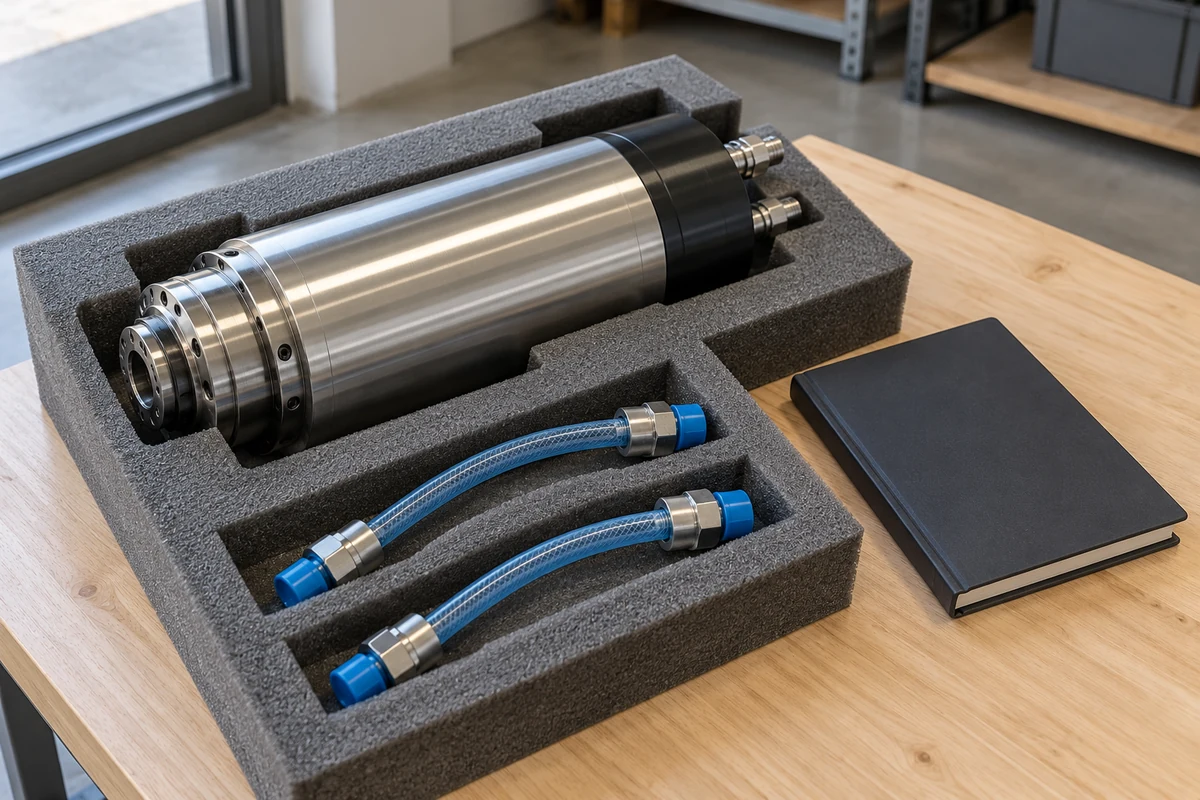
An exterior temperature photograph cannot, on its own, demonstrate that a spindle completed the agreed thermal evaluation. The report must connect the identified unit, the required duty, the actual cooling arrangement and the recorded temperature channel over the relevant period. Without those links, “temperature normal” leaves the buyer guessing what was established.
The purpose here is to review evidence already supplied by a competent provider. It is not a warm-up schedule, a safe-temperature chart or permission to run an uncommissioned spindle. The exact manufacturer’s instructions and approved evaluation plan govern physical work and acceptance.
For this original editorial review, we checked the linked primary manufacturer or metrology explanations on 13 October 2026 and used only their stated distinctions. The coverage method below is our document-review proposal. We did not inspect a physical unit, receive an actual order report or verify a supplier’s performance.
First identify which temperature the report describes
A report can refer to ambient air, coolant supply, coolant return, spindle housing, a bearing location or a motor winding. Preserve the channel’s actual name and measurement point. “Spindle temperature” is too broad when the requirement concerns one particular point or protection function.
SPINOGY’s X22 technical page lists coolant supply and return temperatures separately from housing temperature. It also distinguishes a winding-head temperature sensor from optional front or rear bearing sensing. These are different configuration-dependent entries, so a result for one channel should not silently stand in for another. SPINOGY X22 cooling and sensor data.
The mechatron HFS/HFSAC manual likewise distinguishes cooling-liquid monitoring from direct spindle-body monitoring in its English cooling sections. We use that distinction to identify the kind of information a report must preserve, without importing that manual’s temperatures, flow requirements or protection arrangements into another product. mechatron HFS/HFSAC operating manual, English sections 3.3 and 7.4.
Ask the report author to identify the instrument or installed sensor, its location and the meaning of its output. A logged reading, a threshold event and an image of an exterior surface answer different documentary questions. Have the responsible specialist explain which evidence the approved plan requires; do not infer internal temperatures from appearance or touch.
Connect the time record to the agreed duty
Start from the order’s evaluation-plan reference and revision. Ask for the duty or operating sequence that was actually evaluated, including the provider’s stated speed and load conditions where relevant. These are report fields to retain, not settings for the reader to apply. A catalogue rating describes a stated product condition; it does not prove that the offered unit completed a particular test.
Keep start and end times, elapsed time, recorded intervals and interruptions together. If a graph begins midway through a session, ask whether earlier data exist. If only selected screenshots were supplied, ask how they relate to the original record. Do not infer a complete trend from the first and last image.
Separate the sequence identifier from the conclusion. A file called “full duty test” still needs evidence of what occurred. Equally, do not call a recorded pause a failure without knowing the agreed plan and the provider’s explanation. The reviewer should be able to compare the planned period with the actual recorded period and see any departure.
Where thermal stability is an agreed criterion, request the plan’s definition and the provider’s assessment against it. Do not invent a maximum rise, a universal duration or a rule that a nearly flat line always means acceptance. A limited record may establish an observation while leaving the agreed evaluation incomplete.
Preserve the cooling and environment that produced the record
Identify the exact spindle variant, cooling type and relevant cooling equipment used. For a liquid-cooled arrangement, retain the provider’s recorded coolant-system identity and applicable channel references. For an air-cooled variant, retain the stated arrangement and conditions required by its documentation. The equipment supplied with the order should be distinguishable from any equipment used only at the test site.
Record the ambient conditions reported for the evaluation and any changes or limitations the provider noted. If a temperature-rise claim is made, ask what baseline and corresponding time record support it. Do not subtract readings from unrelated sessions or combine one unit’s ambient figure with another unit’s measurement.
Check configuration changes between report and delivery. A substituted cooling unit, altered spindle variant or different sensor option should be brought back to the technical reviewer. The earlier record remains evidence for its stated arrangement; its applicability to the changed supply requires an explicit decision.
A compact review record should keep six items together: unit identity, duty-plan reference, cooling configuration, ambient record, temperature point and time series, and authorized disposition. For each, note the original report location and the consequence of any missing field. This structure is an editorial review aid, not a manufacturer test standard.
Work through a fictional exterior-temperature photo
Suppose fictional order TH-08 calls for a documented evaluation of spindle S-08 with cooling package K-08 under plan TP-08. The supplier returns one exterior temperature image and writes “passed.” The image does not identify its time within the evaluation, the ambient condition or the cooling equipment. There is no complete logged record. These labels and circumstances are invented and contain no recommended temperature.
Record the file as an exterior-temperature image, with unit and timing attribution unresolved. Do not rewrite its status as a failed spindle or an accepted thermal test. Request the existing report linking S-08 to TP-08, identifying K-08 or the equipment actually used, and stating the measurement channel and time coverage.
Now suppose the returned log identifies S-08 and provides the missing time record, but names a test-site cooler K-LAB. The better documentation exposes a configuration difference. Ask the responsible reviewer whether the evidence can support the ordered K-08 arrangement and what remains necessary. A complete log for K-LAB cannot be relabelled as a test of K-08.
Alternatively, the provider might explain that TP-08 was interrupted and only a partial record exists. Preserve the interruption and the covered period. The next action is an authorized decision on the unresolved evaluation, including whether further work is needed and who can perform it. The buyer should not propose an improvised extension or ask someone to touch the spindle to confirm it feels acceptable.
Keep the result and the protection claim separate
Ask which requirement the thermal conclusion addresses. A temperature record may support one defined operating observation without documenting every protection function or the machine’s overall safety. If the purchase also requires a qualified functional-acceptance report, keep that deliverable separately identified rather than using an absence of recorded alarms as a substitute.
If the report refers to a manufacturer limit, preserve the document revision, applicable variant and relevant channel. A coolant limit cannot be casually compared with a housing image, and a sensor’s stated characteristics should not be repurposed as the buyer’s allowable operating temperature. Unclear correspondence belongs with the manufacturer or competent technical reviewer.
Close the thermal evidence decision with the exact unit, tested configuration, accepted scope and remaining limitations. Further claims about continuous service in another environment or application require their own supported review. This article does not diagnose bearings, prescribe drive settings or authorize a cooling-system change.
Request the missing record through the right channel
We are an independent buying agent. We can organize the requested identities and supplier documents within an agreed scope; technical evaluation availability and acceptance responsibility need separate confirmation. The CNC router spindles category supplies broader purchasing context.
Use the CNC quote form for a supported listing link, description or identification images. It accepts up to five PNG, JPEG, WebP or GIF images, no more than 10 MiB each and 20 MiB total. Request an authorized separate exchange for logs, manuals, PDFs or other technical files rather than placing them in the image field.
Frequently asked questions
Is one exterior temperature image enough for thermal acceptance?
Only if it provides exactly the evidence required by the approved scope, which must be established for the real order. A single image does not by itself establish duty, cooling configuration or a complete time record.
Can a housing reading substitute for a winding or coolant reading?
Keep the measurement channels distinct. Ask the responsible reviewer to relate the actual channel and method to the applicable requirement rather than treating all temperatures as interchangeable.
What temperature is acceptable for every CNC spindle?
This article supplies no universal limit. Use the exact manufacturer’s applicable documentation and the approved evaluation plan for the identified variant and channel.
What if the report used different cooling equipment?
Preserve that configuration difference. Have the technical reviewer decide whether the evidence applies to the ordered arrangement and identify any additional authorized work needed.
Sources
Discuss a sourcing request related to this article.Read a Spindle Temperature Test with Its Conditions