
Agree the Ballscrew Transport-Retention Scope Before Packing
Clarify the supplied screw-and-nut state, any transport-retainer role and the responsible provider before approving a ballscrew packing change.
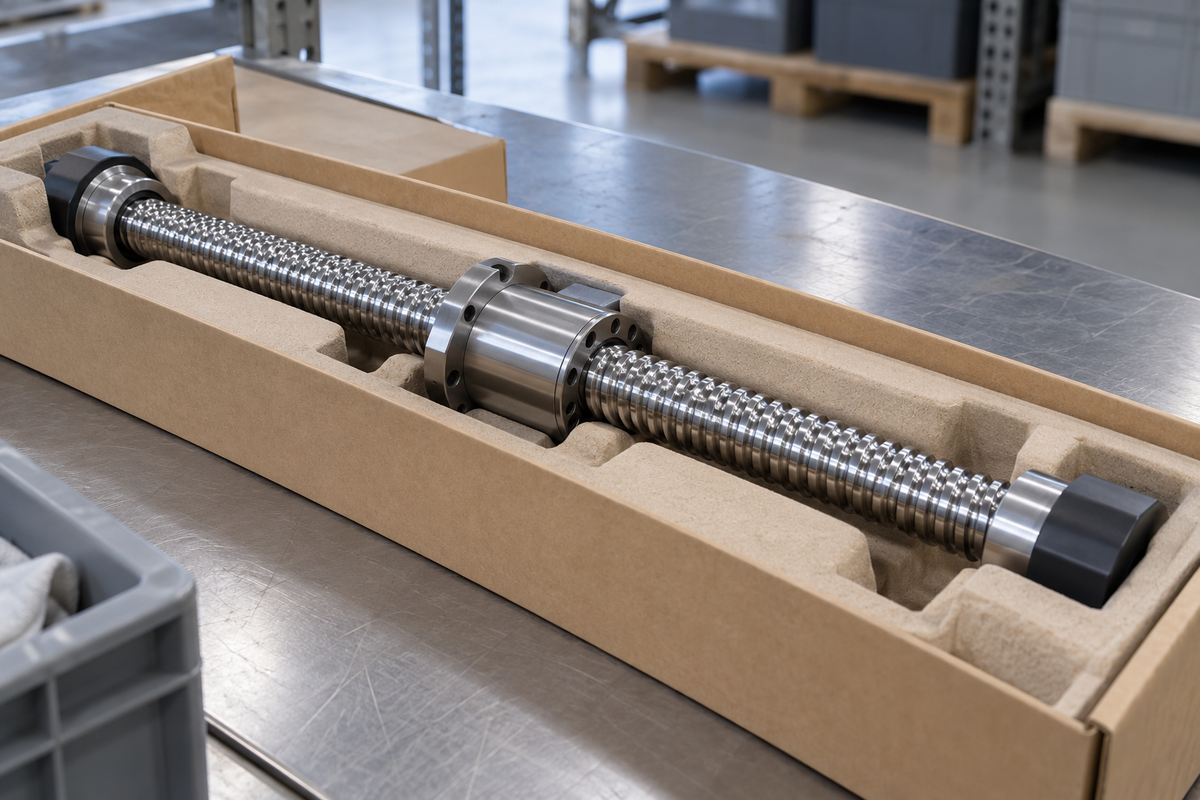
Before approving a ballscrew packing change, establish the supplied screw-and-nut state and the manufacturer’s transport instructions for that exact product. If a proposal includes a retainer, ask what it is, which assembly it belongs to and who has authorized its role. “Secure for shipping” leaves too much unresolved when the proposal may alter the supplied assembly.
This decision concerns transport-state preservation after the purchased configuration has been agreed. It does not select screw dimensions, specify end machining or explain how to remove a nut. A packaging quote should make the boundary of authorized work understandable without turning the buyer into the person designing or performing that work.
Begin with the state the supplier is responsible for delivering
Record the full screw-and-nut assembly identity and the approved scope of supply. Ask whether the release record describes an assembled unit, a separately supplied component or another manufacturer-defined configuration. Do not infer the supplied state from a catalogue photograph containing both loose and assembled products.
Include the maker instruction reference and any order-specific response governing transport or repacking. If the supplier’s generic packing statement does not identify the actual configuration, ask for clarification. Existing order approval may establish which product is being bought while leaving a later packing-driven change unapproved.
THK’s ball-screw precautions warn against disassembly and against removing the nut from the shaft during assembly. The same page refers to manufacturer-designated packaging for storage. These bounded instructions illustrate why a proposal to separate a supplied screw and nut needs product-specific review; they do not provide a universal transport-retainer design. THK ball-screw handling precautions
Preserve the applicable instruction rather than reducing it to “handle carefully.” Ask the qualified product provider which supplied condition must be maintained and which actions the packing scope excludes. The buyer should receive a clear answer before deciding whether the commercial packing proposal can proceed.
Ask what “retainer” means in this offer
The term should point to an identified item or arrangement in the supplier’s documentation. Ask the provider to explain its intended role for the actual shipment and distinguish it from other included accessories. Do not assume a visible ring, sleeve or protective cover is an approved transport device because it resembles one in another product’s photograph.
If an existing maker-supplied item is to remain with the assembly, record its documented identity and the instruction that governs it. If a new item is proposed, request its product-specific authorization and the party responsible for determining suitability. A packing note with a familiar name cannot supply that technical determination.
Keep transport arrangements distinct from parts included for machine installation. Ask which items are intended only for the shipment and which are part of the purchased assembly. Any destination action should be covered by the responsible provider’s instructions and carried out by authorized personnel; the packing list should identify the reference, not improvise the procedure.
Where no retainer is specified, ask whether that reflects an intentional manufacturer-approved packing state or missing information. This article does not prescribe a retainer for every ballscrew. The objective is to resolve the actual offer, including a documented answer that a particular proposed device is unnecessary or unsuitable.
Put separation proposals into a change request
A request to reduce package size may conceal a change to the screw-and-nut configuration. Ask the packer to state the proposed change explicitly and identify who would perform it. Keep the current approved state in the record so that reviewers can compare the proposal with a clear baseline.
Request the manufacturer’s or authorized technical provider’s disposition for that exact proposal. The answer should say whether the supplied state must remain unchanged, whether an alternative can be considered, or what further information is needed. Silence is not permission, and a smaller shipping estimate does not answer the technical question.
Do not ask the packer to demonstrate removal, rotation, reloading or an improvised substitute arrangement to resolve the uncertainty. If the required answer cannot be obtained, keep the proposed change pending and ask for a packaging option compatible with the established supplied state.
Separate commercial acceptance from technical authority. The buyer may approve a revised packing charge while still needing the product provider’s instructions. Conversely, a technical response allowing an option does not mean the buyer has accepted its price or delivery implications. Record each decision against the same identified proposal.
Use a transport-state scope sheet
The following fields are an original editorial review method. They help define the information to request without specifying support spacing, materials, loads or physical execution.
- Supplied screw/nut state: approved assembly identity, configuration and the record establishing how it will be released
- Maker transport instructions: applicable document, revision and order-specific clarification, with unanswered questions retained
- Retainer identity and role: actual provider description, associated assembly and the evidence supporting the intended use
- Separation restrictions: proposed changes, relevant permission or prohibition, and the exact extent of the decision
- Responsible provider: who defines the technical arrangement, who executes the authorized packing and who answers discrepancies
- Destination instruction reference: the information the receiving technical provider needs to recognize the supplied condition and any authorized next step
Ask the supplier to return the completed scope with the final packing proposal. A response that identifies the assembly but leaves the responsible provider blank is still incomplete. A named provider without an applicable instruction also leaves an important gap.
A fictional proposal to remove the nut
Imagine a fictional seller offering an approved screw-and-nut assembly. Its packer proposes removing the nut as part of a smaller-package proposal, but supplies no maker authorization and no defined destination instructions. The buyer has only a product code and an assurance that the parts will be packed securely.
The proposed separation remains unapproved. Ask the seller to confirm the manufacturer-authorized supplied state and provide a revised packing proposal that preserves it, or obtain the responsible provider’s explicit disposition of the requested change. Do not describe a removal method or assume that successful reassembly is established.
Suppose the seller withdraws the separation proposal and returns a plan referring to the original assembled state and a documented maker-supplied transport arrangement. The buyer can now check whether the assembly reference, retained items, responsible provider and destination document agree. The physical arrangement still requires the appropriate provider’s approval.
If the response instead names a generic substitute retainer without evidence for this assembly, the gap has changed rather than disappeared. Ask who has approved that substitute and against which product instruction. The fictional example ends with a decision path, not an invented technical clearance or supplier promise.
Carry the approved scope into handover
Keep the accepted packing revision with the assembly’s supply records. If a later packer changes the proposed retained item, separates components or substitutes a package arrangement, reopen the affected scope before release. A previous approval should not be stretched to cover a materially different proposal.
At destination, records should identify the supplied assembly, the documented transport condition and the applicable technical contact. Closed-package photographs may support the record of labels and apparent packaging condition. They do not prove internal condition, functional performance or that every manufacturer instruction was followed.
We act as an independent buying agent, organizing supplier questions and the commercial approval record. Product-specific transport design, physical packing and any technical assessment require their own responsible provider. See CNC linear motion components for purchase context.
Start the CNC quote request with a supported listing link, text description or up to five PNG, JPEG, WebP or GIF images, limited to 10 MiB each and 20 MiB total. The form does not accept PDF, CAD or ZIP attachments. Identify technical documents that need a separate authorized exchange.
Frequently asked questions
Does every ballscrew shipment need the same type of retainer?
No universal retainer is specified here. Obtain the actual assembly maker’s transport instructions and ask the responsible provider to identify any required arrangement and its role.
Can a packer remove the nut to reduce package size?
Keep that proposed change unapproved until the responsible product provider gives an applicable disposition. Ask for a packing option preserving the manufacturer-authorized supplied state; this article provides no removal procedure.
What information should identify a proposed transport retainer?
Request its documented identity, intended role, associated screw-and-nut assembly, applicable authorization and responsible provider. A generic name or photograph does not resolve suitability.
What should accompany the shipment for the receiving team?
The assembly identity, approved transport-state record and applicable destination instruction reference should be available. Any physical next step belongs with authorized personnel following the responsible provider’s instructions.
Sources
Discuss a sourcing request related to this article.Agree the Ballscrew Transport-Retention Scope Before Packing