
Specify Cutter Shanks and Collet Ranges Without Rounding Units
Keep metric and inch cutter shanks distinct, identify the exact collet range, and resolve the holder and nut before approving a combined order.
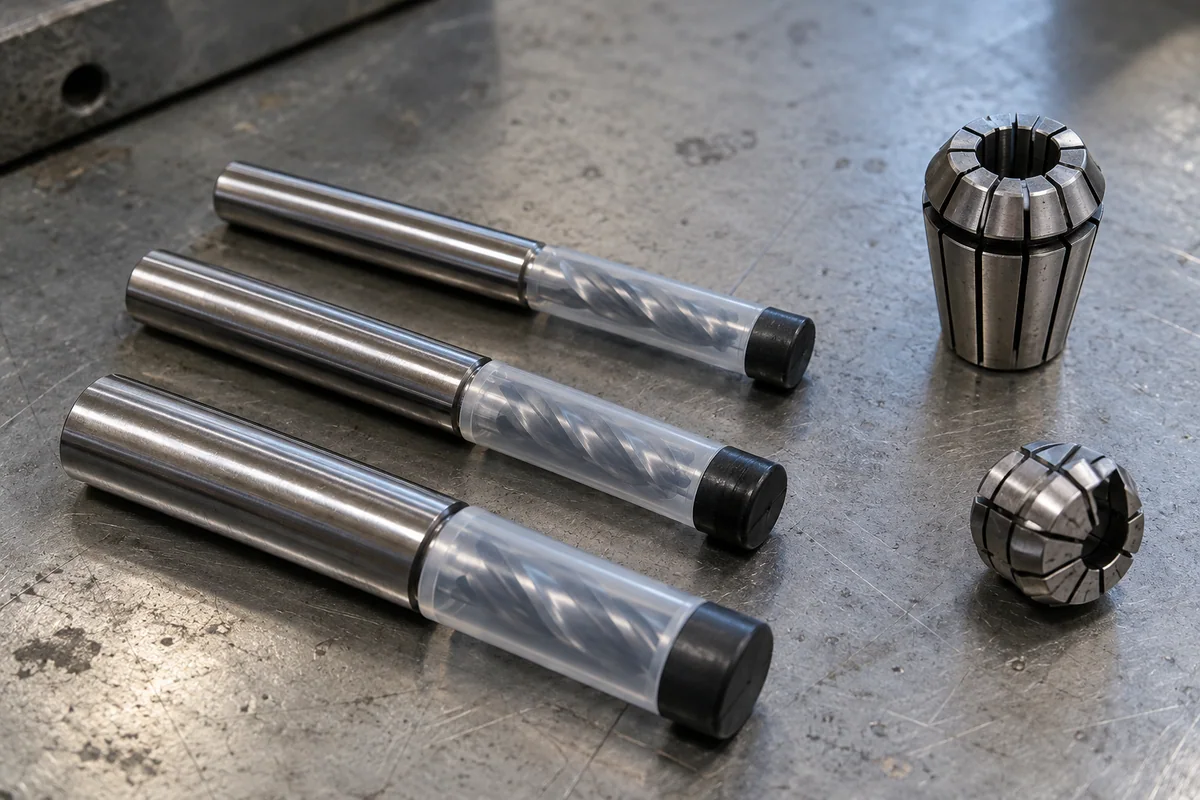
Before ordering cutters and collets together, preserve the cutter’s exact shank designation and ask for the collet manufacturer’s stated gripping range. A marketplace option called “6 mm / quarter inch” leaves an important purchase question unresolved. The buyer needs to know which physical cutter is being supplied and which documented holder, nut and collet combination is proposed for it.
This RFQ concerns the part of the cutter that is gripped. Cutting diameter, flute geometry and usable reach need their own review. Keeping those decisions separate makes it easier to identify a wrong shank option before it becomes a mixed order of otherwise similar-looking tools.
Start with the cutter drawing rather than the listing title
Request the manufacturer and full cutter part number, then locate the shank dimension on its drawing. Preserve the original units beside the value. If a seller’s listing has several options, save the selected option text as well as the product link; the family photograph may be shared by every option.
A tool can have more than one diameter in its description. Ask the seller to identify which one belongs to the gripping shank and which belongs to the cutting section. If the drawing is unavailable, record that gap explicitly. A seller’s paraphrase of a title should not be promoted to manufacturer dimensional evidence.
Keep any converted value in a second field. This gives an English-speaking buyer and a supplier working from metric data a common reference without overwriting the original specification. Ask for clarification if a drawing, package label and selected option disagree. Do not choose whichever value makes the existing collet appear usable.
Preserve the difference between 6 mm and a quarter inch
NIST states that one standard inch equals exactly 25.4 mm. Therefore a nominal quarter-inch shank converts to 0.25 × 25.4 = 6.35 mm. Its nominal difference from 6 mm is 0.35 mm. This arithmetic describes the designations; it does not determine a collet’s permitted gripping range or the dimensions of a delivered cutter. NIST length-unit reference
For purchasing, retain “1/4 inch” as the original designation and “6.35 mm” as the conversion. Do not shorten it to 6 mm to simplify a quantity list. Similarly, avoid using an approximate conversion as an inspection limit. The acceptable manufactured dimensions and any inspection method must come from the approved specification.
If a supplier says both sizes use the same collet, ask which exact collet it means and request the relevant range statement. The reply may be supportable for a particular documented product, or it may reveal that the supplier has rounded the cutter size. The request for evidence resolves that distinction without assuming either outcome.
Give the collet series and gripping range separate fields
REGO-FIX’s ER standard-collet page presents ER size, shank diameter range and clamping range as separate entries. That is a useful manufacturer example of why a series label alone is an incomplete answer. This article does not transfer the page’s performance figures or family-wide range to an unnamed collet. REGO-FIX ER standard collets
Ask for the offered collet’s manufacturer, full order code, designated size and applicable range document. Add the holder or spindle-nose identity and the clamping-nut identity. If an existing machine supplies either component, identify it from its records rather than asking the seller to infer it from a distant photograph.
The purpose is to make the proposed combination reviewable. It is not a request for instructions on tightening, modifying or assembling the parts. Have the responsible tooling specialist resolve the combination against the manufacturers’ documentation, including any restrictions relevant to the intended application.
| Purchasing field | What to preserve | What an incomplete reply looks like |
|---|---|---|
| Cutter shank | Exact designation, original unit and drawing reference | “About 6 mm” |
| Converted reference | Exact conversion shown separately | Original fractional size deleted |
| Collet identity | Manufacturer, series and complete order code | “Standard ER collet” |
| Permitted gripping range | Exact-product document and applicable limits | A range copied from another model |
| Holder and nut | Existing or offered identities and supporting documentation | A photograph of an unspecified bundle |
| Quantity basis | Cutters, collets and nuts listed separately | One undefined “set” |
Work through a mixed-shank order
Imagine a fictional order for eight cutters with 6 mm shanks and four cutters with quarter-inch shanks. The buyer already has a holder but has not identified its nut or existing collets. A seller replies with twelve “6 mm cutters” and one “ER set.” These quantities are invented solely to illustrate a purchasing discrepancy.
First, the cutter reply has collapsed two requirements into one. Ask the seller to restore separate lines for the eight metric-shank cutters and the four inch-shank cutters, including the selected part numbers. If it intended to propose twelve metric-shank cutters instead, treat that as a change for the buyer to consider, not a correction to the buyer’s units.
Second, the set description leaves its contents unknown. Request its individual collet codes and ranges, whether a nut is included, and which holder the seller assumes. Do not derive the number of required collets from the number of cutters. The buyer’s actual tooling plan determines quantities after the compatible parts are identified.
A revised reply may document a suitable combination, propose separate collets or reveal that a different holder component is needed. Each possibility changes the purchasing list differently. Until the responsible reviewer accepts the combination, label it as proposed and leave the affected order lines open.
Distinguish a replacement from a change of tooling system
When the request is for a replacement collet, ask whether the supplier is offering the original manufacturer’s item or another manufacturer’s alternative. Similar naming does not settle the issue. A substitution should arrive with its own product documentation and a clear statement of which existing components the proposal assumes.
Avoid quietly expanding the order into a new holder system because one accessory is available. Ask the buyer whether that broader change is acceptable, then obtain a complete proposed list and technical review. The decision may involve retaining existing cutters, replacing consumables or maintaining two shank sizes. Those are purchasing choices the buyer should see explicitly.
For a repeat order, keep the approved cutter and collet codes together with the quote. If a later supplier changes a suffix, range designation or included nut, reopen the affected combination. A saved product link can help locate the family, but the approved line-item description records what was actually requested.
Make the evidence request practical
Ask the supplier to return a concise answer identifying each cutter shank, the exact proposed collet and its documented range, and the assumed holder and nut. Request an explicit list of unavailable items or alternatives. If dimensional or functional inspection is needed, agree its scope, responsible personnel and acceptance criteria separately. Receipt photographs can record labels and apparent condition; they cannot establish gripping performance or machining accuracy.
Our role is an independent buying agent: we can collect listing details, request supplier answers and organize the quote for approval. The technical decision belongs with the relevant manufacturer information and a competent reviewer. For the broader product category, see CNC cutters and end mills.
Start the CNC quote request with a supported marketplace product link, a description or product images. The current form accepts up to five PNG, JPEG, WebP or GIF images, at most 10 MiB each and 20 MiB total. Mention any drawings or other technical files that need a separate, authorized exchange; the image attachment field is not a CAD, PDF or ZIP upload channel.
Frequently asked questions
Can a 6 mm collet hold a quarter-inch cutter?
Do not decide from the rounded names. A quarter inch is 6.35 mm; obtain the exact collet’s documented range and have the intended holder, nut and cutter combination reviewed.
Does an ER series label identify the gripping size?
It leaves the exact collet size and range unresolved. Ask for the manufacturer’s complete order code and applicable documentation, alongside the holder and nut identities.
Should I replace inch-shank cutters with metric ones to simplify an order?
Only if the buyer approves that change and the proposed tooling is technically reviewed. Preserve the original request and price the changed cutters as an alternative.
What should I send if I cannot identify the existing collet?
Send clear images of accessible markings and the machine or holder records you already have. Request identification before selection; do not disassemble equipment just to complete an inquiry.
Sources
Discuss a sourcing request related to this article.Specify Cutter Shanks and Collet Ranges Without Rounding Units