
Quote a Spindle Replacement Beyond Its Clamp Diameter
Define the mechanical, electrical and cooling interfaces of a proposed spindle replacement before a nominal clamp-diameter match becomes an approval.
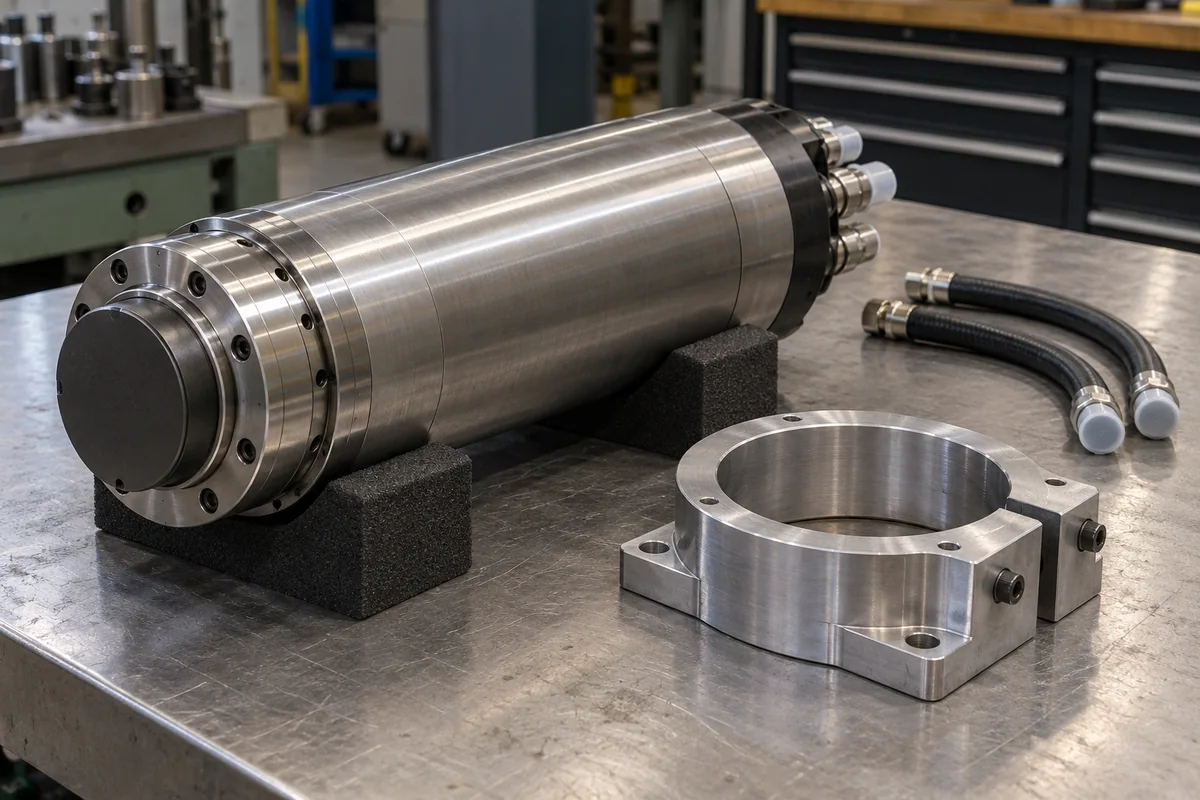
A replacement spindle with the same nominal clamp diameter may still leave the purchase unresolved. Before describing it as a fit, ask for the proposed spindle’s mounting geometry, body and service envelope, mass, drive requirements and connection details. The machine manufacturer or responsible qualified integrator should decide whether the replacement is supported.
Start by defining the replacement boundary. Is the buyer seeking the original spare part, an approved successor or a different spindle that changes the machine? Those requests need different evidence. A seller should not price an undocumented retrofit as though it were a routine like-for-like replacement.
Establish what is currently installed
Collect the machine make, model and revision, the existing spindle’s full identifier, and the relevant machine and spindle records. Include the drive identity and known cooling arrangement. Use information already available from documentation or safely accessible markings; gathering an RFQ should not require opening an electrical cabinet or removing protective equipment.
Keep the original machine configuration distinct from later changes. If a previous owner replaced the drive or mount, tell the reviewer what is known and what is uncertain. An original machine manual may help identify the intended arrangement without documenting what is installed today.
Ask the machine manufacturer or service provider whether a specified replacement route exists. If the original item is no longer offered, request the documented successor or authorized alternative. A seller’s phrase “new version” is not enough to show which interfaces have changed or who accepts those changes.
Build the mechanical comparison around defined references
Request dimensioned drawings of the existing or approved interface and the proposed spindle. The useful comparison identifies mounting surfaces, the permitted mounting region, body length, nose position and projecting features. Ask the reviewer which reference surfaces should be used so both drawings answer the same question.
The mechatron HFS/HFSAC manual treats spindle mounting, cooling-system installation and electrical connection as separate subjects. Its mounting section addresses the supporting holder and the permitted clamping area. This is a bounded example of the information a replacement review may need, not permission to copy that arrangement onto another spindle. mechatron HFS/HFSAC manual, mounting and installation sections
Ask for the proposed unit’s mass and relevant assembly geometry, then have the responsible integrator assess them against the machine’s permitted arrangement. Do not infer allowable loading from the old spindle’s appearance or choose an arbitrary “close enough” mass difference. If an adapter is proposed, it becomes an additional designed component requiring its own approved scope.
The comparison should also show what moves with the spindle. Ask the reviewer to include the tool-holding assembly, cable exits and hoses relevant to the replacement. This identifies which parts of the arrangement need checking without prescribing their routing or redesigning the machine in a sourcing article.
Treat service connections as separate interfaces
A similar connector exterior does not provide a complete electrical compatibility answer. Request the exact connector and cable documentation for qualified review, along with the manufacturer-supported drive pairing. Do not ask a buying agent to infer pin functions from photographs or to reuse another spindle’s settings.
For cooling, ask which system and connections the proposed variant requires and what existing equipment the supplier assumes can remain. Where air, sensor or other services are part of the selected configuration, list them explicitly. Mark an interface “not applicable” only when the actual documentation establishes that it is absent.
SPINOGY’s X22 technical page separates configurations, weights and connection categories, and states that the chosen configuration determines the applicable data. That organization illustrates why a family-level name leaves important replacement details open. It supplies no approval for fitting an X22, or any other product, to the reader’s machine. SPINOGY X22 technical data
| Replacement interface | Evidence to request | Decision owner |
|---|---|---|
| Machine baseline | Exact machine revision and known modifications | Machine owner with manufacturer/service support |
| Mount | Applicable drawings and manufacturer mounting restrictions | Qualified mechanical integrator |
| Mass and body envelope | Exact variant data and defined reference geometry | Responsible machine reviewer |
| Tool-side interface | Supplied nose/holder identity and relevant drawings | Tooling and machine reviewer |
| Drive and electrical connection | Exact spindle/drive documentation and cable scope | Qualified electrical integrator |
| Cooling and other services | Variant-specific requirements and included components | Responsible system integrator |
| Final acceptance | Agreed integration review and commissioning scope | Named party responsible for the completed machine |
A fictional diameter match with two missing answers
Imagine that the old spindle and a proposed replacement share the same stated nominal clamp diameter. The seller gives no proposed body length and no service-connection drawing. No real machine, dimension or successful installation is represented in this example.
Record the diameter match as one reported correspondence. Keep body geometry and services unresolved. The absence of those drawings prevents the reviewer from establishing whether the replacement fits the approved arrangement. It does not justify assuming that moving the mount or changing a cable will solve the problem.
Suppose the next reply includes a longer-body drawing and proposes a different connector. The new information is useful because it identifies the actual changes. Ask the integrator to determine what they mean for the machine, and request a revised supply scope reflecting its decision. The buying agent should not design an adapter, approve a new cable or infer that unused space in a photograph is adequate.
The outcome might be an accepted manufacturer-supported replacement, a separately assessed modification or a decision to seek another part. Each outcome should refer to the exact proposed configuration. An approval for one variant does not extend to another simply because both fit the same nominal clamp category.
Price the work required to make the proposal reviewable
Ask the supplier to distinguish the spindle-only price from any proposed mount, cables, cooling equipment, sensors or other components. Identify which items are existing, included, optional or unresolved. A complete list lets the buyer understand the purchase boundary without inventing a total before the integration questions are settled.
Separately ask who provides the application assessment, installation and commissioning, and what documents will be handed over. A parts seller may not provide those services. If another provider must do the work, confirm that responsibility before treating the quote as a complete replacement package.
Keep performance selection separate. A spindle may have clearly documented interfaces and still need a rating review for the intended operation. Conversely, an attractive power rating does not resolve mounting or service compatibility. Both decisions must be addressed at their own boundaries before the buyer approves the complete proposal.
Agree what receipt checks can establish
Package contents, accessible markings and apparent transport condition can be recorded when goods arrive. Those checks do not establish electrical suitability, spindle accuracy or correct machine integration. Any technical inspection or functional acceptance needs a separately agreed scope and competent personnel using the relevant manufacturers’ instructions.
Ask the supplier to identify changes before shipment. A substituted connector, cooling variant or body revision can reopen a previously answered interface question. Keep the approved configuration and exclusions with the quote so a later replacement decision starts from a readable record.
As an independent buying agent, we can request the documents, clarify the supplied items and organize alternatives for approval. We do not authorize machine modifications or provide a generic wiring procedure. The CNC router spindles category provides broader sourcing context.
Use the CNC quote form to describe the existing machine and the replacement sought. Product links, descriptions and images can start the inquiry. The image field accepts up to five PNG, JPEG, WebP or GIF files, each no larger than 10 MiB and totaling no more than 20 MiB. Arrange CAD drawings, manuals and other technical files through a separate authorized exchange; the form does not offer PDF, CAD or ZIP attachments.
Frequently asked questions
Does the same clamp diameter make a spindle a direct replacement?
It answers only one dimensional question. The exact mount region, body geometry, mass, tooling and service interfaces still need review against the machine’s approved arrangement.
Can an adapter make an undocumented spindle fit?
An adapter is an additional designed component, not automatic approval. Ask the machine manufacturer or responsible qualified integrator to assess the changed arrangement and define the required scope.
Should the RFQ include existing drive and cooling equipment?
Yes. Identify what is installed and what the supplier assumes can be retained. The responsible specialists must confirm the exact proposed combination.
Can the buying agent confirm the replacement by comparing photographs?
Photographs can help collect identity and apparent-condition evidence. They cannot establish electrical compatibility, approved mounting or successful integration of the completed machine.
Sources
Discuss a sourcing request related to this article.Quote a Spindle Replacement Beyond Its Clamp Diameter