
Preserve the Approved Tool Assembly When Packing It
Review packing-driven changes against the approved tool assembly and its accepted balance documentation before authorizing separation or substitution.
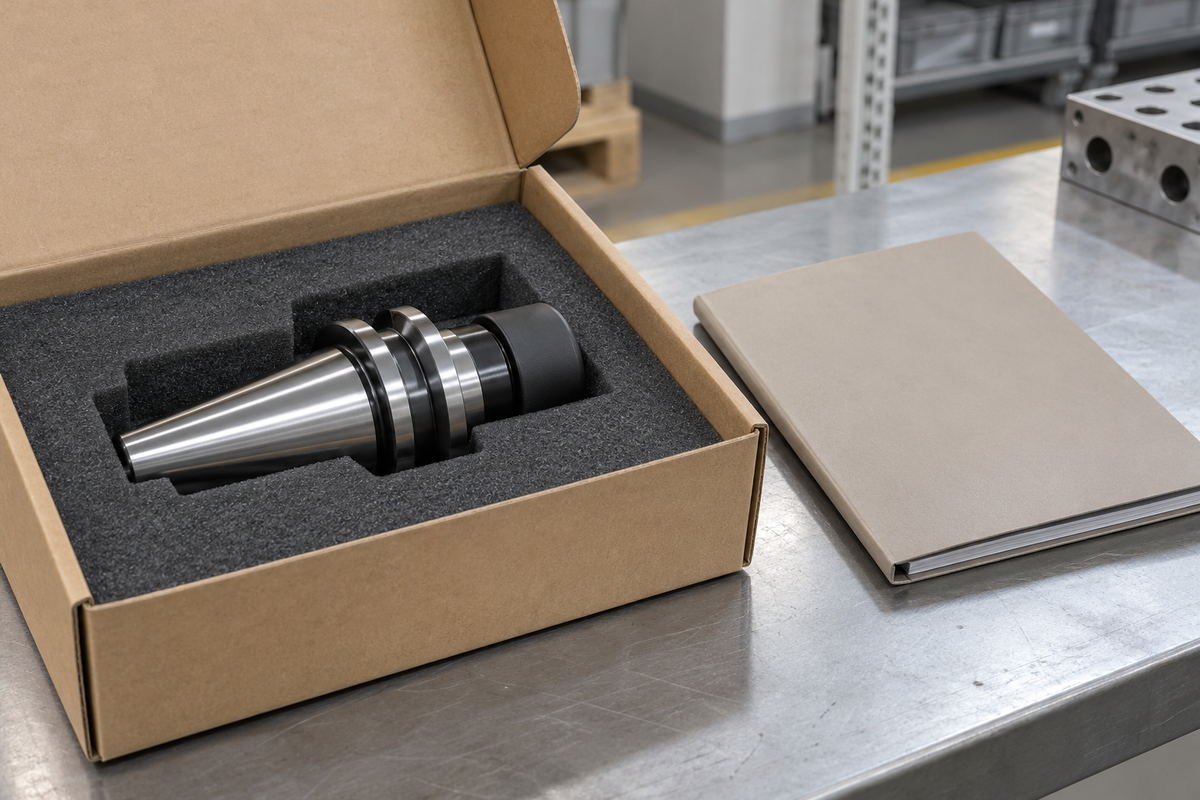
If a CNC tool assembly has an agreed configuration and accepted balance documentation, a packing proposal should preserve that approved state or clearly identify a change for review. Separating the assembly to fit a smaller box creates a new question: what authorization and evidence cover the state that will reach the buyer?
Start after the tooling decision and report review have been completed. The task here is to prevent an apparently routine packing change from silently changing what the documentation covers. It does not calculate balance limits, interpret a grade, recommend a spindle speed or explain assembly and disassembly.
Give the packer an identifiable starting state
The packing scope should reference the approved assembly and the record defining its installed components. Ask the supplier to distinguish components that form the supplied assembly from loose spares or accessories traveling with it. A photograph of everything on one bench does not establish which configuration the accepted evidence describes.
Use the existing approved configuration reference rather than creating a competing description from memory. Retain the report reference and any applicable supplier instructions about packing or separation. If the established documents disagree, ask the technical owner to resolve the baseline before reviewing a change against it.
The public abstract of ISO 16084:2017 covers rotating tools and tool systems, including assembled modular systems, and identifies assembly and clamping effects as relevant to balancing. This supports keeping the documented configuration attached to a packing decision. It does not establish that every change necessarily causes imbalance or that any particular report remains valid afterward. ISO 16084:2017 public abstract
A concise starting-state record can identify the supplied assembly, the applicable component list and the accepted evidence reference. The packer should not have to infer that relationship from the word “balanced” on a quotation. Equally, the packing record should not restate technical values that it is not responsible for defining.
Describe the packing-driven change before discussing convenience
Ask what the proposal actually changes. Does it retain the approved assembled unit inside a different outer package? Does it separate a cutter, nut, collet or modular component? Does it replace an installed component with a shipping substitute? Record the proposed action in words specific enough for the responsible tooling provider to answer.
Keep packaging changes distinct from assembly changes. Both may need review, but they pose different questions. A new outer container needs an appropriate protective proposal. A changed assembly state additionally needs a disposition addressing the existing configuration and evidence. One generic approval to “repack securely” leaves that distinction hidden.
Ask the proposer why the change is wanted and whether an alternative can preserve the approved supplied state. Commercial reasons can be stated openly: package dimensions, handling arrangements or the desired kit presentation. Those reasons inform the buyer’s decision without serving as technical authorization.
If the supplier cannot describe the final delivered configuration, the proposal is incomplete. Do not approve a sequence whose last step is simply “reassemble later” without an identified responsible provider and an applicable instruction and evidence plan.
Request a scoped answer from the right provider
Send the identified change to the manufacturer or authorized tooling provider responsible for the assembly. Ask whether the existing evidence remains applicable to the proposed delivered state, whether a different packing option is required, or whether additional verification is needed. The answer should name the actual assembly and the proposal it addresses.
Where further verification is required, ask who will define it, perform it and provide the resulting evidence. Have the commercial quote distinguish that work from ordinary packing. The buying agent should not imply that it owns a balancing machine or can certify the assembly as part of routine consolidation.
Where the provider says no additional verification is required, retain the attributable response and its conditions. Do not replace it with a broad note that every future separation is allowed. Permission for one identified change is not a general rule for the product family.
Where the response is inconclusive, keep the change pending. Ask for an option that preserves the approved assembly or clarify what evidence the provider needs to decide. Avoid estimating the effect from a component’s appearance, weight description or similarity to the original.
Use a packing-change comparison record
This original editorial worksheet keeps the decision focused on the transition from approved supply to proposed packout. It is not a balancing procedure or an alternative to the manufacturer’s requirements.
- Approved assembly identity: the existing reference for the supplied unit and its configuration record
- Balance-report coverage: the already accepted evidence reference and the configuration to which that acceptance applies
- Installed component configuration: the approved list, with loose spares and shipment accessories distinguished
- Proposed packing changes: an explicit description of each affected assembly state, alongside any unchanged-state alternative
- Maker permission: the applicable response, its conditions and the exact proposal covered
- Reverification responsibility: any required provider, output and commercial scope, or the documented basis for no additional requirement
A useful review can follow one line from baseline through proposed change to disposition. If the proposal changes midway, preserve the earlier version and show which response covers the current one. This prevents a reply about removing an outer cover from being reused to authorize separating the tool assembly itself.
A fictional smaller-box proposal
Imagine a fictional order containing an identified holder, collet, nut and cutter supplied as one assembly. The buyer’s technical reviewer has accepted balance documentation for that stated configuration. A packer proposes separating the components so they will fit a smaller box. No additional technical disposition accompanies the request.
The buyer does not need to declare the assembly unbalanced. The immediate issue is that the proposed change lacks an answer about the approved configuration and the applicability of its evidence. Keep the change unapproved and ask the responsible tooling provider to address the exact proposal.
Suppose the provider responds that the approved assembly should remain together for this shipment. The buyer can request an alternative package proposal on that basis and assess its commercial terms. The packer still needs to supply an appropriate physical protective arrangement; this article does not design one.
Alternatively, suppose the provider offers a defined separation and later verification scope carried out by authorized personnel. That is a proposal requiring the buyer’s agreement on its responsibilities and commercial consequences. Its future evidence should identify the resulting supplied assembly. The original report should not simply be relabeled as a record of work that has not happened.
Now add a loose spare nut to the fictional order. Its presence in the same carton does not make it part of the accepted assembled configuration. List it as a spare, preserve its own identity and avoid implying that approval of the supplied assembly authorizes substituting it later.
Keep the final packout consistent with the decision
Before release, compare the final supplier declaration with the accepted packing-change disposition. Confirm which configuration is being supplied and which documents accompany it. If an unresolved difference appears, return that difference to the responsible provider rather than smoothing it over in the packing list.
Protected photographs can help record accessible package references and the declared supplied state. They cannot demonstrate balance or prove that concealed components match the accepted configuration. Any required technical evidence remains the responsibility of the agreed provider.
Our role is an independent buying agent, organizing supplier clarifications and the commercial record. See CNC spindle sourcing for broader equipment context, then describe the assembly and proposed packing change through the CNC quote request.
The form supports listing links, text and up to five PNG, JPEG, WebP or GIF images, at most 10 MiB each and 20 MiB total. Report PDFs, CAD and ZIP files need a separate authorized exchange; they are not supported by the image upload field.
Frequently asked questions
Does separating a tool assembly automatically make it unbalanced?
This article makes no automatic failure claim. Ask the responsible tooling provider whether the proposed delivered state is covered by the accepted evidence and what additional authorization or verification is needed.
Can the packer decide that reassembly preserves the original report?
The responsible manufacturer or authorized tooling provider should determine applicability for the identified proposal. A packing convenience or visual match is not an attributable technical disposition.
Does a spare component in the same carton belong to the balanced assembly?
Only the approved configuration record defines the supplied assembly. Keep loose spares identifiable separately and do not imply that their inclusion authorizes later substitution.
What should a buyer approve if extra verification is proposed?
Obtain the exact change, responsible provider, required evidence and commercial scope. Agree those responsibilities before treating the packing proposal as ready, without inventing a balancing method or acceptance limit.
Sources
Discuss a sourcing request related to this article.Preserve the Approved Tool Assembly When Packing It