
Ask About the Complete Bar Path, Not Only Spindle Bore
Document the spindle, chuck, collet and liner path before comparing mini lathe offers for through-stock work.
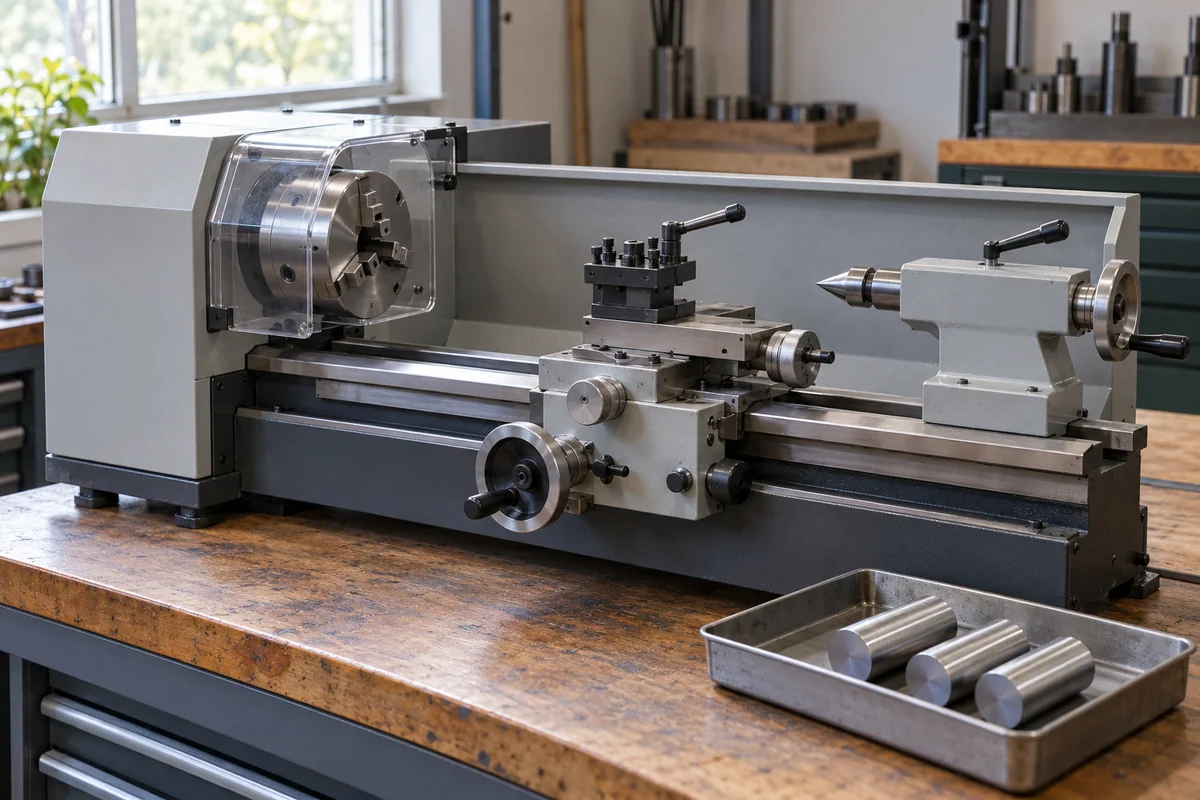
A mini lathe’s advertised spindle bore answers only one part of a through-stock question. Before treating a machine as suitable for your bar, ask the seller to identify the complete passage in the quoted configuration, including the chuck or collet equipment, any liner and the manufacturer’s requirements for support and guarding. An unanswered restriction anywhere along that route leaves the purchase decision open.
This RFQ is about whether the supplier can document the proposed stock path. It does not establish a permissible bar length, prescribe a feeding arrangement or approve a turning setup. Those decisions belong to qualified personnel working with the actual machine and workholding instructions.
Describe the stock that must pass through
Begin with the intended stock form and its drawing or material-supply reference. State whether it is round, hexagonal, square or another profile. Give the relevant dimensions, units and supplied dimensional limits rather than reducing every shape to an informal “diameter.” If those limits are unavailable, mark them as an information gap for the stock supplier.
Separate starting stock length from finished component length. A seller answering a short-part question may not have considered the longer stock that the buyer intends to present to the machine. State whether the requested purchase involves through-spindle stock at all, and describe the intended use for specialist review without proposing an improvised support solution.
Record the stock material designation because it belongs in the application review, but do not turn a passage check into a material-machining claim. A documented opening says nothing by itself about the machine’s ability to produce the required part, finish or accuracy. Keep those acceptance questions in the broader machine specification.
Ask for a passage drawing tied to the supplied assembly
Request the exact lathe model and revision, spindle documentation and the full identities of the supplied chuck, jaws, collet equipment, adapter and liner, where applicable. A photograph of the machine with an unidentified chuck is not a configuration record. If the quote permits an accessory substitution, require the substitute to be identified before the path review is closed.
Ask the supplier to mark the relevant passage and limiting features on manufacturer drawings. Each dimension should identify its physical location and the configuration to which it applies. The buyer should not estimate an internal opening by scaling a listing photo or assume that the largest number in a specification table describes every component.
Haas’s bar-feeder manual treats workholding and spindle liners as distinct subjects. It explains that liners adapt the spindle bore to the stock and separately states that liners do not grip the stock. That is a useful manufacturer example of why passage, guidance and gripping information need separate records. Its requirements concern the documented Haas system and must not be transferred to an unrelated mini lathe. Haas bar-feeder workholding and spindle-liner information.
Keep the questions specific to the route
Use a passage schedule rather than a general machine feature checklist. Its purpose is to expose the first place at which the proposed stock path becomes undocumented.
| Passage question | Evidence requested | What remains unresolved without it |
|---|---|---|
| What stock is being considered? | Profile, relevant dimensions and limits, length, material reference | Whether the seller reviewed the actual stock requirement |
| Which spindle is supplied? | Exact machine revision and spindle drawing | Whether the headline bore belongs to the quoted machine |
| What workholding is fitted? | Chuck or collet assembly identifiers and relevant passage drawing | Whether the supplied workholding changes the usable route |
| Are adapters or liners present? | Part numbers, manufacturer application scope and passage information | Whether an accessory introduces a different restriction |
| What supports and guards the proposed stock arrangement? | Machine-specific manufacturer requirements and qualified review | Whether the proposed use has an approved arrangement |
| Who resolves remaining questions? | Named technical reviewer and written response scope | Whether evidence collection has been mistaken for approval |
The rows are connected, but their answers are not interchangeable. A workholding capacity statement does not answer a rear-passage question. A support proposal does not resolve a missing chuck drawing. Keep both gaps visible if both exist.
A fictional 26 mm bore offer and 24 mm stock request
Assume a buyer asks about round stock described as 24 mm and a fictional seller advertises a 26 mm spindle bore. The seller supplies no chuck-passage drawing and does not identify the liner configuration. These figures are invented to illustrate the purchasing decision; they are not a recommendation, tolerance or machine specification.
The simple difference is 26 − 24 = 2 mm. That arithmetic compares two stated diameters only. It does not establish the actual clearance throughout the assembly, account for stock limits, confirm alignment or approve support and guarding. Recording “2 mm spare, therefore compatible” would turn incomplete information into an unsupported acceptance.
The appropriate response is specific: request the chuck and any collet, adapter or liner documentation for the quoted assembly, then have the intended stock and proposed arrangement reviewed. Keep the offer as “passage evidence incomplete.” If the seller proposes another chuck, retain that as a changed configuration with its own included items and review status.
A different seller might return a complete drawing pack. That seller has supplied reviewable evidence, not automatically passed the requirement. The responsible reviewer still needs to connect the documents to the proposed stock and machine, resolve the support and guarding scope, and state any conditions. Paperwork completeness and technical acceptance are separate decisions.
Do not solve a documentation gap with a demonstration request
An attractive clip of stock passing through a stationary machine may establish only what is visible in that clip. It can omit a rear obstruction, different accessories or a stock form unlike the buyer’s. Ask first for identity and dimensional evidence. Do not ask the seller to rotate unsupported protruding stock to “prove” that the purchase works.
Any necessary physical verification must have a separately agreed scope, competent personnel and manufacturer instructions. Specify the question the verification is intended to answer and the record expected afterward. A sourcing contact can collect the resulting documents; it should not improvise a test method or declare the machine safe from a video.
For a used machine, ask whether the supplied spindle, workholding or accessories differ from the documented original configuration. A manufacturer manual can remain useful background while failing to describe a modified assembly. Have the seller disclose changes and ask the qualified reviewer which evidence is needed for that particular unit.
Close the quote around one documented configuration
Before selection, retain the stock requirement, machine and accessory identities, passage drawings, written clarifications and the qualified review outcome together. The quotation should identify which accessories are included and which required services remain separately arranged. If a later substitution affects the route, reopen the affected questions before accepting the revised offer.
A focused inquiry can say: “Please document the complete through-spindle stock path for the listed stock and quoted machine configuration. Identify the supplied chuck or collet equipment, adapters and liners; return the relevant drawings and manufacturer support/guarding requirements. Mark missing evidence and proposed substitutions explicitly. Please do not infer suitability from nominal spindle bore alone.”
Use the mini metal lathe category to locate the equipment scope and the CNC quote form to send the listing, description or photos. The form accepts up to five PNG, JPEG, WebP or GIF images, limited to 10 MiB each and 20 MiB total. Arrange CAD, PDF or ZIP technical files through a separately authorized exchange. The buying agent coordinates sourcing; technical approval requires its own agreed reviewer and scope.
Frequently asked questions
Does a larger spindle bore prove that my stock will pass through?
No. The exact chuck, collet equipment, adapters and liners may leave unanswered passage questions. Obtain documentation for the complete supplied configuration and have the intended stock reviewed.
Should I quote finished part length or starting stock length?
Identify both separately. The reviewer needs to know the intended starting stock and its proposed use; a finished-part dimension does not describe the complete stock arrangement.
Can a seller video replace the drawings?
A video may help identify what was shown, but it cannot reliably establish hidden passage dimensions, configuration coverage or support and guarding suitability. Request the relevant manufacturer evidence first.
What should remain on hold if the chuck passage is missing?
Keep through-stock suitability unresolved. Ask for the exact chuck assembly and passage evidence rather than accepting the spindle-bore figure as an answer for the whole route.
Sources
Discuss a sourcing request related to this article.Ask About the Complete Bar Path, Not Only Spindle Bore