
Reorder Router Carbon Brushes Without Buying a Whole Router
Use the confirmed service requirement to compare model-specific two-brush packs, qualified service and a complete-router alternative.
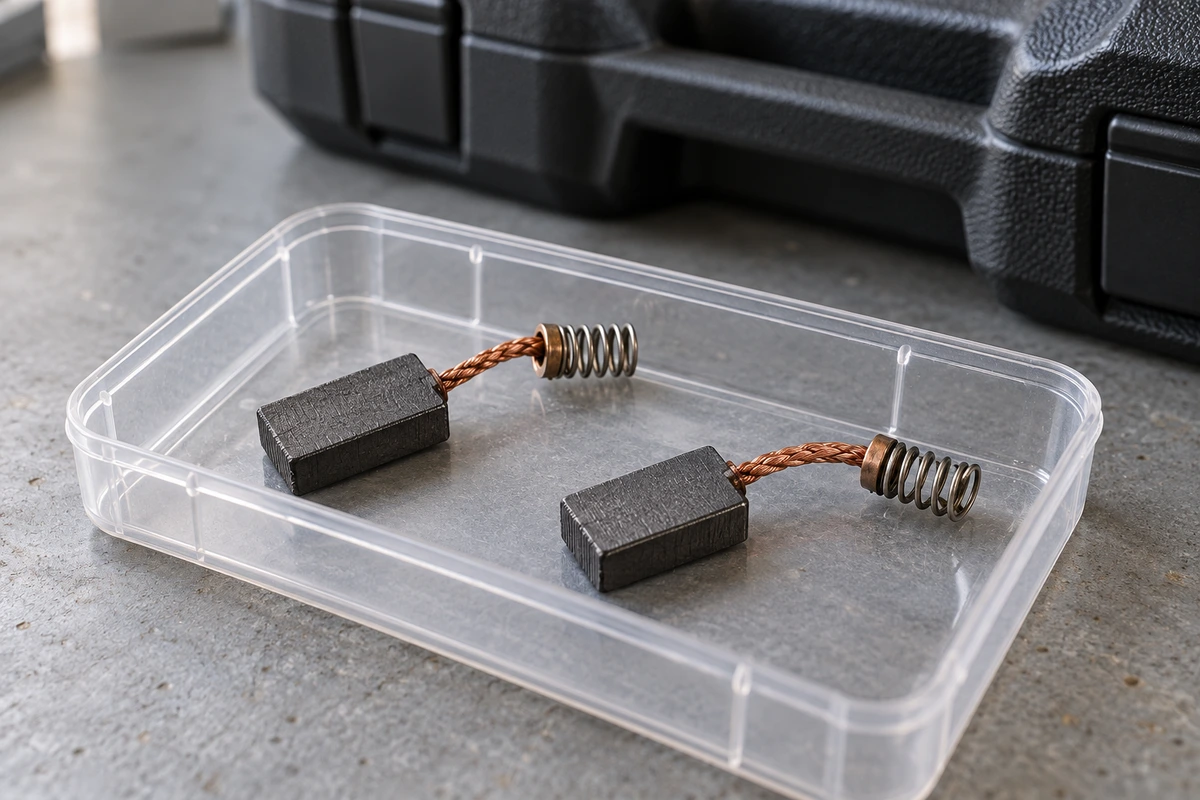
When a qualified service scope calls for replacement motor brushes, the purchasing request can stay at that component level. It need not automatically become an order for a motor or a complete router. The useful decision is whether to buy the specified brush supply, obtain a defined service-inclusive offer or consider a technically justified replacement-router alternative.
A stopped or poorly running router does not establish that brushes are the cause. This article starts after the responsible provider has defined the relevant service requirement. It supplies no electrical diagnosis, opening procedure or replacement instructions.
Identify the motor component behind the word brush
A request for “router brushes” can mean motor carbon brushes or the bristles on a dust boot. Keep the machine, component function and exact approved replacement identity in the purchasing line. That distinction matters when two small consumables appear under similar marketplace search terms.
Carbide 3D’s Carbide Compact Router replacement-brush listing states that the replacement brushes ship in a pack of two. We reviewed that product page on 13 October 2026. It establishes a separate component offer and its stated pack count, rather than an obligation to buy a complete router.
Preserve the named model. A similar housing, a familiar color or a seller’s photograph does not extend that listing’s compatibility to Makita or another router brand. Where the actual equipment identity is incomplete, request identification from existing records before treating any two-piece listing as a solution.
Translate the service requirement into the quoted pack
Ask the service provider to state the required brush supply for each identified job. Where that approved requirement is one matching pair, a two-brush pack can be compared on that pair basis after the exact product relationship is established. Two pieces in a package do not establish coverage for two routers.
Record the seller’s stated pieces per pack beside the buyer’s required pairs. Keep any loose brush in stores visible under its own identity and status. Do not treat an unmatched single piece as half of a completed service or assume it can be paired with a newly purchased brush.
This is also why a past invoice quantity can mislead. “Quantity 3” may refer to three packs, three pairs or three individual pieces. Resolve the historical unit before using that record to estimate what remains on the shelf. The current offer should make the conversion explicit enough for the next buyer to reproduce it.
Compare three actual purchasing boundaries
A parts-only offer supplies the specified brushes. It does not establish who will carry out the work, whether any other parts are needed or whether the router can return to use. Retain any technical service requirement as a separate scope with an identified provider.
A service-inclusive offer should name the equipment, defined work, supplied parts and actual charges. If it includes assessment before the final scope is known, preserve that condition. Do not mark an unknown additional charge as zero or describe a preliminary estimate as a completed repair price.
A complete-router offer supplies a different asset. Include it only where the technical owner has identified it as an appropriate alternative, with the actual compatibility and handover scope addressed separately. The brush listing’s existence does not prove that repair is feasible for every affected router, and a low component price does not settle the complete economic comparison.
Compare delivered parts plus the agreed service costs against the defined replacement alternative. Timing may matter, but use the providers’ actual commitments and conditions. Do not invent a standard service turnaround, a lost-production figure or a universal point at which buying new is better.
A fictional request for three brush pairs
Imagine a fictional service plan calls for one confirmed pair for each of three identified routers of the same approved model. Stores has one unused matching two-brush pack and one loose brush whose relationship to a usable pair is unresolved. All quantities and service facts are assumptions for this example.
Under that plan, the unopened approved pack covers one pair. The loose piece remains unresolved; it does not reduce the other two pair requirements. Two additional two-brush packs would supply the remaining two pairs if the actual offer retains that unit and the service requirement remains unchanged.
Suppose one supplier quotes “three brushes” while another quotes “three packs.” Those offers contain different quantities. Clarify the former and avoid ordering the latter simply by copying the number of routers, because one pair is already covered by the existing pack in this fictional case.
Now suppose the service provider changes the scope for one router after its authorized assessment. Update that identified requirement rather than applying the finding to all three. Purchasing should reflect the actual service conclusion, not use a convenient pack count to overrule it.
Keep replenishment history separate from service life
Save the accepted model reference, brush identity, pack contents, pair requirement and any service offer together. After an issue, record what was supplied to the job without claiming that a purchase or issue proves the work was completed successfully.
Past brush purchases may help describe consumption, but they do not establish a fixed number of operating hours between replacements. Machine use, technical assessment and maintenance requirements belong to their appropriate records. The repeat order should remain a bounded supply decision with any incomplete pair stock visible.
Request the defined replacement supply
As an independent buying agent, we can organize supplier offers and purchasing questions within an agreed scope. Technical suitability and any physical preparation or service remain with the responsible qualified provider. See CNC wear parts, then start a CNC quote request with the product link, description or existing identification images. Arrange technical documents through a separately authorized exchange.
Frequently asked questions
How many brushes are in the cited Carbide Compact Router pack?
The manufacturer listing states two brushes per pack. Keep that commercial unit distinct from the number of routers or service jobs.
Does a stopped router mean I should buy brushes?
No. A stopped router is not a brush diagnosis. Have the qualified service provider define the relevant requirement before choosing the component supply.
Can one loose brush count as half an approved pair?
Not automatically. Preserve its identity and unresolved grouping; do not assume it can be combined with another brush without the applicable technical decision.
Should I compare the brush price with a new router price?
Compare actual scope-complete alternatives: delivered parts plus separately required service versus the technically appropriate replacement offer. Unknown work or charges must remain visible.
Sources
Discuss a sourcing request related to this article.Reorder Router Carbon Brushes Without Buying a Whole Router