
Separate Positioning, Repeatability and Lost-Motion Evidence
Check axis-result coverage by characteristic, travel points, approach direction and configuration before accepting a full-travel claim.
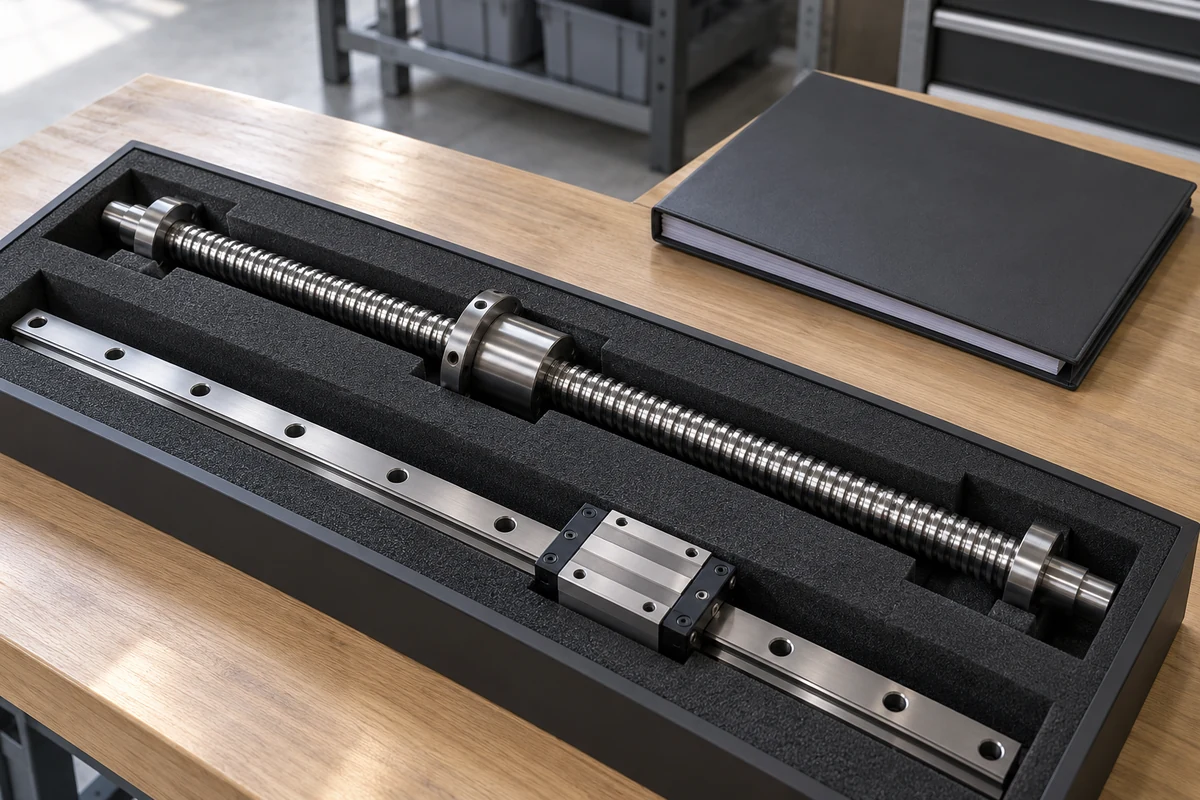
Repeated returns to one point do not establish positioning performance across an axis’s claimed travel. Before accepting an axis report, identify the characteristic being claimed, the locations actually evaluated, the approach directions and the delivered assembly. The headline “accuracy checked” should be supported by that specific coverage.
This article concerns interpretation of a delivered linear-axis report. It provides no motion program, laser setup, backlash adjustment or compensation edits. The qualified provider and buyer’s technical owner must agree the applicable method, conditions and acceptance criterion.
For this original editorial review, we checked the linked primary manufacturer or metrology explanations on 13 October 2026 and used only their stated distinctions. The coverage method below is our document-review proposal. We did not inspect a physical unit, receive an actual order report or verify a supplier’s performance.
Give each characteristic its own question
Renishaw’s encoder glossary distinguishes accuracy, repeatability and resolution. In that context, accuracy concerns closeness to the true position, repeatability concerns returning the same reported position at a point, and resolution concerns the smallest output increment. The distinction helps decode report labels; an encoder specification does not establish the complete machine’s performance. Renishaw encoder glossary.
For the buyer’s record, give positioning error and repeatability separate rows if both were required. Preserve the provider’s definitions and analysis method. A repeatable offset can still leave the position wrong relative to the required reference, so a tight cluster should not be relabelled as small positioning error.
Treat a claim labelled “lost motion,” “backlash” or “reversal” with the same care. Ask which quantity the provider evaluated and how the report defines it. Similar shop-floor terms are not permission to equate different tests or attribute the outcome to one mechanical component. Record the reported result before drawing any causal conclusion.
Map the report to the travel it actually covers
Identify the tested axis, machine or assembly reference and its configuration at the test date. A screw’s catalogue accuracy class, a controller setting and a measured result on an assembled axis belong in different evidence fields. The report must establish which physical system its conclusion describes.
Ask for the target-position list or equivalent original record, with the coordinate reference and units. Compare its first and last covered positions with the range named in the requirement, then check the intervening coverage. A plotted line joining sparse points should not be summarized as though every location along it was measured.
The CARTO Capture guide lists target positions, sequence, run direction and number of runs as separate test-definition information. Its unidirectional and bidirectional options distinguish approaching targets from one direction or both. This is a manufacturer example of why those fields matter; it is not a requirement that every buyer use CARTO or copy its test sequence. Renishaw CARTO Capture guide, Targets section.
Keep exclusions visible: an unavailable portion of travel, an untested direction or a different operating condition can narrow the result. Ask the qualified reviewer how that limitation affects the agreed claim. The procurement record should neither conceal the gap nor prescribe an extra motion test to fill it.
Preserve direction rather than averaging it away
If the requirement concerns bidirectional performance, ask where the positive- and negative-approach records can be found and how the report’s summary was derived. Combining them into one unlabeled average can erase the distinction the buyer needs to review. Preserve the original sign convention, units and analysis labels.
Renishaw’s TE334 paper provides a bounded example: in its described diagonal analysis, reversal at a target is derived from the difference between mean forward and reverse positioning errors. The paper concerns diagonal testing, so it is not a substitute linear-axis acceptance standard. It illustrates why a directional comparison answers a different question from repeated readings in one direction. Renishaw TE334, page 4.
A provider’s conclusion about reversal should identify the method actually used for the ordered axis. Ask the technical reviewer to resolve ambiguous terminology or an unsupported standard claim. This article supplies no universal run count, target spacing, statistical conversion or acceptable backlash. Those choices belong in the applicable approved plan.
Read a fictional single-point result honestly
Consider invented assembly AX-21. The order requires an agreed X-axis positioning evaluation across a defined travel range, with directional coverage set out in plan P-21. The supplier sends repeated readings at target T-C near the centre, approached in one direction, and labels the report “full-travel positioning accuracy passed.” No real distances, readings or acceptance thresholds are represented.
The buyer’s evidence map records one target and one approach direction. It preserves the repeated readings as the provider supplied them and asks the qualified reviewer what they establish about repeatability at T-C. The range requirement remains unresolved because the packet gives no identified results for the other required locations. The opposite-direction requirement also remains open.
The clarification request names AX-21 and P-21 and asks for the original target list, directional records and applicable analysis covering the requirement. It also asks whether omitted results exist or the wider evaluation was not performed. This avoids accusing the provider of a measured failure when the immediate problem is unsupported coverage.
Suppose a second attachment shows several targets but gives no axis identity and no configuration reference. The attachment is now broader in apparent spatial coverage, yet it still cannot be attributed to AX-21. Ask for the missing association. If the author confirms it belongs to another assembly, retain it as unrelated background rather than merging it into AX-21’s report.
If an attributable complete record later arrives, the qualified reviewer can compare its method, conditions and results with P-21. Closing the coverage gap makes a decision possible; it does not preselect acceptance. A properly documented departure must remain visible even when all requested pages are present.
Record configuration and compensation without changing them
Ask the provider to identify the configuration and compensation state associated with the reported data. Keep before-change and after-change results in separate, attributable records. A favourable chart from an earlier setup cannot be silently assigned to the delivered configuration.
Record the test’s reported environmental and operating conditions, measurement-system reference and stated limitations. Ask what changed between evaluation and dispatch, including relevant service work or configuration changes disclosed by the supplier. The responsible reviewer decides whether an existing result remains applicable or additional evidence is required.
Do not ask a purchasing coordinator to enter correction values or adjust mechanical parts based on a chart. A correction proposal is a separate technical activity with its own authority and manufacturer requirements. Preserve any approved change reference and the subsequent evidence the plan calls for, without treating a settings screenshot as a measured outcome.
Finish with a characteristic-by-characteristic decision
Use a short final register with separate entries for the claimed characteristic, tested assembly, target coverage, directions and repetitions, configuration state, evidence reference and qualified disposition. Give each unanswered item a specific owner. “Report received” and “scope verified” are useful administrative states before technical acceptance.
Keep the conclusion within its reach. A linear positioning result does not, by itself, settle every geometric error, a complete machined part’s conformity or rotary-axis acceptance. If the order requires those outcomes, retain their separate evidence requirements rather than extending one axis chart to cover them.
As an independent buying agent, we can organize the supplier’s report and outstanding questions within an agreed scope. See CNC linear-motion components, or use the CNC quote form to describe the assembly and requested evidence. Testing availability and technical acceptance require named competent parties.
The form supports listing links, descriptions and up to five PNG, JPEG, WebP or GIF images, limited to 10 MiB each and 20 MiB total. Arrange axis data, PDFs and other technical files through a separately authorized exchange. Retain the original report alongside the final decision so its coverage remains clear.
Frequently asked questions
Does good repeatability prove full-travel positioning accuracy?
It answers a different question. Check which positions and directions were evaluated and whether the report contains the required positioning evidence for the claimed range.
Is encoder resolution the same as machine accuracy?
No. The encoder glossary distinguishes resolution, accuracy and repeatability, and an encoder characteristic alone does not verify the complete assembled machine.
Why must approach direction remain in the report?
Directional coverage is part of the evaluated scope. Where a bidirectional or reversal claim is required, the qualified reviewer needs the corresponding records and analysis rather than an unlabeled combined value.
Can I use a ballscrew accuracy class as axis acceptance?
Keep the component specification separate from the delivered assembly’s measured result. The agreed axis requirement needs evidence attributable to that assembly and its stated configuration.
Sources
Discuss a sourcing request related to this article.Separate Positioning, Repeatability and Lost-Motion Evidence