
Reconcile Tool Identity, Pocket Location and Offset Data at Handover
Connect supplied tool data to each physical assembly while preserving controller identifiers, location meaning, capture state and measurement provenance.
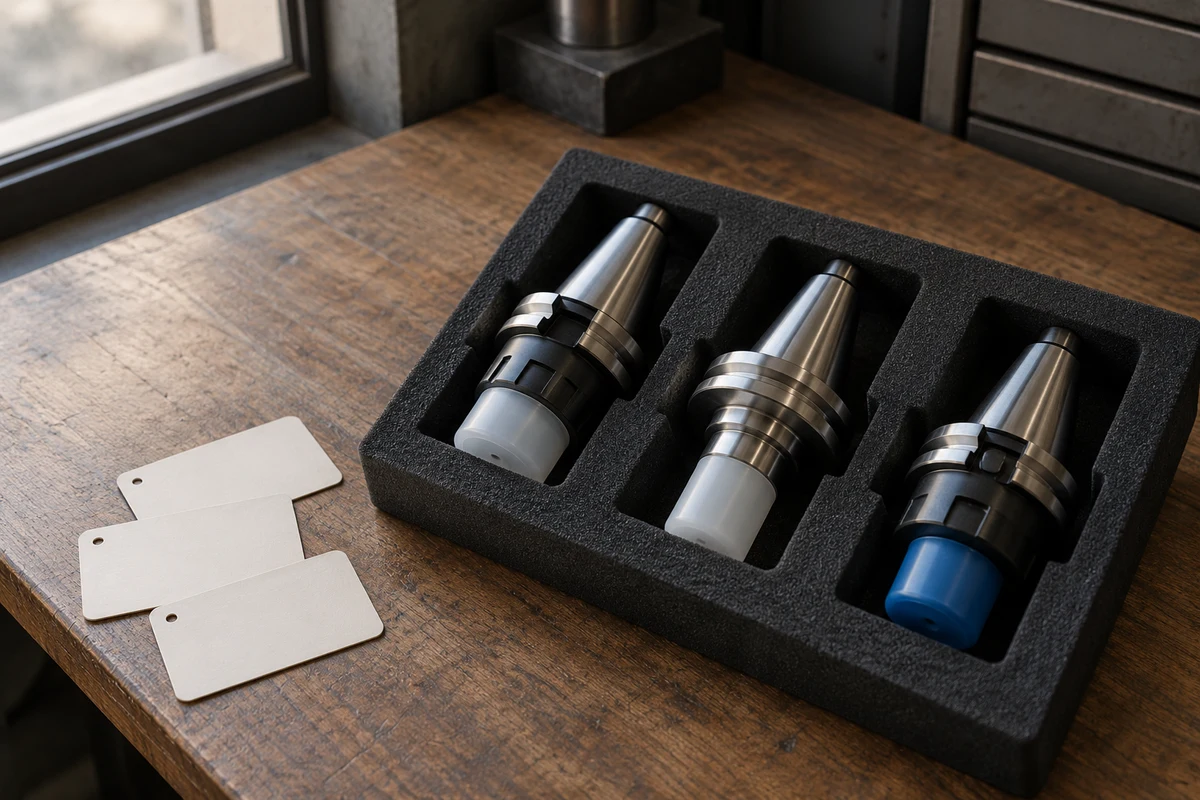
At handover, ask the supplier to connect each tool-data entry to the physical tool assembly it describes. Keep the controller’s tool identifier, the machine’s pocket or location reference and the shipment label in separate fields. Matching numbers are convenient, but the purchasing record should not depend on them being identical.
A useful tool data identity handover answers a precise question: can the buyer trace the supplied data to the delivered assembly and understand the state that the location record represents? It does not approve offset values or establish that an automatic tool-changing system is ready. No actual order records or tool measurements have been supplied for this article.
Give the physical assembly its own identity
Begin with the supplier’s existing assembly identification and the approved order line. Request the identities of the cutter, holder and other components included in that assembly where applicable. Preserve the supplier’s references rather than inventing a serial number to make the worksheet look complete.
A cutter part number may identify a product type while several delivered assemblies contain that same cutter model. Ask how the supplier distinguishes the individual assemblies covered by its data. A general tool description such as “end mill” cannot resolve that association on its own.
Use existing records and accessible package markings to request clarification. If the documentation does not establish an individual association, leave it unresolved and ask the responsible supplier for an authorized identification route. Do not turn a paperwork question into a request to remove protective packaging or handle exposed cutting edges.
Keep assembly identity separate from its current surroundings. A tray position, carton number or photographed rack slot can help locate an item in a particular record. Ask the supplier to identify what each such reference means before carrying it into the controller-data comparison.
Establish what the location field means on this controller
LinuxCNC 2.9 documents tool identifiers, pocket information and offsets as distinct data fields. Its fixed-location description returns tools to assigned positions; its random-location description updates pocket information as tools exchange places. Length and diameter values have a machine-unit context. These distinctions apply to the documented LinuxCNC architecture, not every controller marketed for CNC use. LinuxCNC 2.9 tool table and tool changers
Ask the supplier to explain the location semantics for the exact delivered implementation. Does the supplied record describe a fixed association, a captured current location or a separate bookkeeping label? The supplier should identify the applicable manufacturer reference and connect its explanation to the delivered records.
Keep the record’s capture state visible. A pocket list supplied after one event and a packing list prepared later may describe different states. Ask when each record was captured and which state the supplier intends it to represent. Do not resolve a difference by assuming that one list is wrong or that a tool must always retain the same pocket.
Preserve the origin of the offset data
Ask which supplier-issued data source the handover copy represents and how that copy is identified. Record its date or revision and the configuration it covers. A screenshot can help explain a discrepancy, but it should not silently become the authoritative source for a complete tool-data set.
For each supplied measured value, request the associated assembly identity, stated units and the measurement record that the supplier says supports it. Keep a nominal catalogue dimension, a measured result and a controller offset labelled according to their actual roles. Do not rename them all “tool size” in the purchasing spreadsheet.
If units or measurement provenance are missing, ask for the missing explanation. Avoid converting values, filling blank fields or copying values from another apparently identical tool. The responsible technical reviewer must decide whether the supplied data is applicable to the actual assembly and configuration.
Also ask whether the recorded assembly remained unchanged between the measurement record and the handover state. If a component was replaced or the assembly identity changed, preserve that information and request the supplier’s assessment of which records still apply. This article supplies no measurement procedure or offset acceptance limit.
Compare the three identities in one worksheet
The worksheet below is an original buyer-facing comparison method. It organizes evidence already supplied or requested; it does not create a tool table for use on a machine.
| Worksheet field | What to retain |
|---|---|
| Physical assembly identity | Supplier assembly reference and the delivered components it covers |
| Controller tool identifier | The identifier attributed to that assembly in the supplied data |
| Pocket or location semantics | The supplier’s explanation of the location reference for this implementation |
| Data source and capture state | Identified handover copy, capture date or revision and represented state |
| Units and measured-value provenance | Stated units, linked measurement record and its assembly scope |
| Unresolved association | The exact mismatch or missing connection, with the supplier contact responsible for the reply |
Add the shipment label as a cross-reference, preserving its original wording. If it says “tool 3,” ask whether that means order item 3, tray position 3, a controller identifier or something else. The worksheet should expose that ambiguity rather than silently decide it.
Resolve a fictional tool 17 and pocket 3 mismatch
Imagine a fictional delivery whose supplier record associates controller tool identifier 17 with physical pocket 3 at the recorded capture state. The shipment list calls the assembly “tool 3.” Nothing supplied explains whether the shipment wording refers to the pocket or to a different tool.
Ask the supplier to reconcile the shipment line, assembly identity, controller identifier and captured pocket association in one reply. Request the applicable data-source reference and measurement provenance at the same time. Do not change the controller identifier to 3 simply to match the packing description.
Suppose the supplier confirms that “tool 3” was its packing label and identifies the assembly as A-17. A corrected shipment cross-reference can resolve that naming issue. If the measurement record still names only a generic cutter model, the association between the supplied values and assembly A-17 remains open.
Alternatively, the supplier may report that the pocket list represents an earlier state. Ask it to identify the state covered by the handover and explain the relationship between the records. That explanation should account for the discrepancy without asking the buyer to perform a tool change to find out where the tool is.
Close the association question at its documented scope
A completed mapping should show which delivered assembly each data entry describes, what its location reference means and which supporting records remain unresolved. Record the responsible reviewer’s conclusion and its limits. Do not turn an identified assembly into an approved offset set or a tool-change acceptance result.
Our independent buying-agent role is to coordinate supplier answers and keep the purchase documentation attributable. Tool-data evaluation and machine acceptance remain separate technical responsibilities. For the broader product category, see CNC cutters and end mills.
Use the CNC quote request with a supported product link, a description or up to five PNG, JPEG, WebP or GIF images, at most 10 MiB each and 20 MiB total. Tool-data files and technical reports need a separately authorized exchange. The image field does not accept CAD, PDF or ZIP uploads.
Frequently asked questions
Must the controller tool number match the pocket number?
Do not assume that relationship. Ask the supplier to explain the delivered implementation and reconcile the controller identifier, physical assembly and location record separately.
Is a shipment label such as tool 3 enough to identify its data entry?
Only a documented association can establish what the label refers to. Ask whether it names a packing item, physical location or controller identifier, and retain the supplier’s cross-reference.
Can I reuse the supplied offsets for another identical-looking assembly?
Do not infer applicability from appearance or a shared cutter model. Request the assembly-specific provenance and have the responsible technical reviewer assess the proposed data association.
Does a reconciled tool list prove that automatic tool changes are accepted?
It resolves only the documented identity and data-association scope. Tool-change function, technical data approval and machine acceptance need separate evidence and responsible decisions.
Sources
Discuss a sourcing request related to this article.Reconcile Tool Identity, Pocket Location and Offset Data at Handover