
CNC Router Belts: Belt-Only Reorder or Maintenance Kit?
Compare the needed belts with the exact machine kit contents, resolve the Z-belt listing conflict, and keep surplus components out of claimed savings.
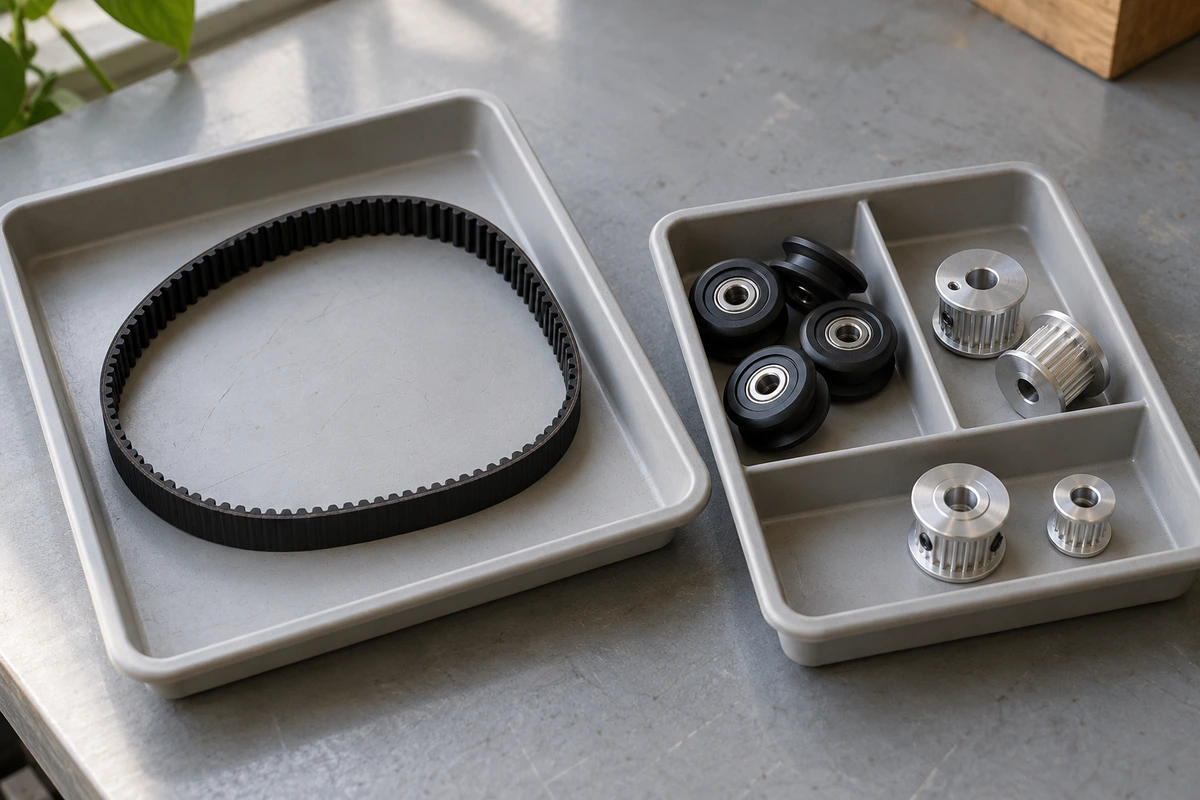
A CNC router belt reorder can become a much larger purchase when the buyer repeats the last maintenance-kit order. Before doing that, ask which components the present requirement actually consumes. If an approved requirement calls only for belts, a bundle containing wheels, pulleys or other supplies needs its own economic justification. Those additional items may be useful, but they should be connected to a real need rather than credited as instant savings.
The comparison begins after the responsible technical person has identified the replacement requirement. A kit contents list does not establish a maintenance interval, diagnose a machine fault or say that everything in the box needs replacement together.
Read the kit as several component lines
Carbide 3D’s Shapeoko maintenance-kit page distinguishes the contents by machine generation. Its Shapeoko 4 option includes belts, assembled V wheels, eccentric nuts, screws and pulleys; its Pro option combines belts with pipettes and oil. Its Shapeoko 3 option includes a separate Z-axis belt among the other components. These examples demonstrate why “one maintenance kit” is an incomplete stock description.
Build the comparison around the exact installed machine and revision. Retain the current approved parts requirement, then ask the seller to identify each component in the offered kit. Put the seller’s proposed substitutions on separate lines. A kit name matching the machine family does not settle the contents or the applicability of every included item.
For each line, distinguish an immediate requirement, a supported later requirement and surplus with no defined use. Existing approved spares belong beside their corresponding component, not in a single pooled “parts available” total. Spare wheels cannot cover missing belts, and an unopened kit in stores should not be counted both as a whole kit and as loose contents.
Resolve the belt-only offer before comparing it
Carbide 3D also has a Shapeoko 3 replacement-belts listing. It names X, Y and Z belts and says the Z belt is not used on Z-plus or HDZ. The current descriptions also contain a discrepancy: the belt-only page describes all its belts as 9 mm wide, while the maintenance-kit page lists a 6 mm Z-axis belt for Shapeoko 3. We reviewed these pages on 13 October 2026.
Do not decide which description is correct or declare the two offers identical. Ask the supplier to resolve the exact supplied Z belt and the installed Z revision in its current quotation. Preserve the discrepancy with that question. The existence of a standalone belt offer supports comparing purchase scopes; it does not support an unqualified equivalence claim.
A seller reply should identify the supplied components, their applicable machine configuration and the quantity basis. If the response covers only X and Y, leave the Z question open. Avoid filling the gap with a remembered specification from an earlier order.
Compare the additional spending with useful additional supply
Obtain current delivered totals for the resolved belt-only offer and the relevant kit. Include separately quoted preparation or service only where it belongs in the approved scope. Neither a parts listing nor a kit price establishes that service is included.
The difference between those totals is the additional spending required to obtain the kit. Compare that difference with the actual extra components the buyer expects to use. For example, a separately quoted wheel requirement can make part of the kit relevant; a shelf already holding those wheels changes that result. Do not assign the full standalone retail value of every extra item to the kit if those items would not otherwise be purchased.
Where later use is plausible but uncertain, show it as a second scenario. The immediate decision should remain readable without that assumption. Retain the amount of surplus, its storage requirements under the applicable product guidance and the cash committed to it. No universal discount or assumed useful life is needed to make that trade-off clear.
A fictional repeat-order request
Imagine a buyer’s previous purchase was a machine-specific maintenance kit. A new, technically defined request calls for its belt supply, while the wheels and pulleys from the earlier purchase remain available for their approved use. The buyer has no current requirement for more wheels or pulleys. These are fictional stock facts, not a statement about any actual machine.
The buyer asks for both a resolved belt-only offer and the exact kit alternative. If the kit costs more in the resulting quotes, that premium buys surplus components unless another supported need is identified. If the kit costs less, it may still be commercially attractive, but the additional components remain surplus rather than evidence that the current job consumed them.
Now suppose the technical requirement separately adds identified wheels. The comparison changes: the buyer can compare the belt offer plus the uncovered wheel supply against the kit, preserving any unmatched contents. It is the changed requirement that alters the economics, not a rule that bundles are always better or always wasteful.
Keep the next reorder at component level
Record the accepted belt scope and the supplier’s resolution of any listing discrepancy. Where a kit is bought, retain its contents beside the purchase reference and track subsequent issues by component. That record prevents the next buyer from treating a partially used kit as a complete spare.
Keep maintenance scheduling, belt preparation, tensioning and return-to-service decisions outside this purchasing record. The result is a defined supply choice with visible surplus, not permission to carry out a maintenance procedure.
Request the defined replacement supply
As an independent buying agent, we can organize supplier offers and purchasing questions within an agreed scope. Technical suitability and any physical preparation or service remain with the responsible qualified provider. See CNC wear parts, then start a CNC quote request with the product link, description or existing identification images. Arrange technical documents through a separately authorized exchange.
Frequently asked questions
Are Shapeoko maintenance kits identical across generations?
No. The cited manufacturer page gives different contents for Shapeoko 3, 4 and Pro. Compare the exact machine option and current quoted components.
Can the Shapeoko 3 belt-only and kit belts be assumed equivalent?
No. Their current Z-belt width descriptions conflict, and the belt-only listing excludes its Z belt from Z-plus and HDZ use. Have the supplier resolve the supplied belt and installed revision.
Should unused wheels and pulleys count as immediate kit savings?
Only credit extra components against a supported purchase requirement they would actually cover. Show uncertain later use and surplus separately.
Does buying a maintenance kit establish when to replace its parts?
No. Kit contents define supply, not replacement timing or diagnosis. Those decisions need the applicable machine guidance and responsible technical owner.
Sources
Discuss a sourcing request related to this article.CNC Router Belts: Belt-Only Reorder or Maintenance Kit?