
Keep Matched CNC Precision Components Together in Packout
Preserve manufacturer-defined rail and block associations when reviewing a consolidated CNC packout, with clear records for every approved set.
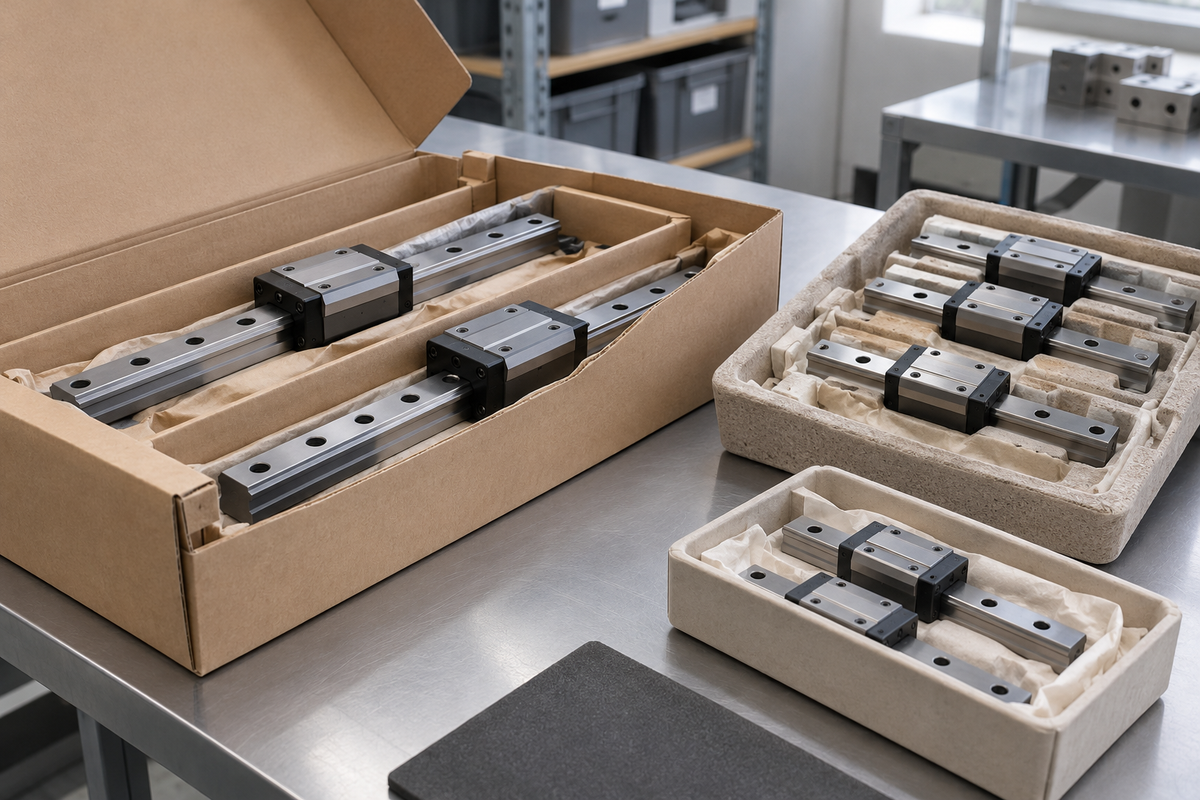
When a CNC order includes manufacturer-defined precision sets, the packing proposal should preserve the established associations from supplier release to destination handover. A carton containing the right total number of rails and blocks can still leave the buyer unable to identify which items belong together. Agree that relationship before approving a new tray layout or consolidated shipment.
The purchase specification should already identify the approved components. This review starts with those components and asks whether a packaging change keeps their documented relationships intact. It does not determine interchangeable replacements, diagnose preload or authorize anyone to remove a block from a rail.
Establish what the manufacturer calls a set
Ask for the exact product family and the manufacturer’s supplied-set record. Preserve any documented relationship between rails, blocks and coordinated guide groups. A seller’s commercial term “set” may simply describe a quantity bundle; request the evidence behind any more specific matching claim.
THK’s LM Guide marking guidance describes serial-number relationships for rails and blocks used in combination. That provides a concrete example of manufacturer-defined association that can matter beyond a shared model name. Use the applicable instructions for the actual supplied product, rather than transferring THK’s marking convention to an unrelated brand. THK marking and combined-use guidance
The rule is product-specific. THK separately describes its GK range as interchangeable products and distinguishes them from assembled-set products, with stated restrictions on combinations. This is why the packing instruction should preserve the approved relationship without asserting that all linear-guide components are universally noninterchangeable. THK LM Guide GK Series
If the supplier has not established whether the order uses matched sets, interchangeable products or another documented arrangement, leave that field unresolved. Ask the responsible product provider to answer before a packer creates a grouping from appearance. An administrative carton number can identify a container, but cannot create manufacturer matching evidence.
Separate the supplied state from the proposed packing change
Describe how the supplier will release each approved unit: its documented assembly identity, associated components and existing protective-package references. Use records and protected views already available. Missing information should trigger a clarification request, not an instruction to expose components for a photograph.
Next, describe exactly what the packing proposal changes. It may keep each supplied unit intact while combining outer packages, or it may propose regrouping components by size. Those proposals need different answers. The word “consolidation” alone does not reveal whether a precision association will be disturbed.
Ask the packer to identify each point where the proposed plan depends on separation or reassignment. Request the applicable manufacturer permission and the responsible provider’s confirmation. Do not treat a packaging supplier’s willingness to perform a change as proof that the product maker supports it.
If preserving the existing supplied state requires a different outer-package proposal, ask for that alternative. Compare the commercial implications only after the technical boundary is understood. A smaller package is an offer to evaluate; it does not independently justify changing an established set.
Record the association outside the protected package
The following buyer worksheet is an original editorial method for reviewing correspondence. It is not a manufacturer packing specification. Use it to ask whether the proposed package can be identified at each handover without unnecessary opening.
- Manufacturer set identity: record the actual reference and the document that defines its scope. Preserve the manufacturer’s wording where the meaning is uncertain
- Associated component IDs: transcribe the supplied identifiers and their relationships; show which references are confirmed and which remain missing
- Documented separation permissions: cite the exact response covering the proposed change, including any conditions and the party responsible for execution
- Packing group: identify the proposed outer package containing the approved unit, while retaining any subordinate protected-package references
- External association record: identify the packing-list entry or other authorized record that links the outer package to the established set
- Unresolved substitutions: list any component change separately, with its approval status and the person expected to decide
Check that this record works in both directions. Given a shipment package, the recipient should be able to find the associated approved set record. Given a set record, the shipment documentation should say where its supplied components are accounted for. This is a documentary consistency check, not a physical conformity test.
Avoid inventing maker serial numbers to fill blank cells. If administrative references are useful, label them clearly as buyer or packer references and link them to the evidence that actually exists. A new reference should help locate information rather than disguise its absence.
A fictional proposal to group blocks by appearance
Consider an explicitly fictional order containing two separately identified rail-and-block sets. The manufacturer records establish distinct membership for the two supplied groups. A packer proposes one tray for the rails and another tray containing all the blocks, sorted by appearance. No separation permission accompanies the proposal.
The buyer’s first response should identify the precise issue: the proposal does not demonstrate preservation of the established associations, and the proposed separation is unapproved. There is no need to assert that any two blocks are interchangeable or that damage has already occurred. Neither conclusion follows from the proposal alone.
Ask for a revised plan preserving the maker-authorized supplied state and the documented membership. If the supplier instead seeks approval for a different arrangement, request its applicable technical authorization and association records before the change proceeds. Keep both proposals distinguishable in the review history.
Suppose the revised proposal retains the two supplied units and maps each to a separate identified inner package within a common shipment. The buyer can review whether the records preserve the known relationships. That review still does not approve the physical packaging design or establish guide accuracy. The responsible provider must cover the actual protective arrangement within its agreed scope.
If a component substitution emerges during the discussion, reopen the affected product decision separately. Correcting the packing list cannot approve an alternative component. The packout should reflect the final accepted supply rather than quietly turning a replacement proposal into a completed set.
Make exceptions visible before release
A partial shipment needs the same association discipline. Ask which approved units are complete, which components are deferred and whether the proposed dispatch would divide an established group. Obtain the responsible provider’s disposition instead of treating all missing contents as ordinary backorders.
For mixed orders, keep unrelated spare blocks or accessories distinguishable from manufacturer-associated components. The packing record should make clear whether an item belongs to an approved set or is separately supplied stock. Similar descriptions on the invoice should not erase that distinction.
Before release, reconcile the accepted set record, current supplier response and final packing list. Any unresolved relationship should remain visible with an owner and a specific next question. Photographs may support identification of accessible labels and closed packages; they do not prove matching, preload, condition or machining performance.
Our role as an independent buying agent is to organize supplier questions and purchase records. Product-specific permissions and physical execution belong with the responsible manufacturer or authorized provider. See CNC linear motion components for sourcing context.
Use the CNC quote request to send a supported listing link, description or product images. The form accepts up to five PNG, JPEG, WebP or GIF images, at most 10 MiB each and 20 MiB total. Arrange technical documents separately through an authorized exchange; the image field does not accept PDF, CAD or ZIP files.
Frequently asked questions
Does the same model number prove that two guide blocks belong to the same set?
No. Use the actual manufacturer-defined association record for the supplied product. Model similarity and a commercial quantity bundle do not establish the membership of a precision set.
Can matched sets share one shipping carton?
Ask for a proposal that preserves each maker-authorized supplied unit and its documented associations. A shared outer carton still needs a suitable protective arrangement approved by the responsible provider.
What if a supplier cannot provide the matching reference?
Record the missing evidence and ask the product provider to resolve the supplied-set identity. Do not create a manufacturer relationship from appearance, carton position or an invented serial number.
Can package photographs approve the completed set?
Photographs can help connect accessible package labels with shipment records. They cannot establish matching, preload, guide accuracy or a technical acceptance decision.
Sources
Discuss a sourcing request related to this article.Keep Matched CNC Precision Components Together in Packout