
Keep Cutter Edges Protected Without Losing Tool Identity
Keep each CNC cutter connected to its exact order code while preserving approved individual protection through a mixed-tool kit packout.
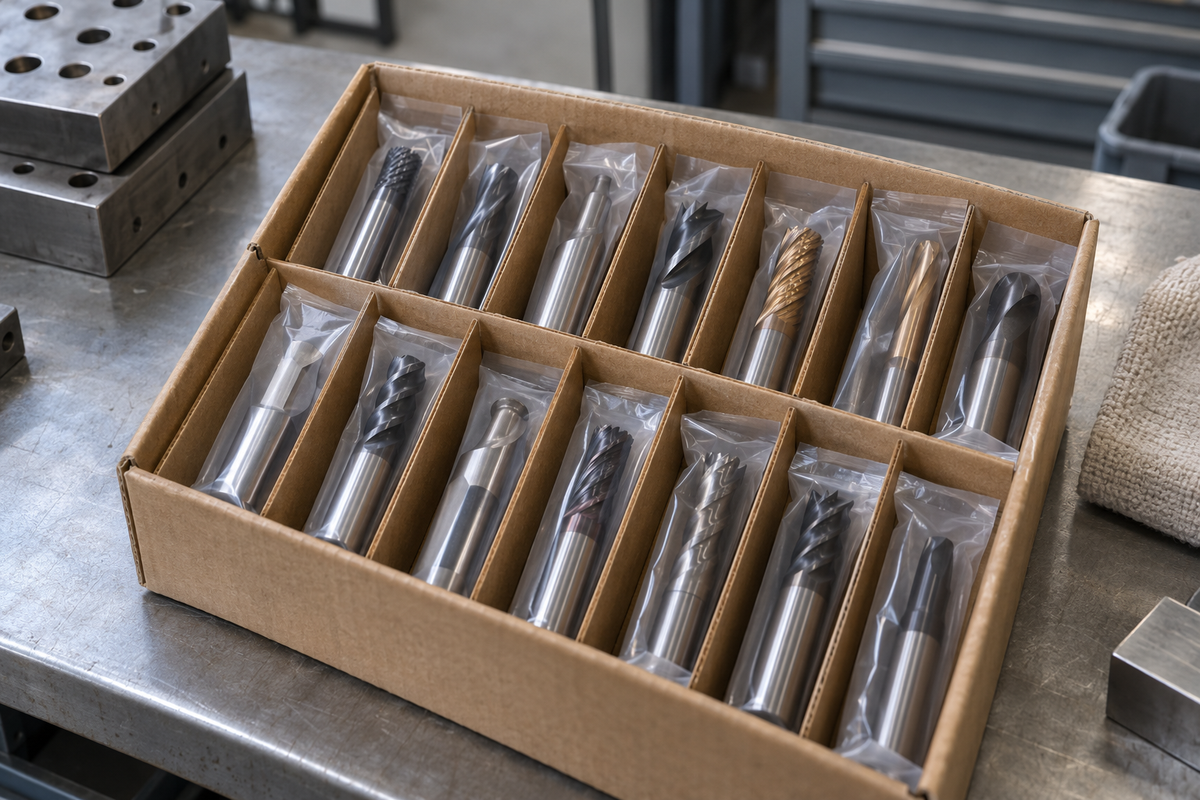
A mixed CNC cutter kit should preserve two things together: each tool’s approved protective packaging and a reliable association with its ordered identity. A tidy display that removes individual packs may make counting easier while discarding the information needed to distinguish similar tools. Resolve that tradeoff before authorizing the kit layout.
The cutting tools should already be selected. This review asks how the approved items will remain protected and identifiable during consolidation. It does not choose flute geometry, inspect edge sharpness or establish that a generic cap, sleeve or organizer protects every cutter.
Identify where the tool’s identity currently lives
Start with the approved order code and the supplier’s actual package description. Ask whether the identifying information is on the individual pack, the tool, a multi-item container or accompanying paperwork. Record what the supplier has confirmed rather than assuming the familiar label arrangement from a previous purchase.
Link Industries provides a concrete manufacturer example: its cutting-tool catalog describes individual tools in clear telescoping tubes or snap packs, identified with barcode labels. That example connects packaging with item identification. It is not evidence that another manufacturer’s tools use the same arrangement or that a proposed replacement pack is suitable. Link Industries catalog, “Distributor Friendly Packaging,” printed page 36
For the actual order, ask the supplier which visible package reference corresponds to each approved tool code. If the package contains several tools, record its stated quantity basis. “One pack” and “one cutter” should not quietly become interchangeable terms in the kit list.
Where an identifier is concealed by an unopened package, record the limitation and request an appropriate evidence route. Do not ask the packer to expose a cutting edge simply to satisfy a photograph requirement. The responsible tooling provider should decide whether further identification work is needed and how it will be performed.
Preserve two separate links through consolidation
The first link connects the protected item with its exact order identity. The second connects that protected item with its location in the completed supply kit. Both should survive a change of outer container. A compartment name can help the recipient find a tool, but cannot recover an order-code association that was never established.
Ask for a kit contents map based on the approved codes and existing package references. The map may identify a protected item within an outer group, provided the proposed arrangement is accepted by the responsible packing provider. It should not depend solely on tool length, shank appearance or the color of a sleeve.
Keep maker information distinguishable from added administrative information. If an outer label is proposed, ask what it will say, which original reference it reproduces and whether its placement is permitted. Do not present a buyer-created code as a manufacturer’s tool marking or use it to conceal conflicting information.
A map also needs a revision. If the final kit replaces one tool code or changes a quantity, update the affected entry and preserve the buyer’s approval of the change. A visually complete organizer with an outdated contents card leaves the recipient with two competing descriptions of the same shipment.
Compare retained packaging with a repacking proposal
Ask whether the desired outer kit can accommodate the supplied individual packs. This gives the buyer an option to evaluate before considering removal or replacement. It does not establish that the outer package is suitable for transport; the packing provider still owns the proposed protective design within its agreed scope.
If the seller proposes repacking, ask which tools are affected and what will happen to their original identifying information. Request the maker-authorized replacement approach and the party responsible for maintaining the tool-to-code relationship. “Equivalent protection” without an applicable basis leaves a technical question open.
Separate the buyer’s presentation preference from the packaging provider’s technical response. A uniform appearance may be desirable, but it should not be described as a reason that authorizes exposure, relabeling or substitution. Show the buyer what would change, what evidence is available and what remains unresolved.
Also distinguish an additional outer container from a replacement for the existing individual protection. A photograph can make both proposals look like the same neat box. Written scope should say whether the original protective packs remain intact and how the final arrangement will be identified.
Review a tool-by-tool packing worksheet
This original editorial worksheet organizes the approval questions. It does not specify pack materials, clearance, cutting-edge contact or a method for handling sharp tools.
- Exact tool code: the approved maker and complete code, with the supplier’s stated package quantity
- Maker protective packaging: the supplied pack reference or description and any applicable instruction
- Permitted outer identification: the proposed administrative label and its link to original, attributable information
- Kit location: the relevant entry in the current contents map, separate from the manufacturer’s identity
- Unopened evidence route: accessible label images or supplier records available without altering protection
- Repacking authority: the responsible provider and applicable permission for any proposed change, or an explicit unresolved status
Ask the supplier to mark exceptions by tool code. An answer saying “all tools protected” may omit the single oversize item that does not fit the chosen organizer. An exception list makes that item visible without requiring the buyer to design its packaging.
Check the worksheet against the final packing list rather than the first sample layout. If no physical sample has been reviewed, say so. A concept image or catalogue photograph can illustrate a proposal, but should not be described as evidence of the actual completed kit.
A fictional kit with similar shanks
Consider a fictional order for several cutters with similar-looking shanks but different approved cutting geometries. Each supplied individual pack carries the only established association with its order code. The proposed display removes the individual packs and groups the tools by apparent length.
The problem is already specific: the proposal discards the established identity link and has not supplied an authorized replacement protective arrangement. There is no need to guess which cutter would become mixed up or to claim that every tool would be damaged. Keep the proposed repacking unapproved while requesting an alternative.
One possible revised proposal retains each individual pack and uses an external contents map to identify its kit location. Ask the responsible provider to confirm the actual protective arrangement and verify the documentary links. The example does not establish that any particular box or map will be suitable for a real order.
Another response might propose new individual packaging supported by the toolmaker and an accountable identification process. That would be a different option for review, not an automatic rejection or approval. The buyer needs its scope, evidence, responsible provider and any commercial consequences before deciding.
If the supplier has already discarded the only identity evidence, creating fresh labels from visual guesses does not restore it. Ask the tool provider for an attributable identification and disposition. Keep uncertain tools distinguishable in the records from those whose identities remain supported.
Close the kit record without claiming edge acceptance
Before release, reconcile approved tool codes, quantities, retained or authorized replacement packs and the current kit map. Record any unresolved exception. A complete identity record helps the recipient know what was supplied, but does not itself prove cutting-edge condition or dimensional conformity.
Any inspection beyond accessible package evidence requires its own agreed scope and competent provider. Our independent buying-agent role is to organize the supplier’s proposal and clarification requests. For product-selection context, see CNC cutters and end mills.
Use the CNC quote request for a supported listing link, text description or product images. Up to five PNG, JPEG, WebP or GIF images are supported, at most 10 MiB each and 20 MiB total. Arrange drawings and technical reports through a separately authorized exchange; the form’s image field does not accept PDF, CAD or ZIP files.
Frequently asked questions
Can a kit map replace the labels on individual cutter packs?
A map can identify kit locations, but it needs an established link to each protected tool and its approved order code. It cannot recover identity that was never documented or was lost during repacking.
Should similar-looking cutters be grouped by shank appearance?
Use the approved tool codes and attributable package records to define the contents. Appearance alone is not a reliable basis for deciding which ordered tool a protected item represents.
Does retaining original packaging approve the whole shipping kit?
No. It preserves an existing packaging and identity arrangement for review. The responsible provider must still define and approve the actual outer protective arrangement for the shipment.
What if identifying a cutter would require opening its pack?
Record the evidence limitation and ask the responsible tooling provider for an authorized identification route. Do not expose a cutting edge merely to complete an administrative photograph checklist.
Sources
Discuss a sourcing request related to this article.Keep Cutter Edges Protected Without Losing Tool Identity