
Check the Conditions Behind a CNC Noise-Acceptance Report
Check whether a CNC noise report uses the agreed acoustic quantity, operating state and auxiliary-equipment scope before relying on its acceptance conclusion.
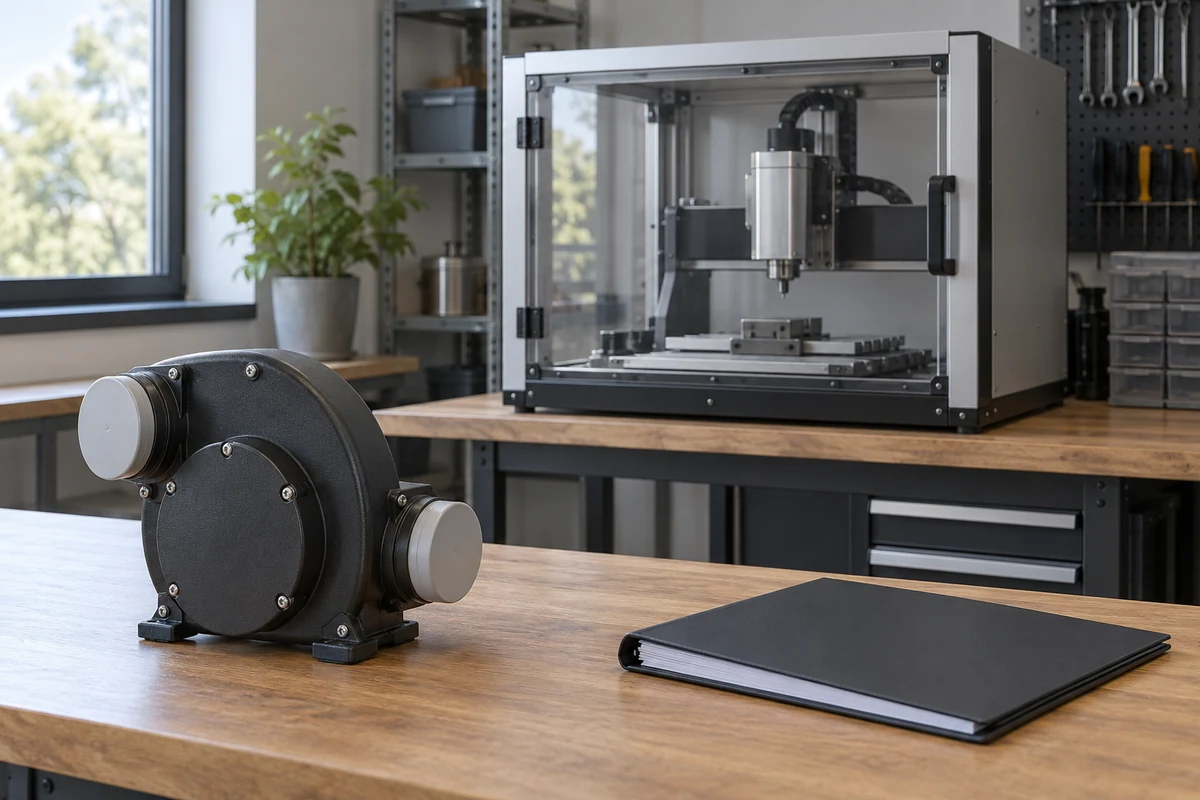
A CNC noise-acceptance report should answer the acoustic requirement agreed for the delivered configuration. Before comparing its headline number with the order, identify the reported quantity, operating condition and included equipment. An idle-machine result with no extractor identified may answer a different question from the agreed machining-condition assessment.
The task here is to review an existing report for comparability. It is not an acoustic test procedure, a noise limit or permission to run machinery. No real purchase specification or acoustic result has been supplied. The responsible acoustic specialist must determine the applicable method and whether the evidence supports the buyer’s acceptance decision.
Find the requirement before interpreting the number
Locate the accepted acoustic requirement and its revision. Preserve its exact quantity, units, weighting, specified condition and acceptance basis. If the agreement says only “quiet CNC,” ask the authorized owner what was actually committed to and what evidence can resolve the ambiguity. Do not invent a decibel target after the machine arrives.
Distinguish a catalogue declaration from a report for the identified delivered machine. Either may be relevant within an agreed evidence arrangement, but the receiving summary should state which one was supplied. A family-level specification should not be relabelled as a measurement of the buyer’s unit.
HSE’s UK guidance explicitly includes checking an agreed noise specification after machinery is delivered and installed. It also says meaningful comparisons require the same or comparable conditions. This supports treating acoustic evidence as a receiving decision, while leaving the actual agreement and applicable local requirements with the responsible reviewers. HSE L108, paragraphs 278(j) and 289
Preserve sound power and sound pressure as different quantities
Brüel & Kjær explains sound power as the rate at which a source radiates acoustic energy. It explains that measured sound pressure depends on position relative to the source and the acoustic environment. Consequently, the quantity name is essential context for a reported noise level. A number labelled sound power should not simply replace a required workstation emission sound-pressure result. Brüel & Kjær: sound pressure and sound power
Copy the full reported label, including any frequency weighting, unit and associated uncertainty. Keep those fields attached to the result when summarizing it for procurement. If an unfamiliar abbreviation appears, ask the report author to explain it rather than shortening everything to “noise, dB.”
Where the report concerns a workstation or another specified position, retain the position reference. For a sound-power result, retain its stated source boundary. The qualified reviewer must decide whether the evidence addresses the requested quantity; the receiving team should not calculate a conversion, substitute a generic distance adjustment or subtract an assumed background level.
Check the method’s scope without choosing one by title
ISO 230-5’s public abstract distinguishes workstation emission sound pressure from sound power. It describes defined environmental, mounting and operating conditions and addresses related auxiliary equipment. Its general scope names stationary floor-mounted machine tools. The title alone is therefore not grounds to declare that it is the applicable method for an unspecified desktop CNC. ISO 230-5:2000 public abstract
Only the public abstract was reviewed here, not the full paid standard. Ask the acoustic provider to identify the method and edition actually used, explain its applicability to the machine and state any departures. Do not add “ISO compliant” to a report summary merely because a standard number appears in a supplier’s email.
Keep the declared uncertainty and any interpretation rule available to that reviewer. Additional decimal places do not resolve missing method information. Where a result is near an agreed boundary, procurement should obtain the authorized conclusion rather than inventing how uncertainty changes the decision.
Match the enclosure and auxiliaries to the reported condition
Identify the supplied machine, enclosure configuration and relevant auxiliary equipment in the report. Ask whether the documented operating state concerns idle operation, an identified machining condition or another defined state. Preserve the recorded description and its exclusions rather than replacing it with a broad “machine running” label.
For an extractor, coolant unit or other auxiliary, request its identity and how the report treated it. The acoustic question is whether the agreed noise source boundary was assessed. This does not assess airflow, filtration, coolant performance or protective functions. Those outcomes cannot be inferred from an acoustic result.
ISO 230-5’s abstract itself treats some related auxiliaries differently from centrally operated equipment serving multiple machine tools. That distinction illustrates why an unexplained “extractor included” checkbox may be insufficient. Let the provider explain the actual arrangement and method treatment; this article does not classify the reader’s equipment or prescribe a correction. ISO 230-5 auxiliary-equipment scope
Build a comparison that exposes the acoustic mismatch
Use an agreed-versus-reported comparison with the original document references. The following fields are an editorial review aid, not a list of new measurements to perform.
| Comparison field | Evidence question |
|---|---|
| Acoustic quantity | Does the result answer the specified sound-power or emission sound-pressure question? |
| Result description | Are weighting, units, uncertainty and any stated limitations retained? |
| Machine/enclosure | Is the reported configuration the one covered by the acceptance requirement? |
| Operating condition | Does the recorded state match the agreed condition or an approved equivalent? |
| Auxiliaries | Which identified sources were included, excluded or treated separately? |
| Method and environment | Are the method reference and recorded environmental conditions available for qualified comparison? |
Mark a mismatch precisely. “Operating condition differs” is more informative than “noise test failed” when the actual required condition has no comparable result. Similarly, an omitted auxiliary identity is an evidence gap, not proof that the auxiliary was switched off or that the measured level is wrong.
Work through a fictional idle-only report
Imagine a fictional order requiring acoustic evidence for an identified machining condition with the supplied enclosure and extraction arrangement. The report names the correct machine family but describes idle operation. Its result has a clear acoustic quantity and uncertainty, while the extractor’s identity and treatment are absent. No numerical readings or limits are needed to see the mismatch.
The buyer records the reported idle condition exactly. It asks the provider to identify whether an existing result addresses the agreed condition and to explain the source boundary. The idle result is retained as evidence for its stated condition, rather than discarded or promoted into a machining-condition pass.
Suppose the provider replies with a sound-power result for a different configuration, while the agreed requirement concerns workstation emission sound pressure. That creates a second mismatch. Ask the qualified reviewer whether an authorized, supportable alternative exists or whether further agreed work is needed. Do not convert the quantity merely to populate the acceptance spreadsheet.
A corrected report may resolve the configuration and operating-state questions. Its acceptance still belongs to the authorized reviewer under the actual agreed basis. If the required evidence cannot be supplied, record that unresolved decision without diagnosing a fault from the report gap or directing staff to run a makeshift sound test.
Keep acoustic acceptance separate from workplace exposure
HSE explains workstation emission sound pressure as a machine-specific quantity at a specified position with workroom-reflection effects removed. It warns that a low manufacturer declaration may not represent the actual workplace noise risk. These points concern interpretation in UK guidance; no legal threshold or safe exposure duration is transferred here. HSE L108, paragraphs 282–283 and 296
The final acceptance note should name the acoustic requirement, configuration, report and bounded conclusion. Leave workplace exposure assessment and other required safety decisions with the appropriate competent people. An acoustic pass does not establish guard adequacy or freedom from mechanical defects.
We act as an independent buying agent and can coordinate supplier records and clarification requests. See CNC enclosures and use the CNC quote form for the initial listing or description. The form supports up to five PNG, JPEG, WebP or GIF images, limited to 10 MiB each and 20 MiB total. Acoustic reports, manuals or drawings requiring PDF, CAD or ZIP exchange need a separately authorized route.
Frequently asked questions
Can an idle-noise result answer a machining-condition requirement?
Only if the authorized acoustic reviewer establishes that the evidence answers the agreed basis. Preserve the reported idle condition and request the required condition or an explicitly approved, supportable alternative.
Can sound power replace workstation emission sound pressure?
Keep the quantities distinct. Ask the competent reviewer whether the supplied result can answer the specified question; do not relabel it or make an unsupported conversion.
Does ISO 230-5 automatically apply to a desktop CNC?
No applicability claim follows from its title. Its public general scope names stationary floor-mounted machine tools; the acoustic provider must identify and justify the method for the actual machine.
Does an accepted emission report establish safe workplace exposure?
It establishes only the conclusion supported under its stated scope. Workplace exposure and other safety requirements need their own competent assessment; do not infer them from an emission acceptance label.
Sources
Discuss a sourcing request related to this article.Check the Conditions Behind a CNC Noise-Acceptance Report