
Ask What a Spindle Rating Covers Before Comparing Watts
Request the applicable curve, speed and duty conditions before comparing spindle wattage, and keep application approval separate from documentation completeness.
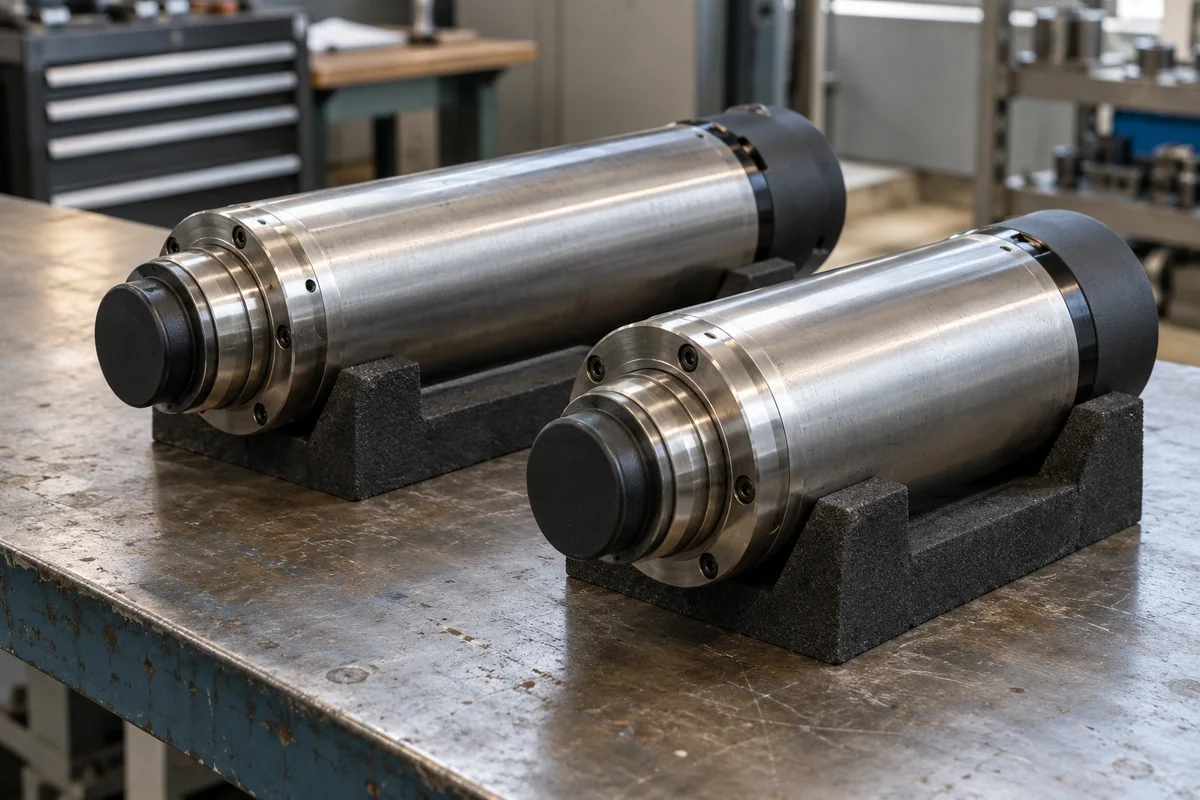
Compare spindle offers only after the supplier states what its power rating covers. Ask for the exact model, the applicable torque and power curves, the speed associated with the quoted rating, the duty basis and the required drive and cooling conditions. A headline wattage is a starting reference for the inquiry, not a complete answer about the buyer’s operation.
The useful outcome is a documented spindle proposal that a competent application reviewer can assess. This article concentrates on rating evidence. Mount dimensions, service connections and permission to replace an existing spindle are separate integration questions, even when the same supplier answers both inquiries.
Describe the work the rating must support
Begin with the operation, material designation and selected or proposed tooling. Ask the responsible process planner to identify the required operating region from appropriate tool and machine information. If that work has not been done, describe the intended result and mark the application requirements as pending. Do not select a universal spindle speed from the material’s common name.
Explain the expected pattern of work. A supplier needs to understand whether the buyer is discussing one short demonstration, repeated jobs or a longer production period. Record the known durations and pauses as requirements or observations, with their source. Do not manufacture a duty percentage from guesses about how often an operator takes a break.
For an existing machine, provide the machine and drive identities and state whether the aim is like-for-like replacement or a changed capability. For a new system, ask who will specify the spindle and drive together. The seller should identify which assumptions it needs confirmed before recommending a model.
Keep the rating conditions beside the number
HSD’s official ES951 technical sheet gives separate entries for maximum speed, torque and power, with the latter two labeled by S1 and S6 duty and an associated percentage. The page contains several variants. That document shows why copying one power figure without its column and duty label loses important context. It does not establish the performance of an unrelated spindle or a marketplace seller’s goods. HSD ES951 technical sheet
SPINOGY’s X22 technical page also separates motor variants and S1/S6 power entries, and notes that the applicable values depend on configuration. Use such documentation as a model for the information to request, rather than borrowing a rating from a familiar family name. SPINOGY X22 technical data
Ask the actual manufacturer to explain the duty designation in the supplied document and identify all applicable conditions. Keep any percentage, cycle definition and qualification attached to the figure. A shorthand explanation from another product page should not become the operating rule for the offered spindle.
| Evidence item | Supplier response needed | What stays unresolved without it |
|---|---|---|
| Exact variant | Full model, option code and applicable revision | Which spindle the rating describes |
| Power figure | Value, units and whether it describes the spindle output or another quantity | Whether two quoted numbers describe the same thing |
| Speed basis | Speed at the rating and applicable curve reference | Performance across the required operating region |
| Duty basis | Manufacturer designation and its stated conditions | Whether the rating applies to the buyer’s work pattern |
| Drive pairing | Proposed drive and supporting manufacturer information | Whether the proposal covers the intended spindle-drive combination |
| Cooling and environment | Conditions assumed by the rating | Whether the proposal addresses the buyer’s installation |
| Application disposition | Named reviewer and unresolved requirements | Whether the documented proposal meets the actual need |
Ask a specific question of the curves
Request the torque-versus-speed and power-versus-speed information applicable to the exact offered variant. Ask the supplier to identify the relevant curves and explain how its proposal relates to the required operating region. A chart for another motor winding, drive arrangement or duty condition should remain supporting background until its applicability is established.
Preserve the chart axes, units, legends and notes when preparing a review pack. A cropped graphic can remove the condition that distinguishes one curve from another. If the seller sends an unlabeled curve, request the original manufacturer document rather than tracing the curve into a new graphic that appears more authoritative.
The review question is not whether the chart reaches an impressive maximum. It is whether the proposed configuration has documented support where the actual job needs it, under the applicable conditions. Let the qualified reviewer identify any gap, restriction or additional evidence needed. Do not fill a missing region by extending a curve yourself or converting a single advertised point into a guaranteed operating envelope.
If no curve is available, say exactly that. Ask whether the manufacturer can provide other suitable application evidence. A missing chart is an evidence gap; it is not by itself proof that the spindle is defective, and it should not be hidden behind a confident performance claim.
Two fictional offers both say 1.5 kW
Consider two invented quotations. Offer A states only “1.5 kW spindle” and includes a photograph. Offer B also states 1.5 kW, but identifies the model, the rating’s speed and duty, and a manufacturer document. Neither offer has yet been checked against the buyer’s intended operation.
A cannot presently be compared on the same basis because the meaning and conditions of its number are missing. Ask for those conditions and the exact product identity. B is better documented for review, but it does not automatically become the preferred spindle. The reviewer must still determine whether the referenced information covers the required operation and the proposed drive and cooling arrangement.
Suppose B’s document turns out to cover a different variant. Return it for correction rather than keeping the more complete-looking answer in the comparison. Suppose instead A later supplies applicable evidence. Reassess A on that evidence, retaining the distinction between documentation completeness and application suitability.
There is no torque value, runtime promise or recommended cutting setting hidden in this example. The shared 1.5 kW label establishes only what the fictional quotes initially said. It cannot decide which offer will complete the buyer’s job.
Make any demonstration answer the unresolved question
A video of a spindle turning does not supply the missing rating conditions. If a representative evaluation is necessary, agree its purpose before requesting it. Ask the responsible specialists to define the configuration, application, observations, acceptance criteria and personnel needed. A sourcing inquiry should record that agreed scope without prescribing how to run the equipment.
Keep manufacturer ratings, supplier statements and actual test results distinct in the returned material. A seller may have supplied a genuine catalogue and still have provided no test of the offered unit. Conversely, a test of a different machine or tool cannot silently become evidence for the buyer’s combination.
Ask who will resolve a result that falls short or differs from the assumptions. The next step might be another spindle proposal, a revised application brief or a decision that the requested change needs broader machine review. Do not accept an unexplained higher-wattage substitution as the automatic remedy.
Request a quote with the technical questions still visible
The final comparison should retain the exact spindle, referenced curves, duty basis, drive and cooling assumptions, and application-review outcome. List any excluded accessories or commissioning work separately. If a condition remains unanswered, keep the relevant selection open while the supplier obtains the information.
We act as an independent buying agent and can collect this evidence and organize supplier replies for approval. We do not turn a catalogue number into a machining-capability guarantee. The CNC router spindles category describes the broader purchasing scope.
Use the CNC quote form with a supported product link or description and available product images. Attachments currently support up to five PNG, JPEG, WebP or GIF images, with a 10 MiB per-file limit and 20 MiB total. Identify manuals or technical files that need a separate authorized exchange; PDFs and CAD files are not supported by this image upload field.
Frequently asked questions
Are two spindles with the same kW rating equivalent?
The shared number does not establish equivalence. Compare exact variants, the meaning of the rating, speed and duty conditions, and the supporting application evidence.
Can I use maximum speed as the speed for every quoted rating?
Do not assume that. Request the speed associated with the rating and the applicable manufacturer curves; maximum speed is a separate entry.
Does a more complete datasheet mean the spindle suits my work?
It makes the proposal easier to review. Suitability still depends on the actual operation and documented configuration, assessed by the responsible qualified reviewer.
What if the seller cannot provide a torque curve?
Record the missing curve and ask the manufacturer for suitable application evidence. Do not invent torque values or treat an unrelated model’s chart as a replacement.
Sources
Discuss a sourcing request related to this article.Ask What a Spindle Rating Covers Before Comparing Watts