
Can You Reorder Just the CNC Ballscrew Nut? Check the Supply Boundary
Identify the ballscrew family’s supply rule before comparing loose-nut and complete-set offers, and count spares in the unit the application actually requires.
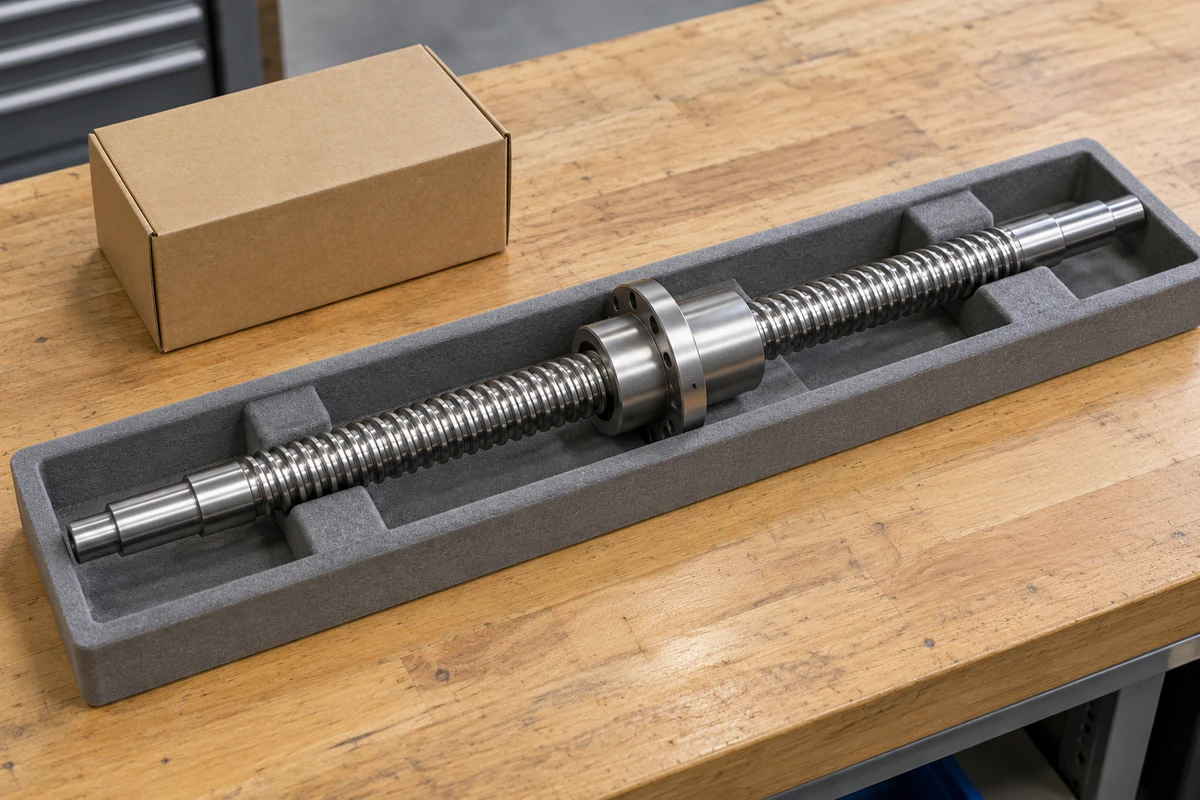
Before asking suppliers for a replacement CNC ballscrew nut on its own, establish whether the identified product family is supplied that way. A request for loose nuts and a request for nut-and-shaft sets describe different purchases. Comparing their unit prices without resolving that boundary can make an incomplete offer appear attractive and make spare coverage look larger than it is.
The decision starts with the installed maker and family, then the manufacturer’s applicable supply rule. Dimensions and machine interfaces still matter once the proposed scope is defined, but they cannot establish that a nut is available separately. This guide addresses replenishment scope, not diagnosis or a nut replacement procedure.
Identify the assembly behind the spare request
Retrieve the machine and axis reference, the manufacturer’s complete ballscrew designation and the existing assembly record. Use the original parts list, prior order, approved drawing or a manufacturer identification response where available. Keep the source attached to the designation so the supplier can distinguish a verified identity from a historical stores description.
A label such as “ballscrew nut, same as before” can outlive a machine modification or refer to several assemblies. Ask which installed assembly the request now covers and whether the earlier purchase supplied a nut alone or an entire set. Preserve the original delivered contents rather than inferring them from a shortened invoice title.
If the family remains uncertain, request identification support before presenting a nut-only quantity as a settled order. A nominal diameter and lead can help describe the inquiry, but should not be used to classify a product as rolled or precision without an applicable record. Photographs and accessible markings are starting evidence, not authority to dismantle an assembly for purchasing purposes.
Use THK’s supply distinction within its own scope
THK’s FAQ states that its rolled ballscrew nuts can be purchased individually, while its precision ballscrews must be purchased as a nut-and-shaft set. This is a manufacturer-specific supply distinction that changes the unit the buyer should request. THK replacement ballscrew nut FAQ
For an identified THK assembly, ask the relevant supplier to confirm which documented family and supply scope apply to the inquiry. For another manufacturer, obtain that manufacturer’s own answer. Do not turn the THK statement into a rule that every rolled nut on the market is separately available or every precision product from every maker has identical commercial terms.
Separate availability in principle from an actual offer. A standalone-sale route does not establish current stock, price, lead time or the contents of a particular seller’s package. Ask for those details after the exact item and supply unit have been identified, and preserve anything still unconfirmed.
A separately sold nut leaves a retained-shaft question
If a nut-only proposal is available, it leaves the existing shaft in the planned assembly. The technical owner must determine whether that retained shaft and the proposed nut are appropriate for the intended requirement. The purchasing coordinator should identify who owns that decision and what evidence the reviewer requires, without pretending to assess wear or diagnose an axis fault.
Ask the supplier to name the exact proposed nut, the existing shaft reference it assumes and the applicable product documentation. A standalone product listing answers what the seller offers; it does not establish suitability for a particular used shaft. Keep any third-party alternative explicitly identified rather than presenting it as the original maker’s supported spare.
Where technical review is still open, leave the purchase conditional on the actual decision. Do not describe the nut as a cure for backlash, noise or another reported symptom. Buying a replacement component does not establish the cause of the reported problem, and this article supplies no removal, insertion or temporary-shaft instructions.
Compare set offers by what they contain
When the required scope is a nut-and-shaft set, ask the seller to identify both components and the assembly reference in one offer. Record the complete delivered contents and any separately quoted work or accessories. A photograph containing supports, a housing and a coupling does not establish that those parts are included.
A set requirement still leaves machine-interface questions. Have the responsible reviewer determine the applicable shaft, nut, end configuration and drawing references. Keep that dimensional review separate from the present supply-unit decision: receiving a complete set does not by itself establish that it fits the machine.
For the commercial comparison, align the quoted unit before comparing totals. One nut, one nut-and-shaft set and one larger axis package should retain different descriptions. Ask a seller using “set” to itemize its contents, and ask whether its offer answers the requested assembly or proposes a different scope. A lower price for fewer components is a different offer, not necessarily a saving against the same requirement.
Revise a fictional loose-nut request
Imagine a fictional buyer copies a historical request for several loose ballscrew nuts. Its records later show that the affected machines include identified THK rolled and precision assemblies. No actual quantity, part code, failure assessment or supplier quote is represented.
The purchaser divides the inquiry by assembly family before seeking a combined price. For the documented rolled applications, it asks for the exact separately offered nut and records the unresolved retained-shaft assessment. For the documented precision applications, it requests the applicable nut-and-shaft set scope under the cited manufacturer guidance.
Suppose a marketplace reply offers a generic loose nut for all lines because their nominal sizes look similar. Keep that as a seller proposal requiring identification and supporting evidence. It does not replace the family-specific supply question or establish an exception to the manufacturer’s statement.
Now suppose another supplier quotes complete sets for every line. That proposal may be worth considering, but the rolled-family request has changed scope. Ask the buyer’s technical and commercial owners whether the larger replacement is wanted and request its exact contents and interface evidence. Do not accept the enlargement simply to make all rows use the same ordering unit.
The revised inquiry can therefore contain different supply units and different outstanding reviews. Its success is that each line describes a real purchase question. It does not claim that any particular nut can be fitted or that buying a complete set will restore the machine.
Count spare coverage in the required supply unit
Keep physical stock and supported replacement coverage separate. A loose nut on a shelf should not be counted as one available nut-and-shaft set, and an unidentified set should not be assigned to an axis solely because its nut resembles the installed part. Retain the assembly identity, delivered contents and application review with the stock record.
For a nut-only line, record the nut identity and the particular application evidence that supports its intended use. For a set line, record the set identity and the contents that make up that supplied unit. If a shaft or another required item is missing, describe the incomplete stock as it is rather than calling it a ready spare.
| Purchase field | Decision it supports |
|---|---|
| Machine, axis and assembly reference | Identifies the demand being replenished |
| Maker and complete family | Locates the applicable supply rule |
| Nut-only or nut-and-shaft scope | Defines the unit to request and compare |
| Proposed contents and exact identifiers | Shows what the seller will actually supply |
| Retained-shaft review, when applicable | Keeps the technical decision visible |
| Current quantity, price and timing | Records the actual commercial offer |
| Stock identity and covered application | Prevents incomplete or unrelated items from becoming claimed coverage |
Request the right proposal before repeating the order
Send the identified assembly reference and ask the supplier to state whether its proposal supplies a nut alone, a nut-and-shaft set or a larger alternative. Require differences and exclusions to be explicit. Preserve the accepted contents with the order so the next purchaser does not have to reconstruct the supply boundary from a thumbnail.
Our independent buying-agent role is to obtain supplier details and coordinate a reviewable purchasing scope. See CNC linear-motion components, then start a CNC quote request with the known assembly identity, product link or existing identification images. Arrange drawings and other technical files through a separately authorized exchange. Technical assessment, service and release for use require their own qualified scope.
Frequently asked questions
Can I order only the ballscrew nut?
It depends on the identified maker and family. THK states that its rolled nuts can be bought individually while its precision ballscrews require a nut-and-shaft set. Ask for the applicable rule and exact proposal for the actual assembly.
Does THK’s rule apply to other brands?
Do not generalize it. Obtain the other manufacturer’s applicable supply statement and a current seller offer, retaining any family or product qualifications.
Does standalone nut availability prove it suits the old shaft?
No. Identify the exact proposed nut and retained shaft, and have the responsible technical reviewer assess the actual requirement. This purchasing guide does not diagnose shaft condition or provide a replacement procedure.
Can loose nuts count as available nut-and-shaft sets?
Keep them in their actual stock unit. A loose nut is not a complete set, and spare coverage also needs the correct assembly identity, delivered contents and applicable technical review.
Sources
Discuss a sourcing request related to this article.Can You Reorder Just the CNC Ballscrew Nut? Check the Supply Boundary