
Buy a Clamping Kit by Table and Thread Interfaces
Compare clamping kits by table geometry, stud thread and component identities rather than relying on the advertised number of pieces.
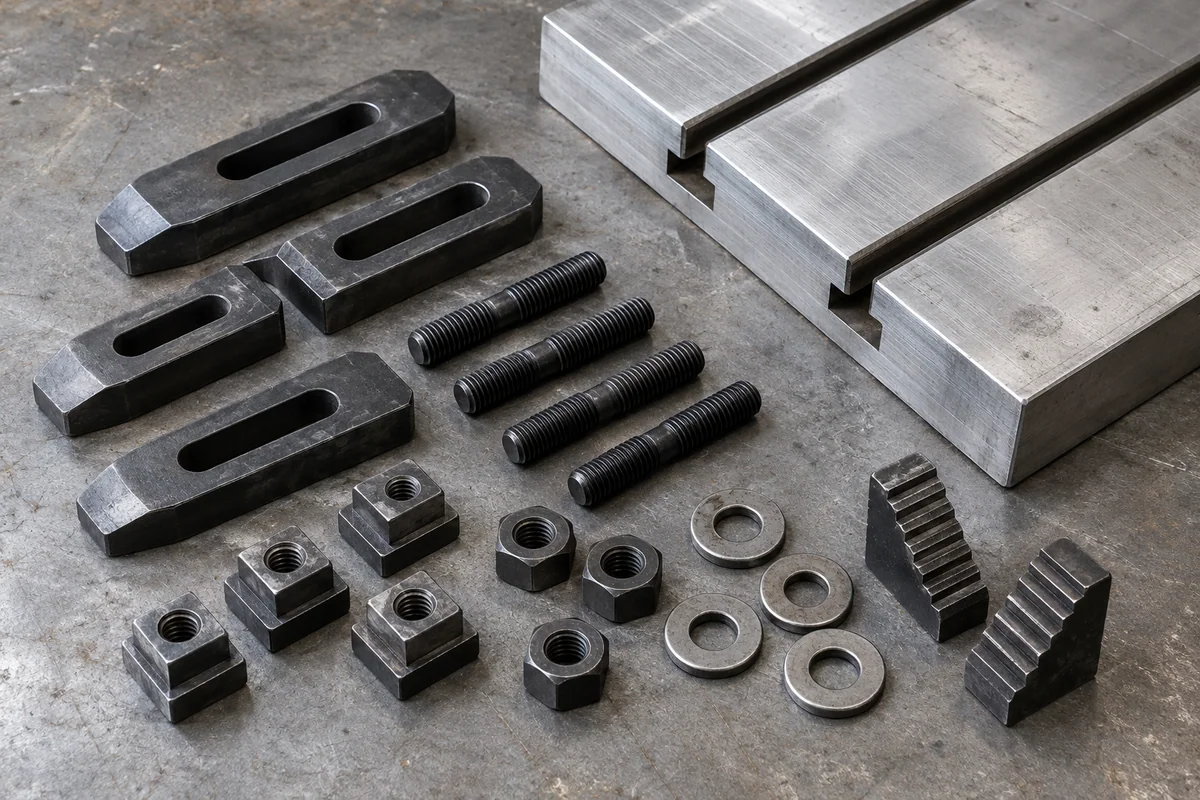
A clamping-kit piece count tells you how many items a seller says are included. It does not tell you whether the T-nuts belong in your table slots, whether every threaded component uses the required thread, or whether the assortment answers the planned purchase. Those are the questions to settle before comparing kits by price.
For a CNC clamp-kit RFQ, start with the table interface and follow the hardware through the set. The purchase decision is which documented components match that interface. Approval of the actual workholding arrangement, cutting loads and part access remains a separate technical decision.
Identify the surface the kit will attach to
State whether the kit is for the machine’s original table or a specified fixture plate mounted on that table. Give the relevant machine or plate model and drawing. A photograph of the whole machine is useful context, but the purchasing interface is the surface that receives the hardware.
For a slotted table, request its documented slot geometry and compatible hardware requirements. The opening visible from above is not a complete cross-sectional drawing. If only a nominal slot width is known, ask what evidence is needed to identify the rest of the interface. Do not silently fill missing dimensions from a similar machine.
For a threaded fixture plate, use its released thread designation, pattern and any applicable mounting requirements. Do not combine a plate’s threaded-hole specification with a T-slot kit description and call the result “table compatible.” Have the supplier explain which components it proposes for the actual interface.
Separate table size from stud thread
Carr Lane’s standard step-block kit tables place stud size, table-slot size and component identifiers in separate columns. The metric table also states thread pitch. Its inch-threaded CL-20-CK row lists a 12 mm table slot alongside a 3/8-16 stud; the metric CLM-1-CK row lists a 12 mm slot with an M10, 1.5 mm-pitch stud. This manufacturer example shows why a metric slot label alone does not identify the kit’s thread system. Carr Lane standard step-block kits.
Use that distinction in the RFQ without treating those products as recommendations for your machine. Ask the seller to state the actual stud thread, including pitch or threads per inch and units, plus the matching nut identifiers. “Metric kit” and “for small CNC” are not adequate substitutes.
Where existing hardware must be retained, list it by documented specification. A buyer may want new clamps to share a known set of studs, or may instead want an entirely separate set. Tell the supplier which situation applies. Otherwise, a complete replacement kit can be quoted when the intended purchase was a compatible addition.
Follow the hardware through the set
Request a component list before evaluating the advertised total. Group items by function and require identifiers or drawings for the interfaces that matter. The list should let the buyer determine whether the proposed package contains the requested assortment without turning the piece count into a safety claim.
| Component group | Ask the seller to identify | What an incomplete answer leaves open |
|---|---|---|
| T-nuts or table fasteners | Exact model, table-interface drawing and thread | Whether the hardware corresponds to the documented table |
| Studs | Thread designation, lengths and quantities by identifier | Whether the required assortment and thread are supplied |
| Nuts and washers | Model and matching thread or relevant interface | Whether the quoted components belong to the same specified set |
| Clamp straps | Exact models, outlines and component quantities | Whether the requested clamp assortment is included |
| Step blocks or support components | Models and manufacturer’s intended combinations | Whether the seller has substituted a different component family |
| Storage and extras | Explicit inclusion and counting basis | Whether accessories inflate a comparison of usable hardware |
Do not infer a material grade, heat treatment or load rating from color, surface finish or a seller’s product photograph. If a technical property is required, ask the responsible reviewer to specify the needed evidence and have the supplier identify the exact product documentation. Another manufacturer’s published property does not transfer to an unbranded kit.
A fictional 58-piece kit versus a smaller set
Imagine a fictional buyer needs a clamp assortment for a documented T-slot table and intends to keep an existing, identified stud thread. Offer A advertises 58 pieces, but neither the thread designation nor the T-nut drawing is supplied. Offer B contains 42 pieces and provides a component list with the requested thread and a proposed table interface.
The correct conclusion is not that B is automatically better or approved. A is missing information needed to compare it. B can move to a specific interface review. The reviewer may still find that B’s T-nut geometry does not correspond to the table or that its assortment does not answer the buyer’s requested hardware list.
Suppose A later supplies its documents and reveals a different thread system. Mark it as an alternative full-set proposal rather than mixing its nuts into the retained hardware plan. Suppose B’s table-interface drawing is accepted but its quote omits some requested stud lengths. Ask B to revise the supply list, then compare the documented packages again.
All quantities and offers in this example are invented. The example illustrates a purchase decision, not the number of clamps needed to hold a workpiece or the suitability of any machining setup.
Keep kit acceptance separate from setup approval
The dimensional purchasing review should identify the correct table interface and included components. A competent workholding reviewer must separately determine whether the actual arrangement is appropriate for the part and intended operation. A kit that matches the table is not a universal holding solution.
Give the technical reviewer the workpiece and process context through an agreed technical-file exchange. Let that reviewer specify the necessary arrangement and assessment. This article supplies no tightening values, force calculation, clamp placement rule or instructions for adapting an incompatible T-nut.
The distinction matters when a seller answers “fits all machines.” Ask which specific table drawing and product documentation support that response. If the seller cannot identify them, keep the suitability question open. A broad statement should not become a substitute for the missing interface evidence.
Order the component list you reviewed
The approval record should name the kit variant and the components that distinguish it: table-interface hardware, thread system, stud assortment and clamp/support models. Ask the supplier to list any exclusions or substitutions before purchase. An unchanged marketplace title does not make a changed component list acceptable.
At receipt, photographs and counts can help establish which labelled items arrived and whether damage is apparent. They cannot establish holding capability, thread conformity or material properties. If the buyer needs measurements or technical testing, agree the work, responsible provider and acceptance basis separately.
Send an interface-first inquiry
A focused request reads: “Please quote the listed clamping components for our identified table or fixture-plate interface. Confirm the exact T-nut or table-fastener model, stud thread including pitch, matching nuts and the quantity of each length and clamp/support model. We intend to retain the specified existing hardware. Identify every difference rather than substituting another kit with the same advertised piece count.”
Use the CNC workholding category for sourcing context and the CNC quote form for the initial request. We act as an independent equipment-and-parts buying agent; any workholding evaluation must be separately defined with a responsible technical reviewer.
The form accepts up to five PNG, JPEG, WebP or GIF images, no more than 10 MiB each and 20 MiB total. Send a listing, description or useful reference images there. Arrange an authorized separate exchange for PDFs, CAD or other technical files so the reviewed table specification remains clear.
Frequently asked questions
Does a metric table-slot size mean the kit has metric threads?
No. Table-slot size and thread designation are separate fields. Confirm the exact stud thread and matching hardware in the selected kit.
Is a larger clamping kit a better purchase?
Only if its documented contents answer your requirement. Compare the table-interface hardware, thread system and component assortment before comparing piece counts.
Can a correctly sized kit prove the part will be held securely?
No. Matching the procurement interfaces does not approve the workholding arrangement. The actual part, loads and operation require competent review.
Can I send a photograph of my table for identification?
Yes, as initial reference evidence within the form’s image limits. A photograph alone may not resolve slot geometry or thread details; obtain the relevant drawing or a separately agreed technical review.
Sources
Discuss a sourcing request related to this article.Buy a Clamping Kit by Table and Thread Interfaces