
Preserve the Hours and Calendar Basis in CNC Vacuum-Pump Handover
Low displayed hours do not settle the service history of a used clamping pump. Keep each obligation’s actual scope and baseline separate through the transfer.
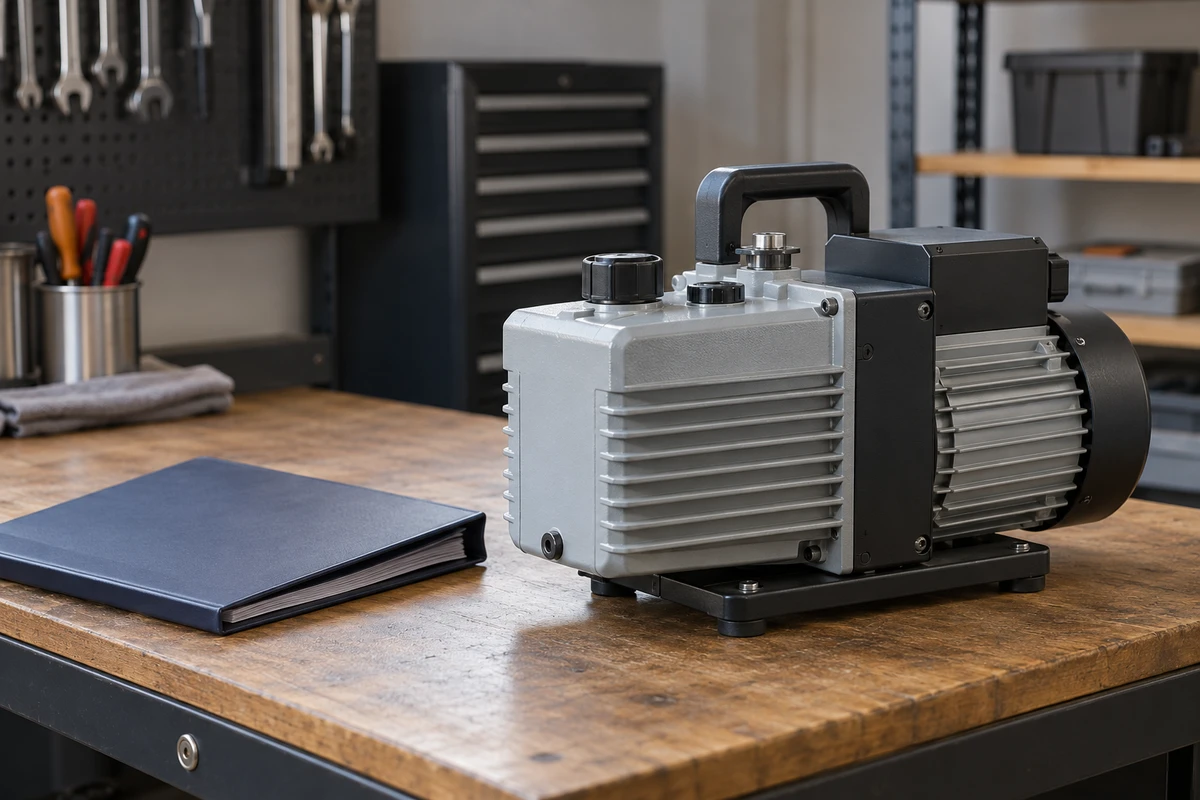
A low hour display on a used CNC clamping pump does not, by itself, establish the remaining allowance for a service item governed by both operating hours and elapsed calendar time. The handover needs the last attributable completion event and the relevant meter history for that particular obligation.
The buyer’s decision is whether the receiving service owner has a supported basis for determining the next action. It is not a calculation of a universal maintenance interval, a pump-selection recommendation or a claim that the unit is overdue or ready for use. No actual pump history is assessed here.
Anchor the review to the exact pump
Record the full model, available unit identity, installation association and applicable manual revision. Broad family branding is insufficient for choosing a service row. Ask the qualified owner to identify the document governing the supplied unit rather than copying a schedule from a visually similar pump.
Busch’s CNC application page identifies its R5 rotary-vane family among products used for clamping. That establishes the relevance of the product family to this discussion only. It does not establish a particular unit’s suitability, holding capability or service condition. Busch vacuum technology for CNC
Keep intended use separate from historical use. If the seller knows only the most recent installation, record the period covered by its answer. The qualified service owner needs the actual disclosed conditions, including uncertainty, rather than an application description inferred from the current advertisement.
Attach both clocks to the source row that actually uses them
In Busch’s R5 RA 0025/0040/0063/0100 F manual, document 0870209168, issue A0006_en-US dated 13 March 2024, section 8.1 contains an oil, oil-filter and exhaust-filter service row with hour and calendar limits. Normal versus harsh application and the lubricant footnote qualify the schedule. Other rows have their own calendar or installed-option conditions. The combined clocks therefore should not be imposed on every pump-maintenance task. Busch R5 RA F instruction manual, maintenance schedule
Ask the service owner to identify the applicable row and explain its conditions for this pump. Retain that determination rather than reproducing interval values in a general purchasing worksheet. A manufacturer schedule gives a basis for qualified interpretation; a displayed hour count alone cannot resolve the row’s calendar history.
Keep lubricant qualification and installed-option identity as inputs to the applicable task. An unknown oil product or unconfirmed option should remain an unanswered source-condition question, not become a guessed schedule classification.
Establish a separate baseline for each actual task scope
For each relevant obligation, request the last attributable completion date, the actual work scope and any hour reading recorded at that event. Identify the provider and the record that supports the entry. “Serviced recently” is too broad when the next decision depends on which service row was completed.
A visit covering one item should not reset unrelated tasks. If an invoice lists only part of a combined service scope, ask the provider what the associated work record establishes. Do not infer the omitted work from the fact that a technician attended or that a general service charge was paid.
Preserve partial evidence precisely. A dated record may establish when an identified task occurred while supplying no attributable meter reading. A photograph of a meter may identify a reading without linking it to any service event. Those are different gaps, and the receiving owner should be able to see each one.
Keep meter provenance and elapsed calendar history separate
Request the current meter identity and attributable readout record where available. Ask whether the provided history includes a changed or reset meter, unknown periods or a reading whose association to the pump is unconfirmed. Record the source of the answer instead of treating the display as a complete lifetime history.
Maintain the calendar event history independently. A pump can change custody or spend time in storage without a documented service event occurring. Purchase, shipment and arrival should not silently become a new baseline date.
Where the history cannot be established, request the service owner’s assessment of the usable basis and the next authorized scope. The buyer should not manufacture a fresh full interval or calculate an overdue verdict from incomplete records. Those conclusions require the responsible provider’s actual determination.
Resolve a fictional low-hour offer
Imagine a fictional used clamping pump advertised with a low displayed hour count. The seller supplies an exterior photo and says it was “serviced,” but no dated record identifies the oil/filter work or the reading associated with it.
The buyer records the displayed reading with its stated source and leaves the service baseline unresolved. It asks for the exact model/manual association, last attributable task scope and date, supporting meter history and the provider’s next-action basis. A clean exterior does not fill any of those fields.
Suppose the seller later produces an invoice for an unrelated inspection visit. That is useful history, but it does not establish completion of the oil/filter obligation. Keep the visit at its documented scope and request the missing service record rather than updating every task to that invoice date.
Alternatively, a qualified provider may review the incomplete history and propose a defined assessment or service scope. The buyer can consider that proposal under the actual commercial arrangement. It should not rewrite the unknown past as newly proven, or describe proposed work as completed before its evidence is received.
Transfer a supported basis rather than a new “day zero”
The closeout should identify each relevant service obligation, its governing row, actual baseline evidence, unresolved meter or calendar history and the qualified owner’s stated next action. Keep any task-specific due determination with the evidence and conditions supporting it.
This preserves continuity when custody changes. It does not establish that every maintenance item shares the same clocks or that one service visit renews the whole pump. Pump suitability, process-history declarations, transport admission and operational approval remain separate decisions.
Buyer document-review worksheet
This original worksheet organizes the provider’s evidence. It is not a manufacturer form or a technical work instruction. Keep the original source reference beside each answer.
| Field | Answer to obtain |
|---|---|
| Exact model and manual revision | Exact supplied unit and governing document issue |
| Applicable service obligation and source row; separate baseline for each task scope | Actual governing row and its own task-specific baseline |
| Actual last-service scope/date | Attributable completion event and precise work coverage |
| Hour reading and attribution at service | Record tying the reading to that event |
| Current meter identity/readout record | Source, date and association of the present reading |
| Unknown or reset history | Known changes and periods the records cannot establish |
| Application and oil qualification | Qualified determination of applicable source conditions |
| Installed options | Options relevant to the particular obligation |
| Qualified next-action basis | Provider-supported action or due determination with limits |
Bring the precise gap into the inquiry
For broader product context, see CNC workholding. As an independent buying agent, we can coordinate supplier questions within an agreed purchasing scope. Specialist work, its availability and its approval require the responsible qualified provider.
Start a CNC quote request with a supported listing link, description or permitted product images. Arrange manuals, drawings, data files and service records through a separately authorized exchange; the form’s image field is not a technical-file upload channel.
Frequently asked questions
Do low displayed hours prove that a used vacuum pump has a full service allowance left?
No. Ask for the identified obligation’s actual service scope, completion date and attributable meter history. A display alone cannot settle missing calendar history or establish what work was completed.
Does every task in the cited Busch schedule have both an hour and calendar limit?
No. The combined-clock example is the cited oil/oil-filter/exhaust-filter row. Other tasks have their own conditions, so the qualified owner must identify the applicable source row for each obligation.
Does one service invoice reset all maintenance baselines?
Only the work actually evidenced should affect its corresponding record. If the invoice or completion report covers a limited scope, keep other task baselines unchanged or unresolved and ask the provider to clarify the coverage.
What if the pump’s meter was changed or its earlier history is unknown?
Label the change or gap explicitly and preserve the attributable readings that remain available. Request the qualified service owner’s next-action basis rather than inventing lifetime hours, a new starting date or an overdue conclusion.
Sources
Discuss a sourcing request related to this article.Preserve the Hours and Calendar Basis in CNC Vacuum-Pump Handover