
Spindle Packaging: Separate Opening Protection and Support
Review spindle closures and packing contacts separately before accepting a changed insert, carton or accessory arrangement.
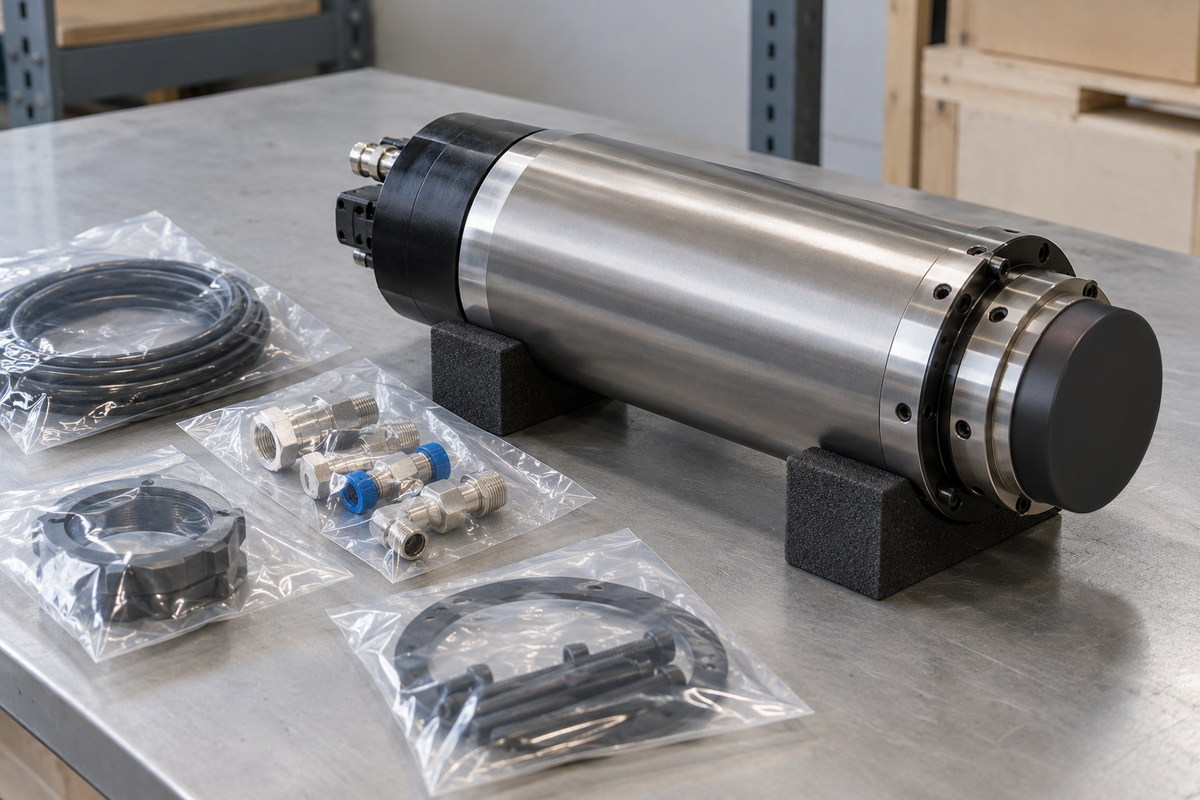
A spindle packing proposal needs separate answers for protected openings and mechanical support. Identify what each supplied closure is intended to protect, then ask the responsible provider to identify the approved packing contacts. A capped connection in a photograph does not establish that the connection can serve as a support or restraint.
This matters when a seller consolidates an already selected spindle into a different carton or insert. The spindle reference may stay unchanged while the proposed package introduces a new contact beside a coolant fitting, pneumatic connection or electrical connector. The buying decision is whether that specific arrangement has an adequate approval basis. The review below is an original editorial method for organizing the question, not a physical packing design.
Start with the spindle configuration that will enter the pack
Use the exact purchased spindle reference and applicable maker drawing. Identify the supplied configuration, including which connection features remain attached and which accessories arrive separately. A family brochure can help locate the product, but the pack provider needs the configuration represented by the actual proposal.
Ask the seller to mark any difference from the maker’s supplied packaging: a replacement insert, removed outer case, relocated accessory or changed position of an attached fitting. These are proposed changes until the relevant approval is recorded. Avoid treating a picture of a similar spindle as the baseline for the purchased unit.
Keep the drawings in their original roles. A product drawing identifies geometry. A connection drawing identifies an interface. A machine-mounting drawing concerns installation. Ask which document actually authorizes the proposed transport support; do not silently give every drawing the same authority.
Establish the intended job of each closure
The SPINOGY X22 operating manual identifies sealing plugs that protect its pneumatic and coolant connections from contamination and damage during transport. This is a product-specific statement of protective purpose. It provides no basis for treating those plugs as an approved packing support on another spindle or for assigning them an invented load capacity. SPINOGY X22 operating manual, printed page 58
For the selected product, ask the maker or authorized supplier to identify the required supplied closures and the openings they correspond to. Use its terminology rather than calling every visible cover a dust cap. If the proposal omits an identified closure or substitutes another item, record that exact difference for a response.
A photo can show that something covers an opening. The buyer still needs an attributable reference for what it is and whether it belongs in the proposed delivered state. Do not choose a cap, sealing material or fastening method from appearance. Where the closure identity is unknown, leave that protection question unresolved.
Obtain support authority independently
Ask the packaging provider to identify each intended contact or restraint region in a reviewable view and cite the product-specific basis it is using. Have the spindle maker or responsible qualified packing engineer address any uncertain region. The question is which interface is permitted for the proposed packing function, not whether a feature looks sturdy.
Be precise when a proposed insert appears close to a closure. Does the view show deliberate clearance, simple proximity, or intended contact? If it does not say, ask. Do not estimate a gap from the image, assume an obscured contact is absent, or assign a support role to a threaded connection because it seems convenient.
The response should distinguish closure approval from support approval. A maker may identify the correct supplied plug without having reviewed the new insert. A packaging provider may describe its insert without establishing permission to act on a particular spindle feature. Keep both questions open until the appropriate evidence covers the actual relationship.
Review consolidation changes at the affected interface
A useful comparison starts with the proposed change rather than a request for a larger gallery of packing photographs. If an accessory moves beside a connection, ask how the revised proposal addresses that relationship. If the spindle changes position within a new insert, ask whether the previously identified support references still apply.
The X22 manual separately addresses transport, packaging and storage, and recommends retaining its packaging, if possible, for storage or return. That is a named manufacturer’s recommendation for the documented product, not proof that a substitute carton or reused insert is suitable for any spindle. SPINOGY X22 operating manual, printed page 13
For an actual purchase, establish whether the applicable maker instructions permit the proposed change and which provider owns its review. Retaining an original case as a delivered item is a related purchasing question. This article’s narrower decision concerns the openings and contacts in the configuration proposed for dispatch.
A fictional capped connection beside a foam insert
Imagine a fictional seller proposes a smaller carton for an already approved spindle. The drawing shows the spindle body in a foam insert, a capped connection near the insert’s edge and separately bagged fittings in an adjacent compartment. The seller says that all openings are covered. No real spindle, approved design or test result is represented here.
The statement answers only part of the buyer’s question. Ask the seller to identify the closures from the applicable spindle documentation. Separately ask whether the insert contacts the capped connection, whether that contact is intended, and who can approve it. The image alone leaves the support relationship unresolved.
Suppose the seller replies that the cap is the original supplied part. Record that supported identity without closing the insert question. If a revised view later identifies the intended body contacts and the responsible reviewer confirms their applicability to that exact configuration, retain that evidence with the packing proposal. The buyer has resolved a specific document gap; no transport-performance result has been created by the exchange.
If the provider cannot explain the contact, keep the changed proposal unapproved and request a supported alternative. Do not design a replacement foam shape, choose an orientation or calculate a permissible force. Those decisions remain with the appropriate technical provider.
Close the review with two traceable decisions
Build a short opening-and-support record. Its structure is an editorial aid, not a manufacturer checklist:
- Identify the exact spindle and drawing revision used in the packing proposal
- Match each documented opening to the provider-confirmed closure or stated unresolved item
- Reference the view showing intended support and restraint contacts
- Record the source and responsible reviewer for the permitted packing interfaces
- List attached and separately supplied fittings affected by consolidation
- State which proposal revision is accepted for the documented scope and what remains open
Avoid a single “caps fitted, packing approved” entry. It merges two decisions that may have different evidence and different owners. Likewise, approval of contact locations does not establish closure completeness or replace any separately required packaging evaluation.
Send a question the responsible provider can answer
An independent buying agent can coordinate the spindle documents, supplier replies and packing proposal for buyer review. Technical approval belongs to the responsible maker or qualified provider. Broader component selection belongs in the CNC router spindles category.
Start through the CNC quote form with a supported listing link, description or images identifying the proposed change. The image field accepts up to five PNG, JPEG, WebP or GIF files, each at most 10 MiB and no more than 20 MiB in total. Arrange manuals, drawings and other technical files through a separately authorized exchange; the image field does not accept PDF, CAD or ZIP files.
Frequently asked questions
Does an original spindle cap also authorize packing support?
Its identity establishes which part is present. Obtain a separate product-specific basis for any proposed packing contact or restraint; do not infer that authority from the cap’s protective purpose.
Can a mounting drawing approve a spindle transport insert?
Ask the responsible reviewer whether that drawing applies to the proposed transport function. An installation interface reference should not silently become permission for a different packing use.
What if a photograph hides the contact beside a connector?
Request evidence that answers that exact relationship, such as a provider-identified view and an attributable explanation. Keep the contact unresolved rather than estimating clearance or assuming no contact.
Who should resolve a proposed substitute closure?
The spindle maker or appropriately authorized provider should identify the supported closure for the exact supplied state. The buyer or buying agent records the answer without selecting a seal or fabrication method.
Sources
Discuss a sourcing request related to this article.Spindle Packaging: Separate Opening Protection and Support