
Reorder Soft-Jaw Blanks by Complete Set and Job Need
Separate blank soft-jaw sets from job-machined jaws, then compare the complete usable set and any separately quoted preparation.
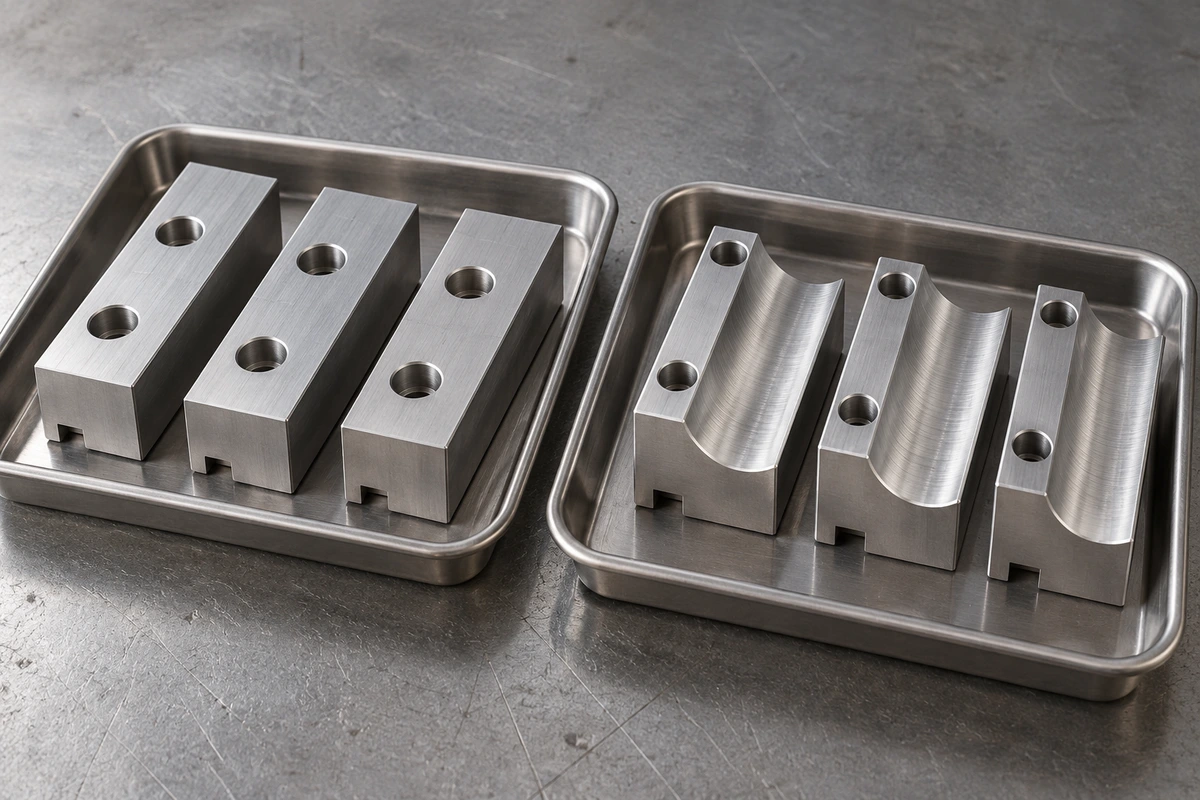
A shelf of soft jaws can contain substantial metal without containing the blank sets needed for the next job. Some jaws are unprepared blanks; others have already been made specific to a workpiece. Before reordering, separate those two demands. The buyer is usually deciding what jaw supply and preparation to purchase while retaining the existing approved chuck, rather than shopping for another complete workholding assembly.
Start with the technical owner’s defined requirement for the identified chuck and job. This article does not decide whether a jaw can be reused, remachined or mixed with another piece, and it supplies no clamping or machining procedure.
Give blank stock and prepared stock different meanings
SCHUNK’s soft top-jaw category describes jaws that can be individually modified for a required clamping diameter. It also gives different set quantities: three pieces for standard delivery, two for specified two-jaw variants and four for identified four-jaw variants. We reviewed the manufacturer’s page on 13 October 2026.
That product mechanism creates two purchasing questions. A new blank set provides material for an authorized preparation process. An existing job-machined set has a particular preparation history and accepted application. Those are different starting points even when the catalogue reference was originally the same.
Keep the original jaw designation and the prepared-job identity together. If an existing set is accepted for a repeat job, it can be considered against that repeat requirement under its actual approval. It should not simultaneously reduce an unrelated requirement for unmachined blanks. Nor should a prepared set be written off simply because another job needs new blanks.
Count complete sets before counting loose pieces
Ask the technical owner to express demand as complete sets for the relevant chuck or job. Then obtain the supplier’s actual delivery-unit definition. The word “set” can conceal a quantity error if the purchasing system assumes every set has three pieces.
For a quoted three-piece set, two sets contain six pieces. That statement is only a unit conversion. Six unassociated jaws already in stores do not automatically become two usable sets. Their identities, condition and permitted grouping must be supported by the applicable records and technical decision.
Keep incomplete groups visible as incomplete stock. Record what is missing and what further identification could resolve, without instructing stores to assemble a set from similar-looking pieces. A purchasing shortage should not become an improvised workholding decision.
Compare preparation-inclusive outcomes
A blank-set quote and a prepared-jaw quote have different delivery boundaries. Ask the prepared-jaw supplier to identify the relevant job specification, what preparation and documentation are included, and what remains for the buyer’s technical provider. Do not assume that a higher price includes a fully accepted workholding result.
For the blank route, obtain any required qualified preparation as its own actual offer. Compare the blank purchase, attributable delivery and agreed preparation charges with the other proposal on the same stated scope. If preparation is not yet priced, retain an open cost rather than setting it to zero.
The retained chuck matters to this comparison. If the approved requirement is solely for jaws, the whole-chuck price answers a different question. A complete-chuck alternative belongs in the review only when the technical owner has defined why it is relevant. A shortage of blank sets alone does not establish that the chuck needs replacement.
Also distinguish repeated-job value from general stock value. A prepared set kept for a supported recurring job may avoid a future preparation purchase, but only within its actual accepted scope. Do not assign that value to every future job or assume unlimited remachining will preserve it.
A fictional shelf with no free blank set
Suppose a fictional store contains one documented prepared set reserved for a repeat job, one unused approved blank set and several loose jaws with unresolved grouping. A new authorized requirement calls for two blank sets for separately planned preparation. The required delivery unit has already been confirmed for that chuck.
The prepared set remains connected to its repeat job. The loose pieces stay visible as unresolved stock. Under these assumptions, one blank set can cover part of the new requirement and one additional blank set remains to be purchased. The example does not authorize borrowing the prepared set or combining loose pieces.
Now suppose the technical owner instead requests a complete prepared set for the new job from a qualified provider. The buyer should obtain that actual offer and compare its boundary with the blank-plus-preparation route. A quote for “one jaw” would not answer either requirement until the seller clarifies whether it means a piece or a complete set.
Preserve what the buyer actually received
The accepted order should identify the jaw series, complete-set quantity, pieces per supplied set, blank or prepared state and any job-specific deliverable. Connect the received package identity to that order without claiming that a package count proves workholding suitability.
Keep later preparation records attached to the same set history. When a set moves from blank stock to a specific job, update its purchasing identity so it is not offered again as untouched stock. This is a record of the actual transition, not a prescription for physical storage, machining or installation.
Request the defined replacement supply
As an independent buying agent, we can organize supplier offers and purchasing questions within an agreed scope. Technical suitability and any physical preparation or service remain with the responsible qualified provider. See Small metal lathes, then start a CNC quote request with the product link, description or existing identification images. Arrange technical documents through a separately authorized exchange.
Frequently asked questions
Does every soft-jaw set contain three pieces?
No. SCHUNK lists three-piece standard sets as well as identified two- and four-piece variants. Confirm the exact series and quoted delivery unit.
Can prepared jaws reduce a blank-set reorder?
Only where the technical owner has established that the identified set covers that actual requirement. Keep job-machined stock distinct from unprepared blanks.
Are enough loose jaws automatically a complete set?
No. Piece count does not establish permitted grouping or suitability. Preserve incomplete or unresolved stock separately pending the relevant technical decision.
What belongs in a blank-versus-prepared comparison?
Compare the defined complete-set supply, actual delivery charges and separately scoped qualified preparation. Keep unquoted work open rather than assuming it is included or free.
Sources
Discuss a sourcing request related to this article.Reorder Soft-Jaw Blanks by Complete Set and Job Need