
Check the Scope of a Rotary Axis Acceptance Report
Read rotary-axis acceptance evidence against the purchased positions, approach directions and fixture conditions before releasing an indexing requirement.
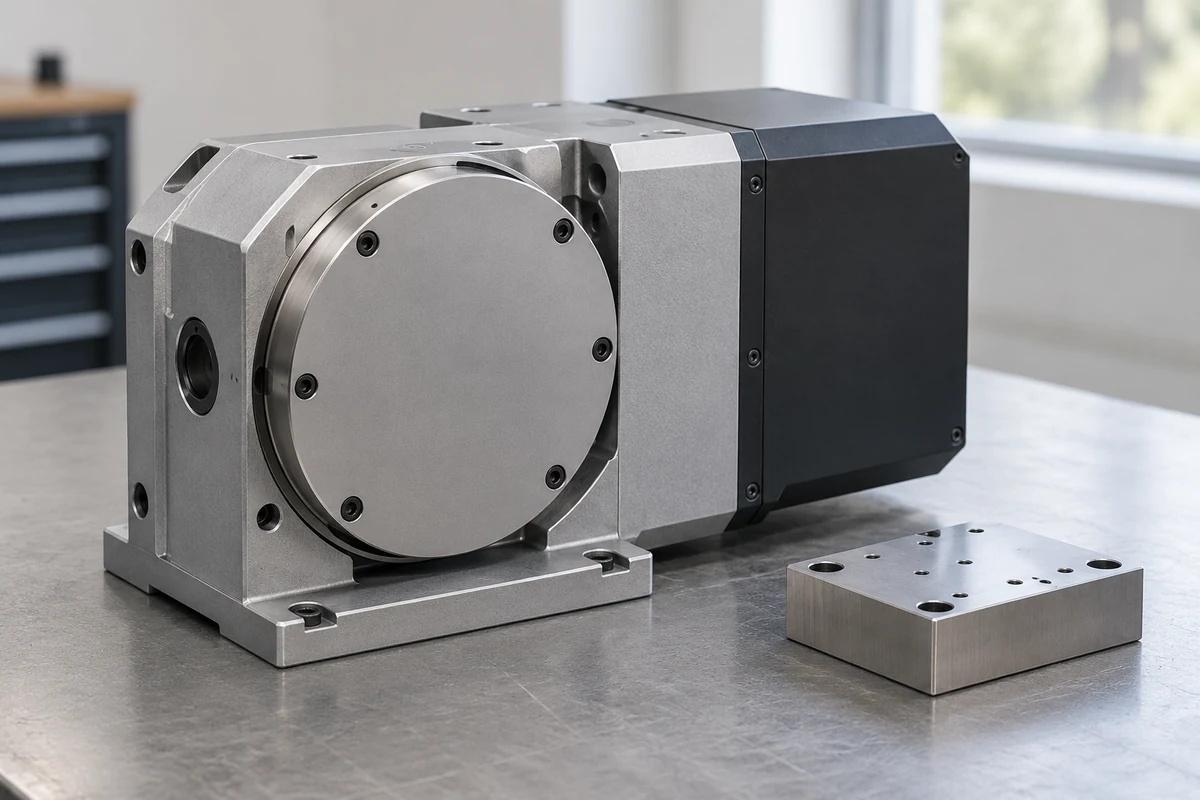
A rotary-axis acceptance report should answer the indexing requirement that was purchased. Start with the approved angular requirements, then locate the corresponding results for the delivered unit. A video of a smooth revolution can document visible motion, but it does not provide measured angular deviations at the required positions.
The immediate decision is whether the evidence supports a defined indexing acceptance, needs clarification or leaves an agreed check outstanding. This article does not select a rotary, program a motion sequence or establish an allowable angular error. Those decisions belong to the approved purchase specification and responsible technical personnel.
Separate the quantities hidden inside “accurate”
The Haas HRT160 product specification lists indexing accuracy, repeatability and resolution separately; it also gives separate backlash and runout entries. The useful lesson is the separation of quantities, not the transfer of that product’s values to another rotary. An attractive number under one heading cannot complete a different required result. Haas HRT160 specifications
In the buyer’s review, ask what each reported number represents. Does the record compare measured position with commanded position? Does it describe variation between repeated visits? Is the number merely the available command increment? Preserve the provider’s definition and analysis basis instead of relabelling every field “accuracy.” If the order uses a term differently, have the technical owner reconcile the definitions.
Renishaw also distinguishes rotary angular positioning errors from alignment errors between axes. Consequently, a report limited to angular positioning should not silently become acceptance of the complete rotary installation or finished-part geometry. Ask for separate evidence wherever the purchase includes those additional requirements. Renishaw XR20 rotary-axis calibration
Establish whose axis and which configuration were measured
Match the report to the rotary manufacturer, model, serial or other controlled unit identifier, host machine and named axis. Preserve the test date and configuration record. A family brochure describes a product range; a report on a demonstration unit describes that unit. Neither can be assigned to the delivered serial number without an attributable connection.
Record the fixture and loading basis stated by the provider, including any support arrangement relevant to the agreed assessment. Ask whether the report describes an unloaded rotary, the proposed fixture or another condition. The buyer should expose that difference to the reviewer rather than invent a numerical correction between conditions.
Retain the control configuration and compensation state identified in the report. If a later adjustment or configuration change occurred, ask which results preceded it and which followed it. Keep both sets where supplied. A corrected result is easier to interpret when its relationship to the original is explicit.
Read the position and direction coverage
Make a coverage sheet with one row for each required position or position group from the approved acceptance scope. Next to it, identify the actual reported targets, the approach directions and the repeated runs covered. Record omitted positions and runs as missing evidence, not as passing values.
Direction deserves its own field. Haas describes worm-drive backlash in relation to a change of direction in its rotary maintenance material. That supports asking how direction was represented in a report; it does not authorize applying a Haas procedure or limit to an unidentified rotary. The test provider must supply the applicable method and interpretation. Haas rotary maintenance reference
A summary graph can conceal important coverage questions. Ask whether it shows individual runs, a directional summary or an average. Renishaw’s CARTO Explore guide includes separate angular units and an option that averages angular results at each position across runs. This is a concrete reason to preserve the report’s analysis settings and request supporting data where needed. CARTO Explore user guide, printed page 10
| Review field | Evidence to locate | Question left open if absent |
|---|---|---|
| Unit and axis | Delivered identity and report reference | Was this rotary measured? |
| Required targets | Approved list and actual reported positions | Which indexing requirement is covered? |
| Direction and runs | Stated approach directions and repeat coverage | What does the summary include? |
| Conditions | Fixture, loading and configuration record | Does the evidence match the agreed basis? |
| Result definition | Units, analysis method and supporting values | Which quantity was actually reported? |
| Disposition | Reviewer decision and cited acceptance requirement | What may be released? |
This is an original editorial evidence-review sheet, not a metrology standard. Use it to expose missing information; competent personnel define the measurement method, its suitability and the acceptance decision.
Work through a fictional indexing report
Consider an invented order for rotary unit R-28. The approved scope calls for evidence at six identified index positions with both approach directions represented. The buyer receives a motion video and a one-page report naming R-28, but the report contains only three position rows and does not identify direction. All identifiers and counts in this example are fictional.
The unit-identity row has an answer. Three position rows have reported values that still need their method and direction context. The other required positions have no identifiable result. Neither the video nor the heading “rotary checked” supplies the missing angular records. The buyer’s status is incomplete indexing evidence, rather than a finding that the rotary has physically failed.
The clarification request should name those exact gaps: provide the remaining required position records, identify approach directions and repeated runs, and state the fixture and configuration used. Ask the provider whether the missing checks were performed and whether original records exist. Do not assume an omitted page is proof that work was skipped.
Suppose the provider replies that its test used only one direction and an unloaded configuration. That reply resolves what occurred but leaves a difference from the agreed scope. The responsible reviewer decides whether additional work is needed or a documented deviation is acceptable. A revised commercial agreement cannot be inferred from receipt of the explanation.
If a later report supplies the missing evidence, retain its revision and relationship to the first report. Close only the requirements that the reviewer actually accepts. The fictional case provides no angular tolerance, measured performance result or basis for certifying a machine.
Keep measurement confidence separate from a printed pass
Ask the provider to identify the measurement system, applicable calibration information, method and uncertainty treatment needed for the agreed decision. A measuring instrument’s published capability is not the measured performance of the rotary, and an instrument model name does not establish the uncertainty of this particular setup.
Where an acceptance result is disputed, send the actual requirement, report and stated conditions to the responsible metrology reviewer. Do not round a reported value until it appears acceptable, select a different unit convention or replace a result with a catalogue claim. The reviewer should explain how the evidence supports the decision under the agreed rules.
Close the indexing question without expanding the claim
The final record should identify the accepted angular requirements, evidence revision, reviewed conditions and unresolved items. Leave alignment, runout, simultaneous motion and part-production capability outside that conclusion unless their own agreed evidence has been assessed. Technical report completion also does not replace installation or safety approval.
Our role is an independent buying agent: we can request and organize supplier documents for review, while technical measurement and acceptance require an agreed competent provider. See the CNC rotary-axis category for sourcing context.
Start a CNC quote request with a supported product link, description or relevant images. The form accepts up to five PNG, JPEG, WebP or GIF images, at most 10 MiB each and 20 MiB total. Arrange report PDFs and other technical-file exchange separately through an authorized channel.
Frequently asked questions
Can a rotation video replace an angular acceptance report?
A video alone does not provide measured deviations at required positions. Match the actual unit and approved indexing scope to an attributable measurement record.
Is rotary repeatability the same report field as accuracy?
Keep the provider’s definitions separate. Ask which quantity each result represents and compare it only with the corresponding approved requirement.
Does a one-direction result cover both approach directions?
Only if the responsible reviewer has an applicable basis for that conclusion. Identify actual direction coverage and leave unsupported coverage open.
Does accepted indexing evidence prove simultaneous machining capability?
No. The indexing result covers its stated positions and conditions. Motion-mode support, alignment and part acceptance require their own evidence.
Sources
Discuss a sourcing request related to this article.Check the Scope of a Rotary Axis Acceptance Report