
Specify Both Sides of an Axis Coupling Before Ordering
Define both coupling bores, shaft connections and assembly limits before asking a supplier to propose a reviewed axis-coupling candidate.
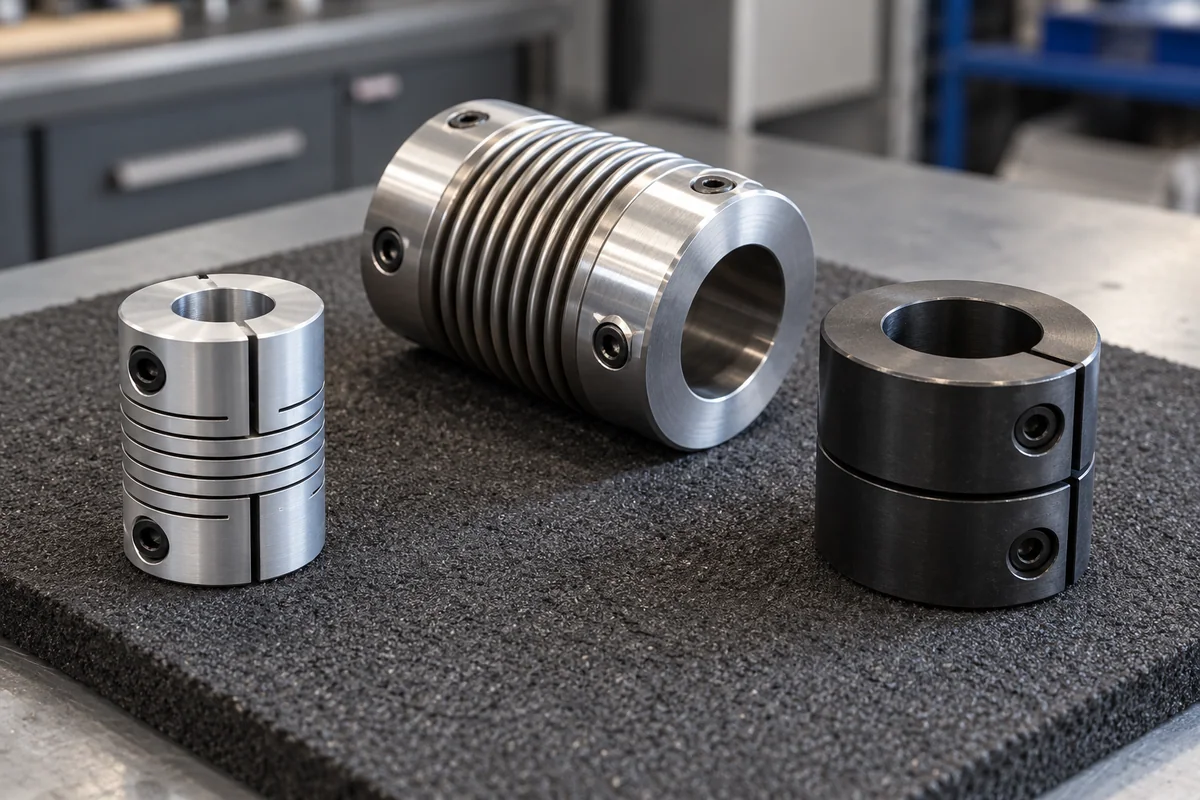
“8 mm coupling” is an incomplete purchase description when an axis connects two different shafts. It may identify only one bore, one hub in a multi-piece assembly, or one option in a listing with several variants. The missing information should be resolved before the price becomes a purchase decision.
The right question is whether a specific coupling is a documented candidate for both shaft interfaces and the demands of the actual axis. A two-bore match is the first check. It does not settle the coupling’s application suitability, mounting requirements or effect on the machine.
Give each shaft its own identity
Start from the motor drawing and the screw or driven-shaft drawing. Name the two interfaces by function, such as motor side and screw side, and keep that naming consistent in photographs, annotations and seller replies. Do not call both ends “the shaft size.”
For each side, request the released diameter, units, relevant length and specified connection features. Where a key, flat or other feature is part of the approved interface, include its drawing reference. Do not invent a feature because a candidate coupling happens to use it. Record which dimensions are verified by documentation and which are still observations requiring review.
An existing part can be useful identification evidence, but its appearance does not resolve a damaged bore, an undocumented previous modification or a different replacement motor. Ask the machine service provider to confirm which configuration the new order should preserve.
Use a two-sided interface sheet
A concise sheet should make it impossible to answer only half the question. Keep the required shaft information separate from the proposed coupling details so a seller’s available product does not quietly become the specification.
| Item | Motor side | Screw or driven side |
|---|---|---|
| Source drawing | Motor model and shaft drawing reference | Screw-end or driven-shaft drawing reference |
| Interface requirement | Diameter, units and released connection features | Diameter, units and released connection features |
| Axial reference | Available engagement and nearby features for review | Available engagement and nearby features for review |
| Proposed hub | Exact hub or coupling designation for this side | Exact hub or coupling designation for this side |
| Unanswered issue | State unknowns rather than copying the opposite side | State unknowns rather than assuming a matching bore |
Add a separate line for the coupling’s complete assembly number. If the seller quotes hubs and an intermediate component separately, require every part identifier and quantity. Ask explicitly whether the stated price buys one hub or a complete coupling. A photograph of an assembled product does not answer that commercial question.
Diameter is only one part of the envelope
Ask the reviewer to compare the coupling drawing with the available space between the motor and the driven assembly. Relevant inputs include overall length, outside diameter, the shaft-end relationship and access required by the manufacturer’s mounting arrangement. Request the drawing needed for this comparison rather than approving a smaller product by sight.
The goal is to preserve the specified assembly, not to discover a way to force the candidate into the available gap. If the proposal requires moving a motor, changing a support, modifying a shaft or altering guarding, identify it as a changed integration scope. The original coupling inquiry has not authorized that redesign.
A supplier may have several coupling families with the requested bores. Keep those proposals distinct. The same pair of bore dimensions does not make their overall geometry, construction or application ratings identical.
Ask for the rating basis, not the largest number
R+W’s precision-coupling guide treats application conditions such as torque, speed, temperature and shock loading as selection inputs. Its terminology separates coupling rated torque, coupling maximum torque and applied peak torque. Those distinctions support asking what a quoted number represents rather than comparing every number labelled “torque” as if it meant the same thing. R+W precision-coupling guide, sizing and selection.
Have the responsible machine engineer or integrator provide the application brief and review the candidate against the exact manufacturer’s limits. Request the applicable torque and speed information, misalignment allowances, torsional behavior, environmental limits and mounting conditions. Preserve the source document and stated conditions with the response.
Unknown application data should remain unknown. Do not turn a motor label into a complete axis-load calculation, treat a peak rating as a continuous rating, or choose a universal reserve factor from an unrelated example. Ask which missing inputs prevent the manufacturer from assessing the proposal.
A flexible coupling is not permission to leave an alignment problem unresolved. The RFQ should request the maker’s requirements and the responsible reviewer’s assessment. It should not contain a home-made alignment correction or instructions for modifying shafts.
A fictional 8 mm listing that cannot yet be ordered
Consider a fictional buyer with a documented 8 mm motor interface and a documented 10 mm screw-side interface. These invented dimensions illustrate the purchasing question; they are not a recommended machine configuration.
Offer A says “8 mm flexible coupling” and shows several products. It gives no second bore, no exact variant and no application data. Offer B identifies an 8 mm by 10 mm assembly and includes a drawing, but the drawing’s overall length differs from the buyer’s specified envelope. Offer C answers both interfaces and the envelope, while its rating assessment remains outstanding.
Each offer has a different next step. Ask A to identify the complete variant. Ask B whether a documented alternative fits the released envelope; do not approve shifting the motor to accommodate it. Send C’s application information to the responsible reviewer. C is the most complete dimensional candidate, but it has not earned application approval merely by completing the drawing comparison.
If the reviewer later accepts C, the order should retain C’s exact assembly identifier and both bore designations. “Supply one coupling as discussed” loses the feature that made the decision defensible.
Keep replacement policy visible
Before approval, ask whether the offer includes a complete assembly, replaceable elements, fastening hardware and manufacturer documentation. State separately which optional spares are requested. Do not let a seller substitute a different intermediate element or hub style under an unchanged listing title.
Ask how the supplied components will be identified at receipt. Markings, packaging and photographs can help compare what arrived with the order, but they do not prove torque transmission, alignment or service suitability. Any dimensional or functional evaluation needs a defined scope and competent personnel.
If an existing coupling has failed, make the purpose of the order clear. Replacing the visible item and diagnosing the cause are different tasks. The purchase record should not claim that a new coupling resolves an unknown machine problem.
Write the inquiry around both connections
Use a request such as: “Please identify a complete coupling candidate for the motor-side and screw-side interfaces in our referenced drawings. Confirm both bores, all hub or intermediate-component identifiers, overall dimensions and supply contents. Return the exact manufacturer’s application data and state which inputs are still needed for review. Treat any change to shafts, mounting arrangement or coupling construction as a separate proposal.”
The CNC linear-motion category covers the sourcing context. Send the listing or requirement through the CNC quote form. We are an independent buying agent, so manufacturer selection review and machine integration must have an identified technical owner.
For the initial inquiry, the form accepts up to five PNG, JPEG, WebP or GIF images, limited to 10 MiB each and 20 MiB combined. Arrange an authorized separate exchange for native drawings or PDFs. Keep those released technical files distinct from a photo used to identify a marketplace item.
Frequently asked questions
Does an 8 mm coupling listing imply two 8 mm bores?
No. It may describe one bore, one hub or one selectable variant. Request both bore designations and the complete assembly identifier.
Can a coupling be selected from motor torque alone?
That is not a complete application brief. Ask the responsible engineer and coupling manufacturer which operating conditions and limits apply to the exact axis.
Should I buy the most flexible coupling available?
There is no universal best type for every axis. Have the exact candidate reviewed for its interfaces, application demands and manufacturer limits.
What if the proposed coupling needs a shaft modification?
Treat that as a separate integration change requiring technical review and approval. An inquiry for a replacement coupling does not authorize modifying the machine.
Sources
Discuss a sourcing request related to this article.Specify Both Sides of an Axis Coupling Before Ordering