
Decide Whether to Quote a Rail Block Alone or a Matched Set
Resolve the actual guide family and interchangeability policy before choosing a replacement block alone or a documented rail-and-block assembly.
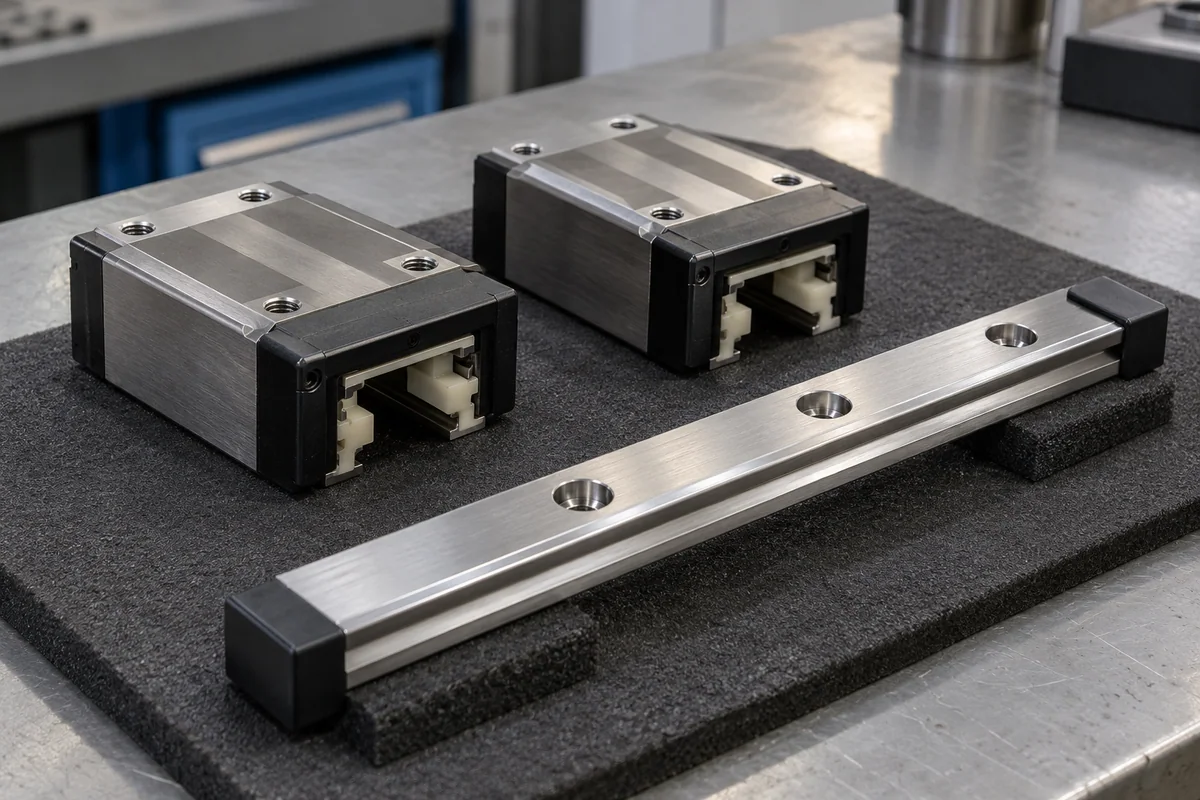
Before ordering a replacement linear-guide block, establish whether the actual rail family permits a separately supplied block. Ask for the rail and block identifiers, the manufacturer’s applicable interchangeability statement and the machine’s required specification. If that evidence does not support a block-only purchase, request a documented rail-and-block alternative for review.
The decision affects the scope of the order. Buying one block, one rail with blocks, or a coordinated group of guide assemblies are different proposals. The smallest package is useful only if it answers the approved replacement requirement; a larger package still needs its own machine-interface review.
Identify the installed guide before selecting a spare
Start with the machine make, model, revision and axis. Gather the original parts list, service records and available guide identifiers. Record the rail and block information separately. Avoid assuming that a block’s visible size marking identifies every option in the installed assembly.
THK’s product-knowledge FAQ explains that a block’s visible markings may omit specifications such as preload and seals. It describes serial-number lookup as one route to fuller identification, with limitations for older products. That is useful guidance for THK identification, rather than a promise that every guide or serial number is traceable. THK product knowledge base
Send accessible marking photographs and the records already held by the buyer. Ask the manufacturer or appropriate service provider to resolve uncertain identifiers. The inquiry should not require the buyer to slide a block off its rail, dismantle the axis or make an improvised fit test.
If the machine has several apparently identical blocks, identify the location that needs attention and the relevant assembly records. Do not assume the other axis uses the same specification. Also state whether the replacement follows a diagnosed component problem or whether the cause is still being investigated; purchasing a spare does not establish the fault’s cause.
Ask what the manufacturer means by interchangeable
THK’s GK page explicitly distinguishes independently supplied interchangeable products from products supplied as assembled sets. Its FAQ also says that GK components cannot be combined with components originally bought as set products, and that mixing GK accuracy grades is not supported. These are bounded rules for the documented THK products, not a universal interchangeability policy for nominally similar rails. THK LM Guide GK Series
For the installed guide, request a statement that covers the exact proposed block and existing rail. Retain the applicable family, options and qualifications. A manufacturer’s statement about one interchangeable range should not be shortened to “all blocks of this size fit.”
Ask the supplier to distinguish an original spare, a manufacturer-supported interchangeable component and a third-party alternative. Each description means something different for the buyer’s review. If the seller uses a broad term such as “compatible,” ask for the actual manufacturer, complete codes and supporting statement before treating the quote as an answer.
Separate three possible supply scopes
A block-only quote should identify the existing rail it assumes and the documentation supporting that combination. Ask for all required block options and any separately supplied accessories. Keep the exact quantity and supplied-unit definition clear, particularly when the seller lists blocks and assembled guides on the same page.
A rail-and-block quote should identify the rail length, block types and count, applicable specification and mounting drawing. Ask whether it is a manufacturer-supplied assembly or a seller-assembled combination, and request the documentation appropriate to that supply. Neither description alone establishes suitability for the machine.
For a machine using coordinated guides, have the responsible machine reviewer determine whether the replacement scope extends beyond one rail. Do not choose a grouping merely because several rails are parallel in a photograph. Obtain the relevant machine specification and manufacturer guidance, then ask the supplier to quote the resulting scope explicitly.
| Question | Evidence for the decision | Purchasing consequence |
|---|---|---|
| What rail is installed? | Full identity and applicable machine records | Defines the baseline for a block-only proposal |
| What block is offered? | Complete code, options and manufacturer | Prevents a nominal-size description hiding a different part |
| Is the combination supported? | Applicable manufacturer interchangeability statement | Establishes whether block-only review can proceed |
| Which specification is required? | Approved preload/accuracy and other relevant requirements | Keeps unnamed options from being treated as equivalents |
| What does the assembly include? | Rail, block count, accessory and grouping details | Defines the alternative quotation’s actual scope |
| Does it fit the machine? | Exact mounting drawings and responsible review | Determines whether the proposed scope is usable |
A fictional same-size block offer
Suppose a seller proposes a block with the same nominal rail size as the buyer’s existing component. The reply omits the series and includes no interchangeability statement. The buyer has an old invoice naming a guide family but no complete code. This is a fictional evidence gap, not an assessment of any manufacturer or seller.
The nominal-size match can be recorded, while the block-only decision stays open. Ask the seller to identify its exact part and ask the machine supplier or guide maker to resolve the installed specification. A brochure describing an unrelated interchangeable family does not answer either question.
If identification later establishes an applicable interchangeable system, submit the exact combination for review under that system’s rules. If it establishes an assembled-set arrangement without support for the proposed block-only replacement, request the appropriate assembly alternative. If identification remains unresolved, keep both possibilities provisional rather than describing the least expensive package as the correct spare.
Now imagine that the seller offers a complete rail and two blocks instead. That is a new supply scope, not evidence that it fits. The reviewer still needs the mounting geometry, applicable specification and machine requirements. Ask for that information before approving the alternative, even if the seller says it is easier to supply.
Keep preload and accuracy requirements attached to the part
Ask the responsible engineer or machine manufacturer to specify the required grade and options from the actual application records. Do not select a preload simply because its description sounds more rigid, or infer machine accuracy from a guide’s catalogue class. The RFQ should preserve the approved requirement without pretending to perform the design review.
When the exact original specification is unavailable, ask the reviewer what evidence would be needed to consider a replacement. A physical measurement or sample assessment may be appropriate in an agreed scope, but the buyer should not invent a universal tolerance to close the paperwork.
Request an explicit explanation of every proposed code change. A different seal arrangement, block form or lubrication option might be an intentional alternative; it should not disappear inside a shortened product name. Keep the accepted alternative and its reviewer disposition with the revised quote.
Finish with a reviewable replacement scope
Before purchasing, the quote should say whether the buyer is ordering a separately supported block or a specified assembly, identify the parts and quantities, and retain any unresolved questions. Ask the supplier to disclose substitutions before shipment. A later family or option change reopens the affected comparison.
Receipt photographs can help document labels, delivered contents and apparent condition. They cannot prove preload, accuracy, interchangeability or the condition of the installed rail. Have competent personnel define any technical inspection and installation scope using the relevant manufacturer’s instructions; this article does not provide a block-removal or fitting procedure.
Our independent buying-agent role is to obtain the seller’s exact proposal and supporting documents and organize the purchase for approval. See CNC linear motion components for the broader category, then start a CNC quote request with the machine details and known rail and block identities.
The form accepts a supported product link, description or images. Image attachments are limited to five PNG, JPEG, WebP or GIF files, 10 MiB each and 20 MiB total. Arrange drawings, manuals or other technical-file exchange separately with an authorized contact; the current field does not accept CAD, PDF or ZIP files.
Frequently asked questions
Can I order any block with the same nominal rail size?
Nominal size alone leaves the combination unresolved. Obtain the exact rail and block codes and an applicable manufacturer interchangeability statement.
Does THK’s GK policy apply to every THK rail or another brand?
No. The cited GK documentation has its own product boundaries and exclusions. Check the policy for the exact installed family and proposed component.
Why can a visible block marking be insufficient?
For example, THK says some specifications are not shown in the visible marking. Use original records and manufacturer identification support to resolve the complete part where possible.
Is buying a full rail-and-block assembly automatically safer than a block alone?
A complete assembly changes the supply scope but does not automatically establish suitability. Its specification, mounting geometry and relationship to the machine still need responsible review.
Sources
Discuss a sourcing request related to this article.Decide Whether to Quote a Rail Block Alone or a Matched Set