
CNC Spare Belts: Keep Packaging Geometry Under Review
Review a spare-belt consolidation proposal against the exact maker’s permitted shape and intended storage state before approving a smaller box.
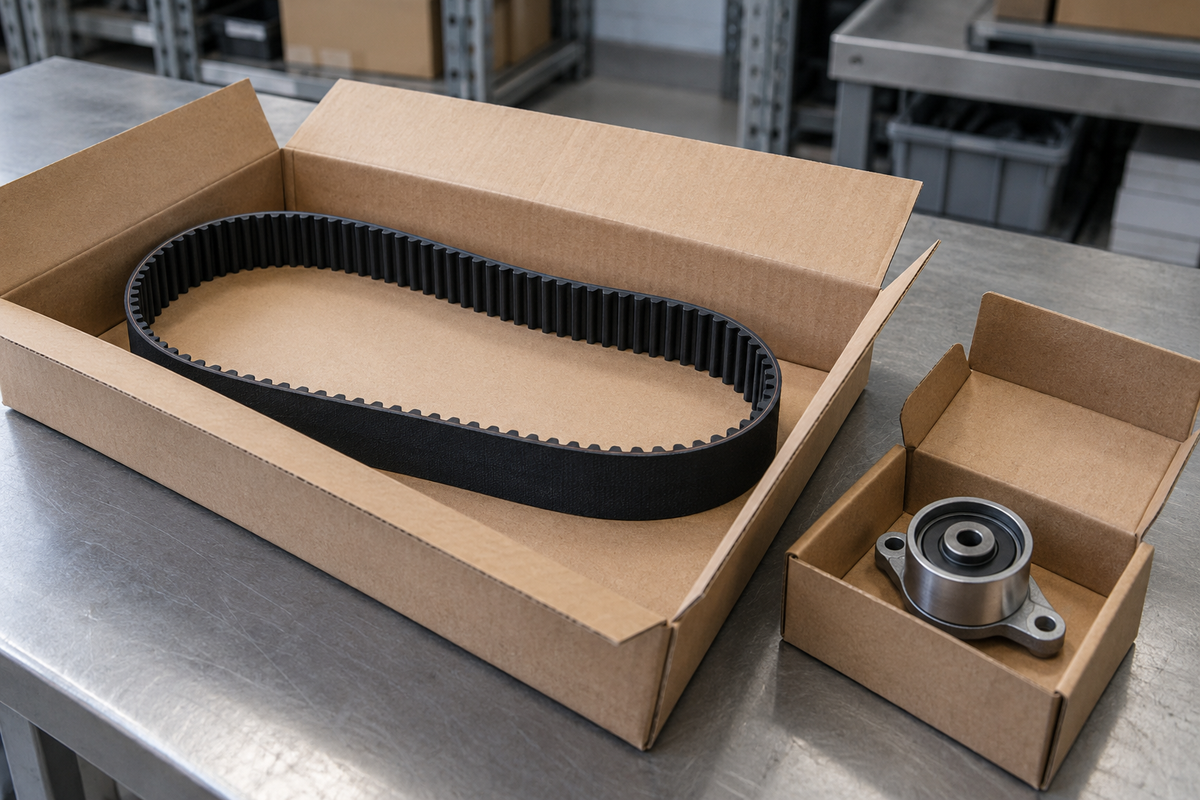
A replacement belt can keep the correct part number while acquiring the wrong packaging arrangement. When a packer proposes making its loop smaller so that it fits beside other CNC spares, the buyer needs a decision about the belt’s permitted shape. A tidy carton and unchanged contents list do not settle that decision.
Start with the belt already approved for purchase. This article does not select a tooth profile, calculate a bend diameter or explain how to coil a belt. It reviews the information needed before a packaging change is accepted. The actual belt manufacturer and responsible packing provider must establish the permitted arrangement.
Make the proposed shape change visible
Ask for the exact belt reference and the state in which its supplier intended to deliver it. Record whether the new proposal changes that shape, adds restraint, combines it with other belts or places another component inside or above the loop. These are questions about the proposed plan, not instructions to manipulate a belt for photographs.
A before-and-after packing description is useful only when both descriptions concern the same belt. A picture of a different size or product family may show the packer’s general approach, but cannot establish that the offered layout applies. Likewise, an empty carton’s dimensions say nothing by themselves about the belt geometry that the closed package would impose.
Keep the reason for the change alongside the proposal. It might be fewer cartons, a smaller accessory box or one maintenance kit per machine. This makes the commercial objective explicit without turning it into technical permission. If the proposed layout lacks support, the objective can be reconsidered rather than leaving the packer to solve an undefined constraint.
Use belt-specific evidence, not flexibility as permission
Gates’ 2019 preventive-maintenance manual explains that unsuitable storage can damage a belt before installation. Its storage section distinguishes methods by belt type and ties synchronous-belt geometry to the applicable bend requirements. It also describes shipping arrangements for some belt types that are not their intended relaxed storage state. These are reasons to obtain the applicable instructions; they are not one universal packing method. Gates preventive-maintenance manual, printed pages 24–25.
We reviewed this manufacturer source on 13 October 2026. Its dated guidance provides technical context, while the comparison method below is an original editorial proposal. We have not inspected a belt, validated a packing design or obtained permission for a real shipment.
A belt’s ability to flex during service does not answer what deformation is permitted in storage or transit. Ask the maker or its authorized technical contact to relate the proposed shape to the exact reference. Do not transfer a rule for one belt construction to another merely because both are described as timing belts or both appear rubber-like.
The response should identify the document and the product to which it applies. If it simply says “normal belt packing,” return the unanswered question: does that answer cover this proposed change, including the restraints and adjacent contents shown? A generic assurance need not be treated as dishonesty, but it is too imprecise to close a specific geometry decision.
Separate transit configuration from spare storage
A maintenance kit may be opened on arrival, stored unopened or divided among several locations. State the intended destination use of the package before asking whether a layout is suitable. The same outer carton can represent a short transport stage or the place where a spare will remain until needed.
Do not assume that a manufacturer’s shipment photo authorizes indefinite storage in that state. Equally, do not invent a deadline for rearranging it. Ask whether the supplied instructions distinguish those states and who is responsible for any required change at the destination. The answer should come from the relevant provider, with the work and its authority separately identified.
Where intended storage is unknown, record it as unknown. Approving a transport layout while expressly leaving storage unresolved is more accurate than claiming the whole spare-life question has been settled. Packaging approval should state its covered stage and should not become a shelf-life promise.
Review a fictional mixed-spares proposal
Suppose a fictional maintenance order contains one previously approved replacement belt and one individually boxed bearing. The initial proposal retains the belt’s supplied package. A revised proposal places both inside a smaller accessory carton by reducing the belt loop and positioning the bearing box within it. No changed part numbers appear on the contents list.
The buyer’s response should identify the actual change: a new belt shape and a new neighboring object in the proposed pack. Mark that layout unapproved pending the belt-specific answer. Do not supply a smaller loop diameter, tell the packer how to tie it or decide from the photograph that it will spring back later.
If the maker supports a revised arrangement for the exact belt and intended stage, the responsible packing provider can document that arrangement and its applicability. If no supported combined layout is available, retaining a separate belt pack within the consignment remains a commercial option. The buyer can compare it with the compact-kit objective without treating separate packaging as a universal technical requirement.
Now suppose the provider explains that the proposal was intended only for transit, while the buyer planned to store the unopened kit. That is a scope conflict, even before any damage is observed. Resolve the destination state and responsibility before the buyer accepts the plan. Correct counts and correct part numbers cannot compensate for that unanswered question.
Close the geometry decision without expanding it
Use a compact belt pack-state record: approved belt reference; original supplied state; proposed shape or restraint change; applicable maker response; covered transit or storage stage; accepted package reference; and unresolved responsibility. The record describes the decision and points to supporting documents. It is not a drawing from which someone should fabricate packaging.
Ask for the final packing record to identify the same configuration that was approved. If the accessory box, neighboring spare or restraint changes afterward, bring the changed feature back for review. A different carton supplier does not automatically mean the geometry is different; the relevant question is whether the actual arrangement covered by the approval changed.
Keep arrival observations separate. An undamaged-looking belt is not evidence that every previous packing state was permitted, while a disputed packing record does not by itself diagnose a failed belt. Refer condition concerns to the responsible technical provider. Selection, installation, tension and operation remain outside this packaging decision.
Bring the unresolved packaging decision into the inquiry
We are an independent buying agent. We can help organize supplier questions and documents within an agreed scope; specialist packaging, inspection and technical approval require separate confirmation. The CNC wear parts category provides broader buying context.
Use the CNC quote form for a supported listing link, description or identification images. It accepts up to five PNG, JPEG, WebP or GIF images, no more than 10 MiB each and 20 MiB total. Arrange a separately authorized exchange for manuals, PDFs, drawings or other technical files rather than putting them in the image field.
Frequently asked questions
Can a timing belt be folded to fit a smaller spares box?
Do not approve an unsupported shape change. Ask the exact belt manufacturer or authorized provider to confirm the proposed arrangement; flexibility alone is not permission.
Does a shipping configuration automatically suit long-term storage?
No. Ask whether the applicable belt instructions distinguish transit and storage states, and record which stage the packing approval covers.
What minimum loop size should the packing plan use?
This article supplies no universal dimension. The exact belt reference and applicable manufacturer requirements must determine the permitted geometry.
Must a belt always travel in its own outer carton?
Not necessarily. A supported consolidated layout may be possible; retaining a separate belt package is an option when the proposed combined geometry remains unresolved.
Sources
Discuss a sourcing request related to this article.CNC Spare Belts: Keep Packaging Geometry Under Review