
A Ballscrew Quote Needs the Ends and Nut Interface Too
Specify ballscrew ends, nut mounting and support interfaces so a replacement quote answers the actual assembly requirement.
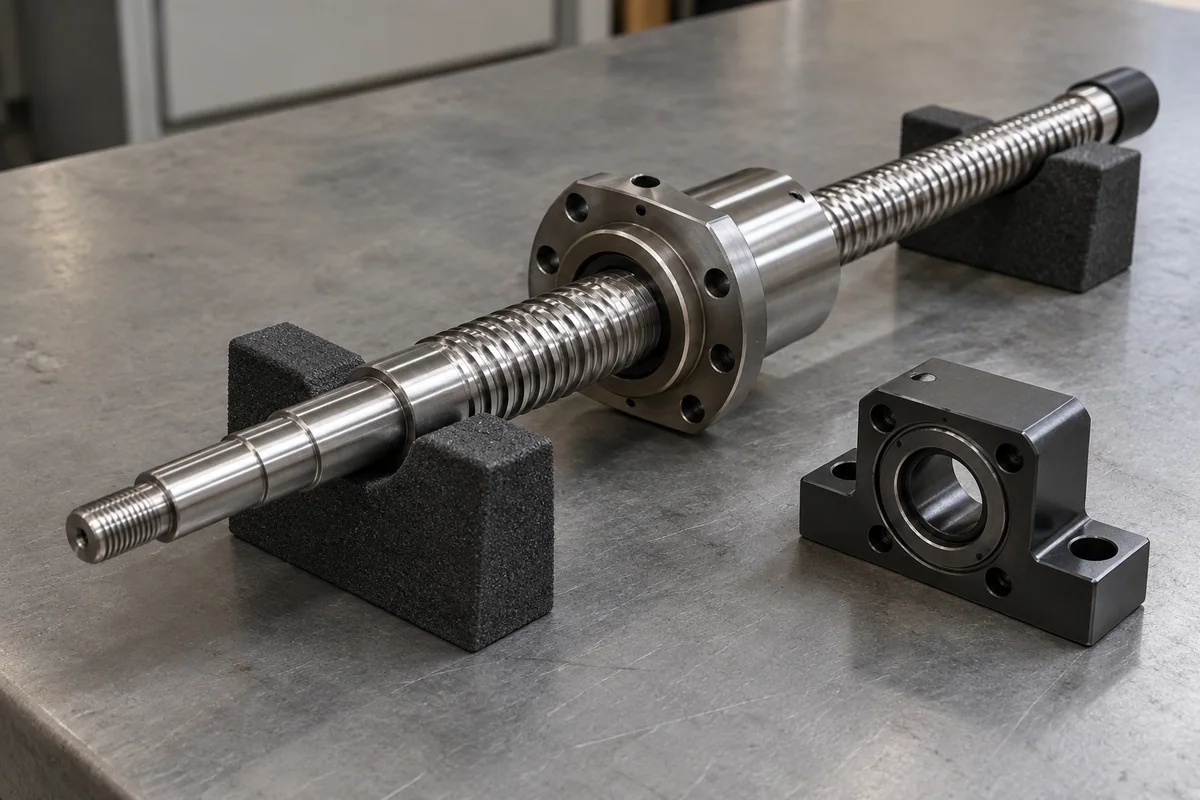
A ballscrew quotation can name the right diameter and lead yet leave the replacement undefined. The screw has to meet the existing bearing supports at its ends and the moving assembly at its nut. Buying from a short catalogue code without those interfaces leaves the buyer approving only part of the item.
The useful RFQ question is: can this offered screw-and-nut assembly be matched to the buyer’s released dimensional specification? That question calls for a drawing-based answer. It does not ask a seller to promise that a familiar-looking screw will fit, or to infer a replacement from photographs alone.
Start with the assembly being replaced
Identify the machine, axis and existing assembly number before selecting a marketplace variant. State whether the purchase replaces the screw and nut together, only a documented replacement component, or a larger assembly that includes supports and housing. A listing photograph containing several pieces does not establish which are included.
Gather the machine assembly drawing, original screw drawing, nut drawing and support-unit identifiers if they are available. Label observations from an old part as observations. If the buyer has only photographs and measurements, ask the responsible engineer or machine service provider to turn those into a reviewed requirement before treating them as manufacturing instructions.
Record the complete screw designation, manufacturer, nominal diameter, lead, handedness and units separately. Keep any required accuracy or preload designation exactly as released by the responsible reviewer; do not choose one from the cheapest dropdown. This article addresses physical purchasing interfaces, not selection of load capacity, accuracy or permissible speed.
“Finished ends” needs an identified finish
THK’s unfinished-shaft-end product page distinguishes several nut models and identifies named standardized shaft-end shapes associated with support units. That is a concrete example of why the screw family, nut and ends deserve separate identification. It does not establish that a marketplace seller’s “standard machining” uses THK’s shapes, or that any standardized end matches a particular machine. THK unfinished-shaft-end product information.
Ask the seller to reference the actual end drawing for the offered configuration. Where the supplier proposes its standard ends, request the drawing and its identifier rather than accepting the word “standard.” The buyer’s reviewer must compare that proposal with the existing supports, drive connection and assembly layout.
Give the two ends unambiguous names such as motor side and opposite side. Mark those names on the same assembly view used for the quote. “Left” in a seller’s photograph can mean the opposite end when the part is turned around. Do not rely on the ordering of two small catalogue thumbnails.
Keep length and interface fields separate
A single length entry is especially easy to misunderstand. Ask what it measures and which drawing references define its endpoints. Overall shaft length, threaded-region length and a machine’s required movement are separate entries; none should be substituted for another without the machine designer’s review.
| RFQ field | Required reference | Question the seller must answer |
|---|---|---|
| Screw identity | Complete manufacturer designation and released requirement | Which exact shaft and nut are quoted? |
| Lengths | Dimensioned assembly drawing with units | Does each stated length use the buyer’s reference points? |
| Motor-side end | Identified end-detail drawing | Which journals, shoulders, threads and drive-interface features are supplied? |
| Opposite end | Separate end detail and support identity | Is this end finished to the requested support arrangement? |
| Nut interface | Nut outline, mounting pattern and orientation | Does the offered nut correspond to the specified housing interface? |
| Included hardware | Itemized bill of supply | Are supports, housing and associated hardware included or excluded? |
This table organizes questions. It supplies no dimensions or permissible deviations. The released drawings should carry the technical values, and the supplier should answer against those drawings rather than creating a second, conflicting specification inside the quote.
Treat the nut as a mounting interface
A nut model label is only useful when it resolves to a drawing. Ask for the flange shape, hole pattern, relevant locating features and overall outline. Have the reviewer confirm orientation in the machine assembly, including the relationship between the flange and each screw end.
Also request the location and identification of lubrication connections and any external features shown on the manufacturer’s drawing. The procurement question is whether the proposed assembly preserves the required access and surrounding space. It is not permission to rotate, reverse, modify or remove the nut to make a mismatched part fit.
If the seller proposes a different nut housing, show that as an alternative assembly. Ask which mounting interfaces would change and who would approve the change. A bundle that includes its own housing does not automatically answer an RFQ whose purpose is to retain the original housing.
A fictional comparison: equal shorthand, unequal answers
Suppose a buyer’s fictional request calls for screw assembly S-17, defined by an approved assembly drawing and two end details. The buyer wants to retain both supports and the existing nut housing. Offers A and B repeat the same nominal diameter and lead.
Offer A states “standard ends included” and shows a nut from the catalogue. It supplies no end drawing. Offer B identifies the requested drawings, supplies its proposed nut outline and marks a different lubrication-connection position. Neither offer can simply be marked “fits.”
The next actions differ. Ask A for the missing end and nut evidence; it has not yet answered the dimensional request. Send B’s stated difference to the responsible reviewer; it is a defined alternative awaiting a decision. Do not quietly accept that difference merely because B supplied more paperwork.
Now suppose B agrees to the requested nut configuration and returns a corrected drawing. The buyer can compare the revised offer against the released specification. Any required inspection, functional assessment or application approval remains a separate agreed step. The example contains no actual manufacturer specification or supplier commitment.
Ask for a supply boundary that survives dispatch
Before approving the item, have the offer name the screw, nut, end configuration, associated hardware and drawing references together. State whether any end machining is included, separately quoted or outside the seller’s scope. The buying agent should not imply that it performs that machining.
Agree which identifiers and documents will accompany the shipment. Receipt photographs may help record labels, apparent damage, quantity and the parts received. They cannot establish dimensional conformity, running behavior or accuracy. If a technical inspection is needed, define its scope, responsible provider and acceptance basis before relying on it.
Keep substitutions explicit. A seller’s later proposal to change the end form, nut model or supplied supports should return to the reviewer. Approval of one assembly does not approve every product using the same diameter-and-lead shorthand.
Send a bounded ballscrew inquiry
A useful inquiry reads: “Please quote the screw-and-nut assembly against our identified assembly and end-detail drawings. We intend to retain the specified support units and nut housing. Identify the exact nut model, orientation, both finished ends and all included hardware. List every difference and any required information before quoting the item as matching. Do not substitute an end form or nut configuration without approval.”
Start with CNC linear-motion sourcing, then send the product link or description through the CNC quote form. We act as an independent buying agent for equipment and parts; engineering approval and any technical inspection need their own agreed scope.
The current form accepts up to five PNG, JPEG, WebP or GIF images, with a 10 MiB limit per file and 20 MiB total. Use images for an initial reference and arrange an authorized separate exchange for native drawings, PDFs or other technical files. A screenshot can open the conversation; it should not silently replace the released specification.
Frequently asked questions
Does a diameter-and-lead match establish a replacement?
No. It leaves the screw ends, lengths, nut interface and other assembly requirements unresolved. Ask for a drawing-based comparison by the responsible reviewer.
Can the supplier use its standard end machining?
It can propose that configuration, but the exact end drawing must be compared with the buyer’s supports and drive interface. The word standard does not establish agreement.
Should a replacement nut be ordered separately?
Only when the manufacturer’s documentation and the responsible reviewer identify that replacement scope. Do not assume a same-size nut is interchangeable with the existing screw.
What should I send if I have no original drawing?
Send the machine and assembly identifiers, listing reference and permitted photos to begin identification. Arrange competent dimensional review and an authorized technical-file exchange before approving a manufacturing specification.
Sources
Discuss a sourcing request related to this article.A Ballscrew Quote Needs the Ends and Nut Interface Too